


- Joined
- Nov 2025
- Subscription
- Core
Admissions profile
Applications


Discussions

I will never understand this question, but that is okay. I won't let this question from hell get to me. I can become a lawyer without getting this.
NEXT.
Key takeaway: Halogen lamps from most major manufacturers IS NOT THE SAME AS most halogen lamps.
This would be such a time drainer in an actual test. I would never get this one right under timed conditions.
PT8.S1.Q24 - Wrong Answer Journal
Why is my answer wrong?
A selected. This answer is wrong because it establishes an unsupported conditional relationship. There is no conditional logic featured in the stimulus. Therefore, there is no basis to conclude (prove that this AC must be true) that anyone who is dynamic + aggressive is also successful.
In other words, it is not the case in the stimulus that:
If dynamic + aggressive --> successful.
Why is the answer correct?
B must be true. Why? Because it underscores the reasoning principle of the stimulus and therefore must be true.
Your car is statement of who you are
Therefore, when you do not embody the traits of the cars you own, you are not being true (misrepresent) to yourself.
Flaw:
X most are Y
Lucinda is Y
Therefore, she is probably X
A (wrong answer I selected):
Cities with malls (x) most are regional hubs (y).
Our city will have a mall (x), so it will likely become a regional hub (y).
Why is the answer correct?
E:
Economic hubs (x) most have a shopping mall (y).
Our city will have a shopping mall (y), so it will likely become an economic hub (x).
It's match!
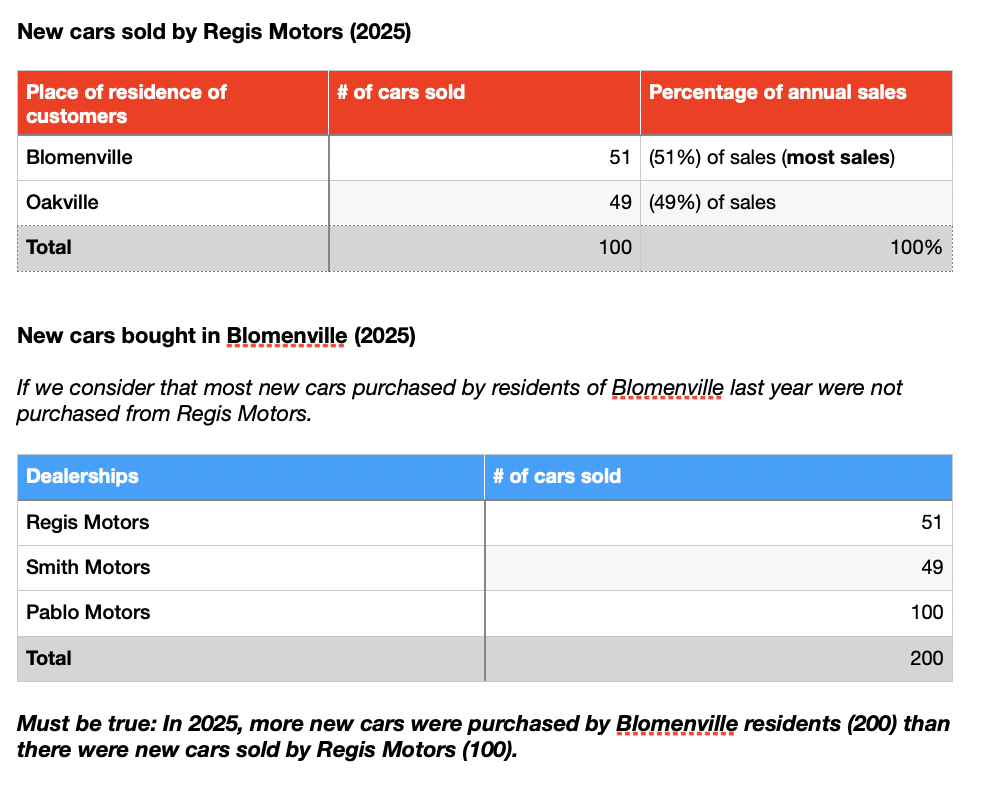
A Q19 has no business being this easy. The way I read the stimulus and correct AC 11 times to make sure I wasn't falling in a trap...
Why is my question wrong and why did I pick it? Why is the answer correct?
I mapped out the conditional structure clearly. The principle was clear, but I fell into a trap 😿. A does not make the argument ironclad!
Why? Because we know the contract is violated if the president or any of the lawyers are not told about it. We know “she,” the president, was not told about it. Neither was Yeung.
We can safely assume in this instance that Yeung is a lawyer. Otherwise, her role in this argument is irrelevant.
But does this (Yeung being a lawyer) guarantee the truth of the conclusion? What if Torres, her colleague, was told instead? We need to add a premise that clearly establishes the fact that neither Yeung nor any lawyer in the company was informed about the proposed contract. Therefore, C is correct.
Why did I pick the wrong answer and why is it wrong? Why is the answer correct?
C establishes a correlation that, while helpful to explain why red squirrels are more likely to make holes in maple trees than in others, does not engage nor address the point raised by Galina. That was the main task of this question.
Galina believes that something other than sugar is what causes red squirrels to make these holes in maple trees. Her reasoning? The quantity of sap required to get any significant amount of sugar would be too much for the squirrels to drink (maybe, their stomachs are too small or they only have one kidney).
D, on the other hand, directly engages with Galina's argument and counters it: as D says, the squirrels let that sap ooze until much of the water has evaporated--evidently leaving behind the sugar. Squirrels come back precisely for this sugar, but it is in a different form, so the limitations presented by Galina are moot.
this question makes no sense to me (I'm Canadian), because maple trees are tapped in the winter when nothing evaporates.
Immediate skip on an actual test.
Low hanging fruit first and foremost, lol.
The difficulty of this question boils down to the convoluted answer choices that are intentionally designed to be misread. They are all equally crappy, but E is crap with a little shinny bow. Enough for MSS, I guess.
Point of disagreement: whether the modernized plays can be a useful tool for teaching history:
Lyle: Yes ([modernized plays] remain[s] valuable for teaching history)
Carl: No ([modernized plays] is of no use for teaching history)
I got it right, but it felt somewhat harder than a one-star question!