


All law students are readers. Some readers are writers.
Inference:
A. Some law students are writers
B. All readers are law students
C. Some writers are readers
D. Some readers are not law students
0
All law students are readers. Some readers are writers.
Inference:
A. Some law students are writers
B. All readers are law students
C. Some writers are readers
D. Some readers are not law students
11 comments
C is correct. Some readers are writers = Some writers are readers. Or in other words, if some readers are writers, then we know that there are at least one writer that is a reader as well.
B is incorrect because all we know is that Law Student => Reader and can only infer Reader <=s=> Law Student.
D is incorrect because it could be the case that all readers are law students, i.e. LS <=> Reader. This would allow for LS => readers while also invalidating Readers <=s=> /LS. Since this could be a possible reality, D cannot be an inference.
A is incorrect. It's a little tricky but what I like to do is imagine ven diagrams/circles that represent the sets and their intersections as the all/most/some/none intersections. Inferences are things that would be be impossible to not draw. So like, LS => Readers would look like a smaller circle encompassed by a bigger circle. Readers <=s=> writers would be, at the bare minimum, two circles that have a tiny overlap.
With that in mind, A is saying that if the stim's statments is true, then there must be some overlap between the LS circle/set and writers circle/set. However, we can draw the stim's statement in such a way that the circles/sets of LS and Writers never overlap. I attached an example. Because the sets can definitely overlap this way, we know A is incorrect. This is talked about in the all before some lesson I think.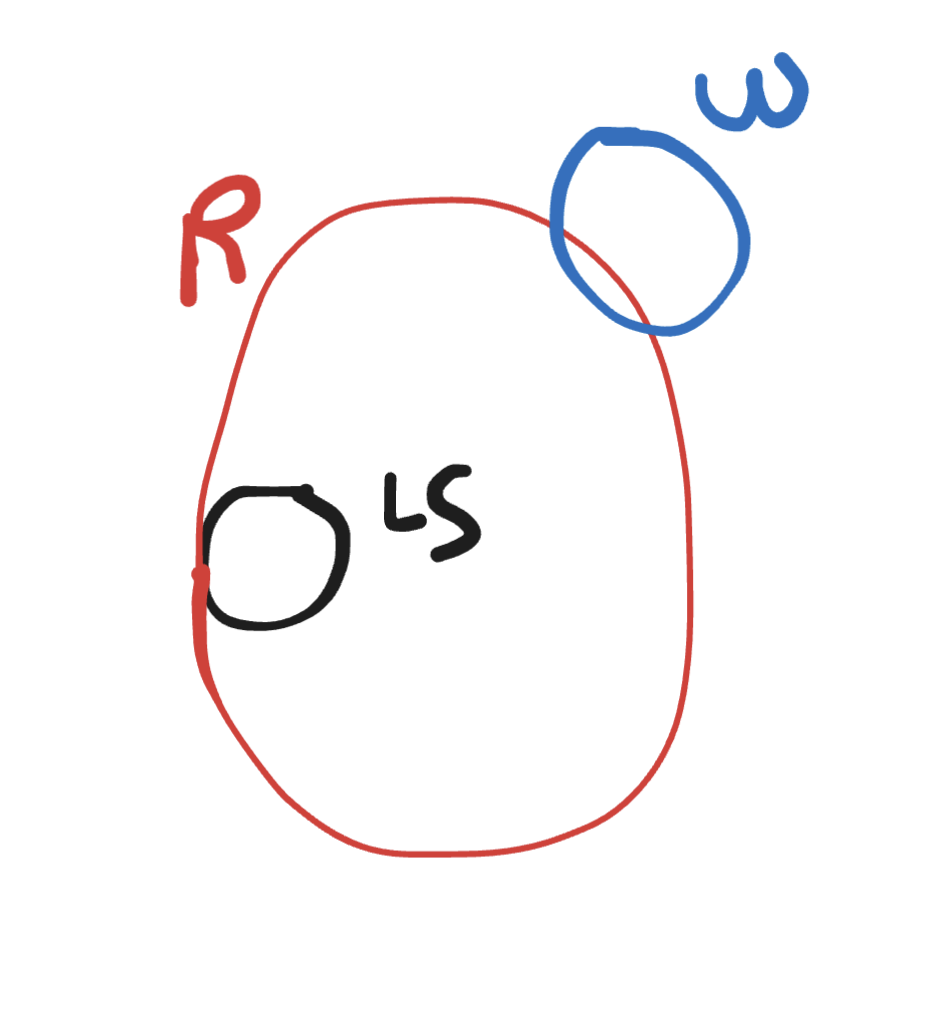
It’s C. If all law students are readers, and some readers are writers, we can only know that a part of all readers are law students, we cannot know for sure whether any of those law students are writers from just that “some readers”. However, if we know that some readers are writers, then it must be true that some of the writers are readers.
It's A
Well, I think the most important part of this question is whether anything can lead to a valid logical chain. Recalling from the core curriculum lessons, and as many people have explained below, we have an "all" into a "some", which cannot lead us to a valid claim.
Hence, the only valid inferences we can make are if we isolate the two sentences and infer from them individually. We know that if some readers are writers, that is a biconditional "some" arrow, meaning that some writers are also readers.
In Lawgic:
Readers <-s-> Writers = Writers <-s-> Readers
That would match with answer choice C.
Another valid inference we could make is that "No non-readers are law students." Remember the 4 groups of conditional indicators: "no" is a group 4 negate-necessary indicator. So this translates in Lawgic as:
/Reader -> /Law Student
(and if you chose to make "non-readers" your necessary condition, which is also the contrapositive of the translation above)
Law student -> Reader
Though this isn't an answer choice in your example above, I think it is important that when you do conditional logic, it's important to try to grasp all the possible correct inferences that the question may ask. Especially if you face an MSS question in the future.
Try this one!
"All library users are readers, and some readers like writing. Some aliens are library users."
Which one of the following follows logically from the above?
A. Some aliens like writing
B. All aliens are readers
C. No aliens are readers
D. Some aliens like reading
E. Some readers are aliens
There is no way this is not A. Law Students = readers. Replace readers in the second sentence with law students. Think of readers as X. Law students equal x. Therefore when you apply this to the second sentence "Some x are writers." -> "Some law students are writers". BTW im new at this ! If this is incorrect I apologize but this is how I would look at it.
@BigMac it cannot be A because A-->B<-->C therefore, A<-->C is not a valid arugument.
Think of A, B, and C as buckets. U put all of A into B. Then you only put SOME B into C. Some just means more than one; you cannot guarantee that you will pick up A in the mixed bucket of A & B.
The valid argument you're thinking of is A<-->B-->C Therefore A<-->C.
This argument, you put some A into B, then if you take that mixed bucket of A & B and put it ALL into C, you will definitely get at least 1 A from that mixed "some" bucket.
@LLAW24 😮 Thank you for the explanation!
C!
Some statements have the double-sided arrow, so they can be read both ways! C would read like this: writers <-> readers. So some writers are readers, and some readers are writers.
C is correct because some = double sided arrow. if the some statement is after the all = no valid inference.
a. Law student -a-> reader
b. reader <-s-> writer
Answer choice C satisfies b. I feel this is the mot secure choice.
OR is it
a. Law student -a-> reader
b. reader <-s-> writer
c. Law student -a-> reader <-s-> writer
Law student <-s-> writer
This could make the answer be A?
I'm thinking that none of these are a valid inference from those premises 🤔🤔