


LSAT
New post299 posts in the last 30 days

Hello,
I was wondering if anyone is in the same boat as me or has advice: I am not feeling ready for the June LSAT. It could be a mix of anxiety but also I have not been PT consistently at the score I want. I did get score preview but this would be my second time taking it (1st time was last year and didn't consistently jump back into studying until start of this year). Should I just reschedule to a later date? Should I just do it? Will it look bad to take it 3 times? What about if I cancelled the score and taken it later.
Feeling frustrated, confused, anxious, plzzz help

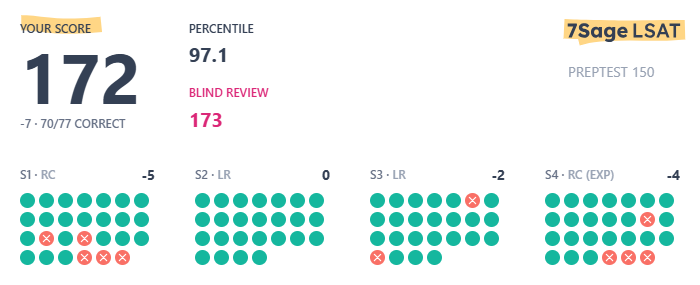
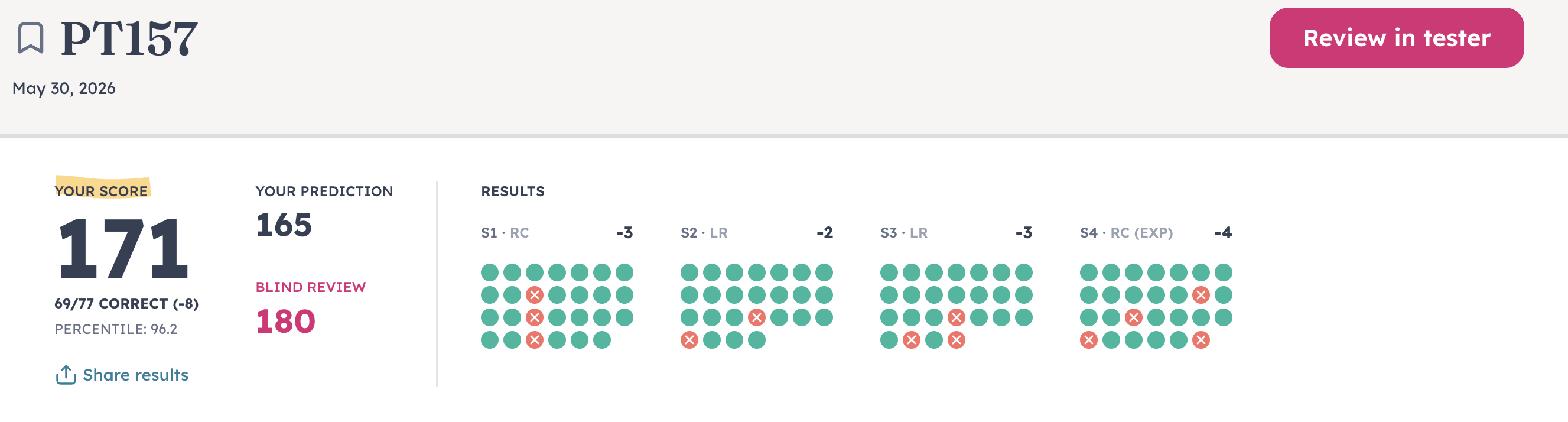
Taking the June exam in 3 days… just PTd for the last time and scored 7 points lower than my last PT. Really frustrated and not sure what I should do.

We just rolled out our AI Coach to every user on 7Sage. Use it to analyze your practice results and get personalized recommendations on how you can improve. Soon, it will also be able to explain tricky LSAT questions (using 7Sage explanations as the source—we're not allowed to show it LSAT content.)
You can access it by opening the chat menu or clicking any of the AI buttons in Analytics:
Please leave feedback in the comments!


Wrong answer journaling, the process of explaining and reviewing your wrong answers, helped me go from a 155 diagnostic to a 177. This was the deciding factor in getting a full scholarship to a T-25 law school (because it definitely wasn't my 3.3, well below median GPA lol).
I wanted to take some time to explain 5 methods of wrong answer journaling that might help you review and see the questions in different ways.
1. Explain every wrong answer, not just the one you got wrong
This is probably one of the most helpful ways you can increase your understanding and depth around each question. You definitely want to understand your own individual wrong answer choice, but if you can go the extra mile and understand why every single wrong answer choice is wrong, you'll be that much better on guard against similar choices in the future.
2. Visualize the problem
This can actually be pretty helpful for taking the test in the first place, but drawing things out has been helpful in the past when I'm having trouble visualizing what's actually happening in the stimulus.

You can use the annotation tool to do this on www.lsatjournal.com to save diagrams to each entry as of... well, yesterday.
3. Summarize and break down the stimulus
Sometimes, you just weren't able to translate the stimulus into its most basic logic. Maybe it was a specific word or confusing phrasing that tripped you up. Logging every time this happens and writing down the simplified version of the stimulus can do wonders for your overall "translation" ability.
4. Come up with a "lesson" for that particular problem, and turn it into a flashcard
I like to think about every single wrong answer as a critical lesson. Sometimes, that lesson shows up across multiple problems that you get wrong. That's the point at which it becomes your own mistake pattern that you want to identify and defend against.
I would have ongoing lessons and add the new question ID on a flashcard every time I made the mistake - this helped me keep a running list of all of my major issues so that I could be mindful of eliminating things on a pattern level instead of just an individual problem level.
5. Take a break
This is less related to wrong answer journaling and more to what effective review looks like in general. If you're getting to the point where you're making the same mistakes and burning yourself out, sometimes just a few days or a week off can help your brain reset and internalize all of the work you've already been doing.
-----------------------
Anyways, good luck out there y'all. And I hope this helps in your study journey.

Hi! I'm unable to click on answers in the new interface RC drill. I've been doing RC drills w the new UI and haven't had an issue before, but today I can't click on or cross off answers. I didn't see a button for "stop passage time tracking" (the way the drills in current Lawhub version do); lmk if I'm missing something.

Hi all, I have finally reached the clarity of mapping RC out for structure as opposed to content and wanted to know how I could maximize this approach while still pacing during the section(s)?
Many thanks


Hello! I saw that the drills assigned for homework have customizable settings. Are there any specific setting that we should be using? And is it recommended to manually select questions that align with the topics taught during the week? Thank you!
On practice result pages and the all questions page, we offer "Timing vs. target" and "practice timing" filters:

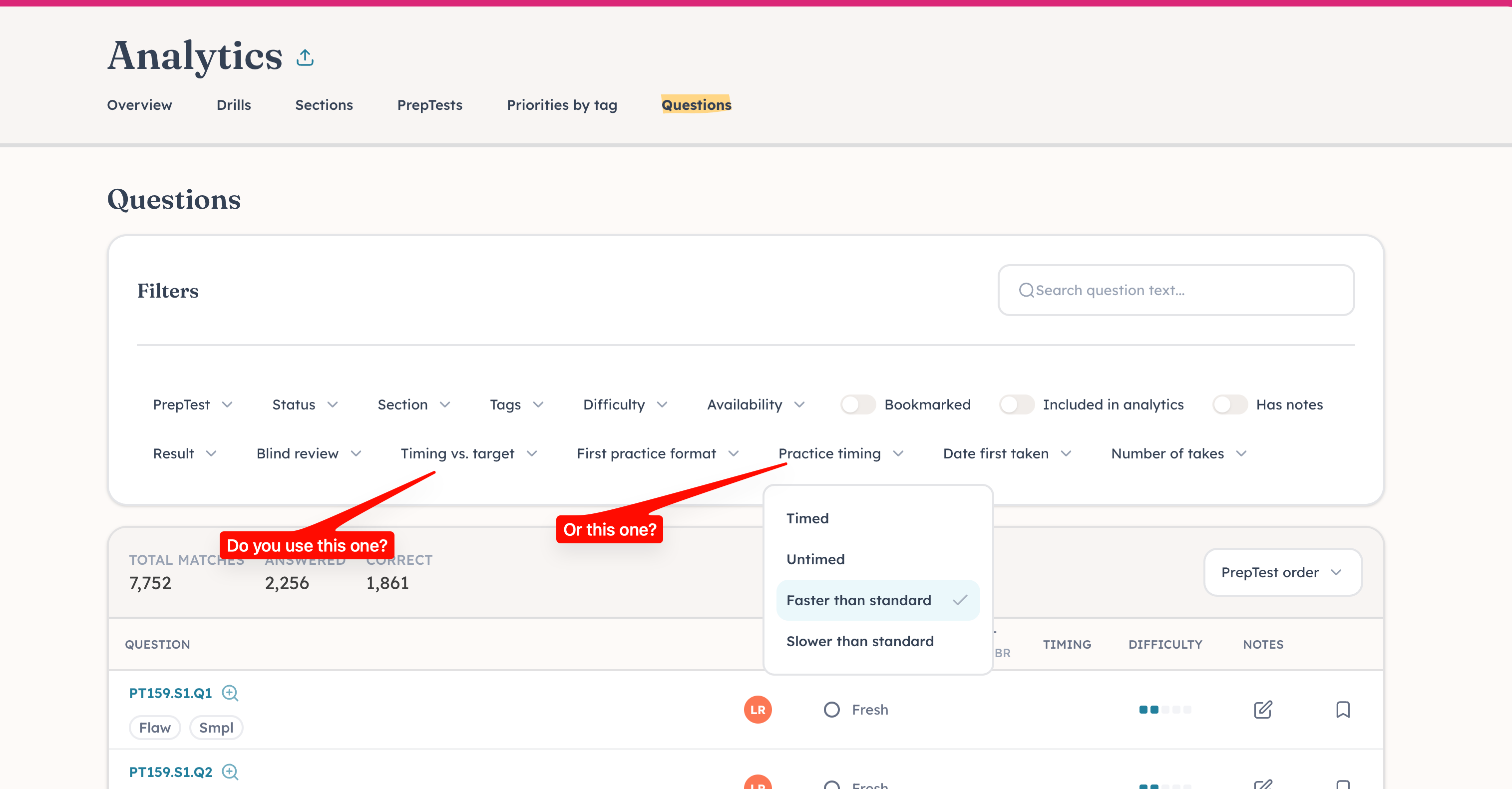
Do you use these? Which ones? When do you use them, and why? I'm especially eager to hear from users who have timing accommodations. Thanks!

Hi everyone!
I am aiming to write the test for the first time this August and am hoping for above 165. However, I would be happy with anything remotely close to score as well (162-170). I am planning to write the September exam as well, just to give myself another few weeks after the August date to see if I can improve.
For reference, I have been studying about 10-15 hours a week fairly consistently since around mid February. Most of my studying up until this point has been going through the 7Sage curriculum, reading The Loophole by Ellen Cassidy, picking at the Kaplan LSAT prep book, and I have been working with a tutor to hone in my reading comp/logic skills for the past 3 weeks.
I feel like I have been fairly successful in bringing up my score. Two years ago I wrote a diagnostic and only scored a (devastating) 127. This past December, I decided to try again and managed to get a 143. Since February, I have put in around 170 hours of studying and have managed to bring my score up to mid to high 150s on practice tests and sections. On blind reviews I routinely get into the mid to high 160s, and sometimes the 170s.
With only 2 months left till August, the countdown is on and I am open to any tips you may have on how to effectively break into the 160s before August!!!!

Basically, I have used all of the RC material that's available for drills and sections. That wouldn't bother me at all if I knew for a fact that I can still improve regardless of whether I've seen the passages before or not. However, I don't really know how to feel about it. For example, I just finished a section and got the best score I've ever gotten, but I don't know if it's because I had read those passages before or because RC finally clicked for me. I will admit that I don't really remember any of the answers to the questions that were being asked, so I felt as if I was answering them myself, but at the same time I did have a tiny little notion of what the passages were about, and I felt like going through them was a lot easier because I had already read the passages before...
So, because I've never gotten a score higher than 161, I was wondering if some other people experienced this issue before and if that fact stopped them from progressing or if they were able to get better despite it. And if so, then do you mind sharing some tips? For example, now that I have read some of these passages, what should I focus on? What can I do in order to make sure that I am still improving? How can I feel confident that whatever result I get is mine alone and not just previous knowledge? Any information would be super useful.

Has this happened to anyone else?
one day I’m drilling and my scores are fine, improving even. Then say a few days later, I’m drilling again and they are worse then ever.
Here’s what specifically happened to me:
Last Tuesday so 5/26 I was drilling a category of LR questions that need the most attention. I drilled 10 questions (on the “harder” difficulty setting) and managed to score a 7/10. I was extremely happy. (Yes I do review my wrong answers)
Then I took the next few days off from the LSAT And grinded for hours (at least 5-7 hrs) each day to with the goal of completing my 3 summer classes early so I can focus entirely on the LSAT.
Today I just got back to LSAT studying, (so about 5 days off from LSATS) and did terrible with my drills. Same category, same difficulty. Horrible scores. For some reason today when I got back to LSAT prep it was like my mind wasn’t sharp like it was before, it also felt like I couldn’t comprehend the words I was reading much less apply them critically.
Everyone online says that scores fluctuating can be a sign of burnout and that you need to take a break and basically allow your brain to take in the knowledge and whatnot.
But I did take a break, at least from LSAT stuff. For those 5 days I didn’t work on LSATS at all. Just my normal class work.
So I’m extremely confused and rather discouraged.
Has this happened to anyone else? I can’t afford to separate my time into 1 day studying the next 5 no studying you know?
Does anyone have any tips? Experience? Literally ANYTHING

Hello! I am potentially going to postpone the exam, and I have already done so before. I am not scoring exactly where I want to be yet. Is it bad to postpone the exam or should I just go ahead and take it?
Thank you!
Marisa Myers

Hello,
I’ve taken 3 PTs in the last 3 weeks in preparation for the June test, and I have got a 158 each time. Don’t get me wrong, I don’t mind this score. I think it’s ok and it’s absolutely better than previous scores I’ve got (including my 156 for the April test), but I am trying to figure out how to improve on it before next weekend. I know that’s not much time but I ran into timing issues with the last PT and just felt so fatigued that I knew I didn’t do well on the rest. I truly think I can get my score up to a 165, but what I’m wondering is if there are any tips or tricks out there that people have to suggest either preparation wise or test taking wise. I can put the time in, I’ve taken multiple PTs, I’ve done the core curriculum (or most of it), I just want to know what else I can do to push past the high 150s. I might retake in August but if I can do well enough this weekend to avoid that, that would be ideal. Thanks!

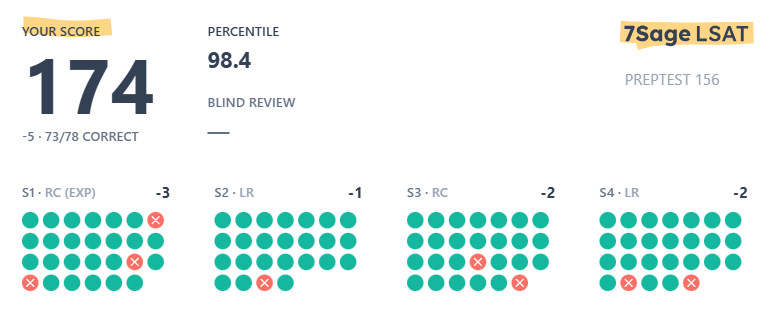
 Best PT and BR score yet leading up to my session on Thursday! Wishing everyone the best as we get closer to next week's exam. We've got this! Stay confident!!

I'm almost 3 months into my studies and my best PT is 159 untimed. Any tips on improving LR stamina and speed? I start disassociating after the first section and my focus just plummets. I can't even attempt timed PTs yet; I have never finished a section and attempted all questions. Any study tips or ways to improve focus and not experience cognitive overload? I'm trying to slowly build it up and focusing on fundamentals but wondering if there's ways to speed up the process.
For context, my diagnostic was 139 so I know I'm improving. My biggest issue isn't understanding every question but maintaining focus and processing information efficiently for multiple sections. Did anyone else struggle with this? What can help build endurance and transition from untimed accuracy to timed performance?

When I am doing drills and I get my results from the drill, I am noticing that I got some of the questions right the first time even though the question is circled in pink during the Blind Review portion of the drill. Is this so they try to trick you into changing your answer? This whole time I thought any questions that are circled for the Blind Review portion needed to be changed because they are wrong.
Can someone confirm please? Thank you!

Hi everyone,
I’m looking for some advice on next steps. I applied this cycle and was not accepted to the schools I was hoping for, including Barry Law and Stetson. I’m disappointed, but I don’t want to stay stuck in that feeling. I still want to go to law school, and I’m willing to study again and reapply stronger.
For context, I’m currently active duty military and planning to use the time I have left in service to improve my application, especially my LSAT. I’m trying to figure out the smartest way to approach a retake and future applications.
For anyone who reapplied after being denied, what helped you the most? Was it mainly improving your LSAT, rewriting your personal statement, applying earlier, adding more schools, or something else? Also, how would you recommend structuring LSAT study while working full-time?
Any honest advice is appreciated. I’m disappointed, but I’m not ready to give up.

I'm registered for the June 2026 LSAT (June 5th), which means that the Argumentative Writing should be available to complete by now. I managed to login to ProctorU, download the browser and all that, successfully. The only problem is that the website won't let me register for a new exam to be able to actually complete the Argumentative Writing. Did anyone else have this problem, and if so, how did you figure it out?

I am so bad at these. I am good at LR except for flaw and one other question type. I just can't figure it out. Sometimes I'll find a gap but it isn't the right one. Other times the answer choices are too subtle or I find multiple ones correct. Sometimes I don't see how the answer is really a flaw. I need a way to reframe these/think about them correctly.

Hi guys! I'm taking the June LSAT at the end of this week. I'm just posting to ask if anybody has any burnout-related info or advice.
For some context, I've been studying consistently for about two months now. I haven't really found myself struggling prior to this week. During the second week of May, I took two practice exams and scored a 161 and 162. During the third week of May, I took one practice exam with double time to focus on accuracy and scored a 166, which is my best so far.
Last week, I started working a full-time internship (five days a week, 9am-5pm, plus three hours of commuting because of traffic🥲). My score immediately decreased and I got two 156s. I've had a really hard time focusing on studying each night and I've been feeling somewhat more rushed with the time constraints than normal. I also have ADHD and testing anxiety so thats probably not helping this situation lol. Could this sudden score decrease be from work-related burnout, and has anybody else experienced anything similar? I was planning to take off work the day before my exam to recharge, but now I'm worried that won't be enough to reset my brain. I'm just not totally sure what to do here. Thank you and good luck to everyone testing this week!!

Dear everyone,
Just a quick question. If we have a A correlates with B and then a A causes B type of argument as a weakening stimulus, can we weaken the argument by showing that a new factor C causes B? or does the AC HAVE to touch on both A and B? I am getting super confused with this concept all of a sudden so any kind of help would be greatly greatly appreciated. Thank you.

I haven't taken any of the PrepTests available on 7Sage yet. Yet, I only have 14 100% fresh ptests left. The rest are all 98% fresh or less. I understand 7Sage uses a bunch of tests for drills and sections, but the algorithm has been giving me questions even out of PrepTests that are explicitly listed as available to take as tests on 7Sage. I've only been using this site for under a month and again, have taken zero of the PrepTests available on 7sage. I'm honestly pretty upset that my preptest bank has been depleted to this level already. How can I preserve the only 14 fresh tests I still have?

According to the AI Coach’s analysis of my most recent PrepTests, there is no longer a specific question type pattern that can be found across my wrong answers — for the most part (and with the exception of an unusually bad test I took while distracted and sick), the questions I am getting wrong are the three to four level 4-5 questions on each test.
When I review those questions, I am generally able to understand both where I reasoned incorrectly and why the correct answer is correct, so I am not incapable of understanding them; however, I often make small mistakes parsing these questions and the possible answers when under time pressure. I think I could benefit from specifically drilling these harder questions to build both accuracy and speed in interpreting them.
Is there a way to drill by difficulty and not by question type?