


LSAT
New post305 posts in the last 30 days

So I've noticed a trend in my own practice drills and sections where I tend to find the higher difficulty LR questions (level 4, level 5) easier to complete and I take the appropriate amount of time on them, whereas easier questions (level 2, 3) I spend 30/40 seconds more per question instead of meeting the target time. Any advice or insight on why this is happening? How can I fix this timing issue?

Hi all! I'm consistently getting 179-180 on BR but in the mid/high 160s on AT. Any advice on closing the gap? I understand speed is likely a big part of this, but I'm curious what has worked for others in closing this gap? Is it doing drills where you gradually give yourself less and less time? I particularly feel that the timing on RC is really tough.

Does selecting in between the study plans (balanced, accelerated, custom, etc) change what's included in the lesson library or change what's included in my study plan/schedule? For example, does being on a balanced pathway for LR include more lessons, skill builders, drills, and "you try?" And does being on an accelerated pathway for Foundations mean fewer lessons, skill builders, etc?
Or is that being on balanced means more lessons, fewer skill builders and "you try?" And then vice versa for accelerated? Because I do not want any content and or any practice to be missing from my lesson library or the study plan because I will choose whether to skip or not.
Wondering what people's experiences are!

what the title says. ive been averaging 165, but want at least a 168. i just havent had much time to study because of school and work, but ill have nothing to do in may and can put 1000% more effort. also lowkey mentally exhausted right now. ive been slowly studying since august 2025, with a diagnostic of 151. i hit the 160s in febrary when i actually started preptesting and not just doing core curriculum stuff. im tired of studying for the lsat and dont want to wait until august...

I went from a 145 to a 177 on the LSAT in 9 months.
Not through guesswork—but by building a structured system for understanding the test, fixing weaknesses, and executing under time pressure.
I just finished with some students for the April LSAT, and now that the test is over, I’m opening up a few more spots.
If you’re stuck in the 140s, 150s, or low 160s and feel like you’re not improving despite studying, I can help you identify exactly what’s holding you back and build a strategy that works.
I offer personalized, one-on-one tutoring focused on real improvement—not just drilling questions.
Message me if you’re serious about raising your score.

Hi all! I am current;y sitting at a 154 PT with the aim of 170+ by June. I am struggling with finding a fool proof study schedule. One day I will do an LR section or two and 2 reading passages. Somedays just one LR section and a PT about every 2 weeks. I am not sure how else to study besides drilling, sections, and review. I really want that 15+ point increase. Any advice?

Hi Everyone,
I was wondering if there is a lesson that details this exact thing, but I'm studying main idea questions and realize that its helpful to know the different type of argument structures for a stimulus. Like how an argument can be structured as 1. introducing an external or generally held belief and 2. the main argument is the authors counter-belief or rejection of the general belief. Or like 1. naming a phenomena and 2. the main argument is a hypothesis for that phenomena. Is there a specific plan or place that shows all the possible argument structures like this and if not, does anyone have a list that i could reference.
Thank you!

Hi everyone. I started studying for the LSAT in February and scored a 149 on my first blind PT. I have been studying since then, having gone through most of the 7sages curriculum, and my most recent full PT, I scored a 158. I have been zeroing in on my LR over the past little while, and have kinda plateaued in the -6,-8 range, and haven't been able to get out. I am seeking any advice people may have for this. I have not watched any of the question type specifc videos 7sage has- is that stupid of me? I found a lot of early success just using common sense, but maybe it would pay to go back to those videos? If anybody has advice, please let me know!
I am an international applicant hoping to apply next cycle, so my only real chance is to take this test in June. I don't really have another option, so I gotta lock this in. Best of luck to everyone, you got this!! 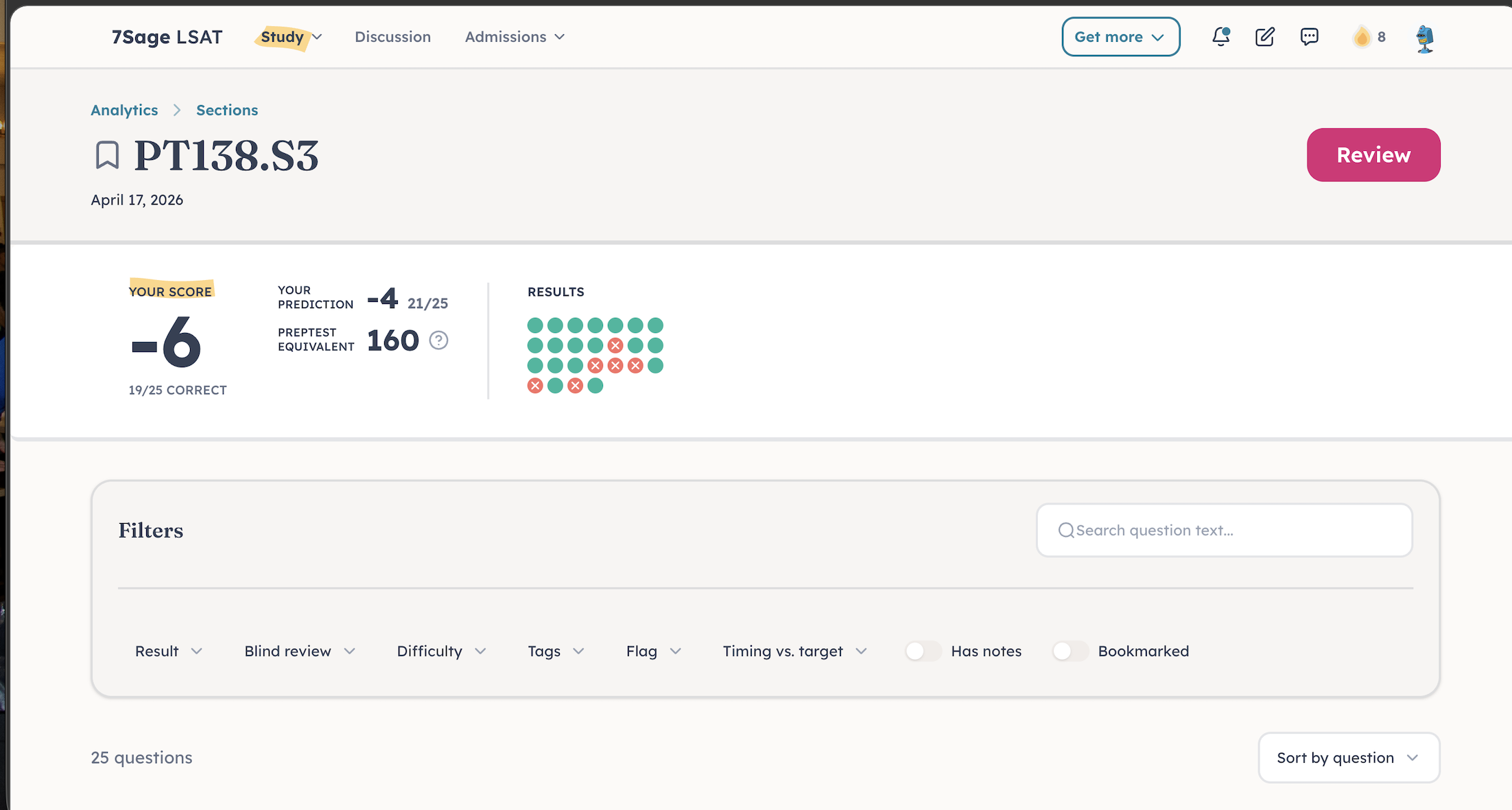

Hi everyone, I am looking for advice. On my timed Practice Tests, I usually get in the mid 150s range but when I Blind Review my scores are in the 170s. When I do the practice tests, I always seem to be running out of time every section, especially in RC.
My question is, how do I close this gap? What are some best practices for answering questions with speed?

Hi everyone! I recently started paying attention to the new feature that predicts your score based on performance in drills and section. I know that it isn't always a perfect predictor of your score but I am curious if anyone has seen similar results to their predicted score on their practice tests/actual LSAT scores?
I took my first LSAT in September and scored way lower than I hoped. I scored a 146 but am planning on retaking in June and I have been getting consistent ranges in the upper 150 and 160's I am just curious how accurate this might be.
Thank you and good luck to everyone in their study journey!

Are windows allowed in your Argumentative Essay Question? I plan to draw the curtains and close the blinds if so.
When you do your Argumentative Essay, do you have to take one of the perspective listed? I heard no but I want to confirm. I know you have to counter address at least 2 perspectives in your essay.
Is there any down side to taking a 2nd LSAT? I took the April test. Deadline for June tests is coming up. Since I won't have my score until then, I figure I should just sign up and take it. Very worst case is I somehow scored my best score on the most recent test (167) and then score badly on the 2nd go round, but that probably doesn't affect admissions I have been told, right?
How much time do you need to prepare applications for colleges? How do you know if you have scholarship from a college after application, they just tell you? Is it a separate application?
I took 1 practice LSAT Argumentative Writing on Lawhub. I plan to prep and practice 2 more before the real thing. Any other particular good website links you have to have me prepared for the essay?
Thanks!

Hi All,
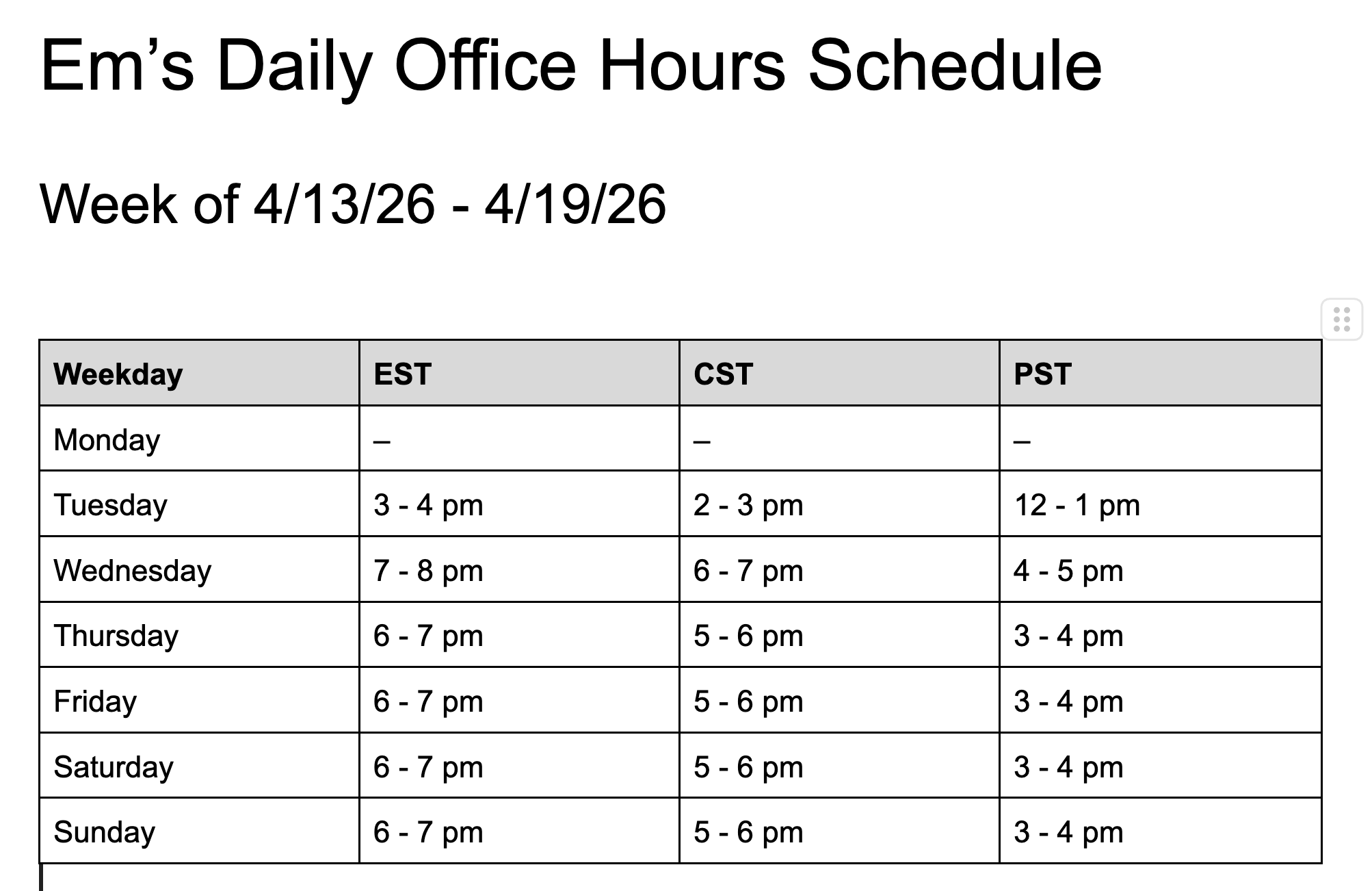
Here are the office hours times this week! You can find me under the discussion page (here) on the bottom left where it says "Tutor Office Hour" at these times! Hope to see some of y'all there!

My study plan is still showing “Week 1” even though it’s been about 3 weeks and I’ve completed every step assigned.
At this point, I’ve just been generating new blocks at the start of each week, but all the blocks stills say week 1.
Am I missing something that marks the week as complete, or is this a bug? Has anyone else run into this?

7Sage will be temporarily unavailable while we update our servers.
Eastern time: 5am Wednesday, April 15th
Pacific time: 2am Wednesday, April 15th
The site will be available again in two hours, hopefully less.
Please avoid doing a PrepTest or Problem Set near this time so that your work is not interrupted. Sorry for any inconvenience!

Will 7sage update practice tests and drills to look more like the new LSAT interface?

I have found this LR Cheat Sheet (very useful. Is there something similar anyone has available for the RC section?.

I took the LSAT August 2025 and January 2026. I got the same score (142) both times. I am looking to take it again in June 2026 to get off the waitlist at my top school. Is it possible to start studying now and get a 150 in June?

hi! i'm a current junior in college aiming for a 175+. i've been prepping for a while since the summer of 2025, but have been pretty lax with it up until february 2026. i completed the 7sage core curriculum over the last summer, with a diagnostic of 164. my score has barely shifted over the past few months of consistent practice tests and drilling. the highest pt i've gotten is a 169, and i seem to end up around there every time.
when i completed the 7sage core curriculum, i used the old website. is it worth redoing the curriculum for the new content? i just don't know how to improve my score. i've been doing practice tests, blind review, all that jazz. i go over every question i get wrong and put it in my WAJ so i've identified patterns in my mistakes, but it always seems like smtg new comes up. timing used to be a bit of an issue for me, but now i've learned to better pace myself. yet, i'm still getting questions wrong and my effort over the past few months feels a bit like its been wasted since my score hasn't really shifted.
i was thinking about pursuing tutoring for more direct support, but not sure where to look for that and if it would be helpful. any guidance would be appreciated on how to approach studying, especially as i am hoping to take the exam in june!

I am living proof that this test is learnable-- a year ago I would've been anxiously thinking about how bad I am at reading and how hard it would be to overcome this test. Hopefully third time is the charm this June and I can finally end my 7sage subscription-- although bittersweet haha. Good luck to everyone studying and embrace the storm of this test. I was feeling a bit down on myself the past two weeks because I just wasn't as focused as I could've been while taking PrepTests, but a couple days off is a great reset.
I just scored a 174 on PT154.
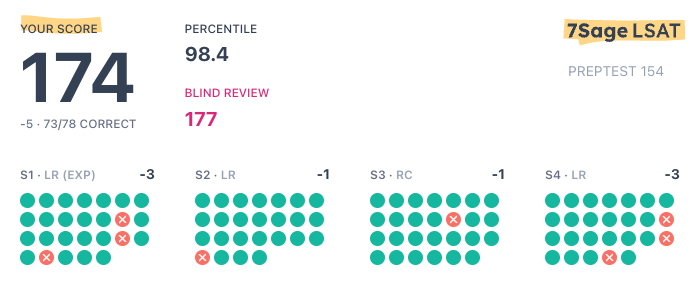

i started studying earlier this year. I put in 4 hours a day, 7 days a week consistently in anticipation of the April test. Then my mom died unexpectedly the first week of March. Needless to say, the studying flew out the door. I still took the test last weekend, because I had committed - the change in career was discussed with my family and Mom was my biggest cheerleader. We talked about what all we were going to do when "i get rich". I ran out of time on the test, so those last few questions in each section were just a random choice, so who knows if I passed or not. I've registered for June, and had my doctor fill out my request for accomodations, which were approved- but i'm having theeee hardest time getting back into studying. I just stare off into space during a session. How do I on ramp again? We know life can life, but gahdamn, life t-boned me this year.

Hello, my study plan drills are suddenly not allowing me to customize when clicking on drills. I used to be able to click drills in my study plans and it's going to lead me to a page where I can customize time, question types, etc. Now when I click on the drill it just immediately goes to the questions. Anyone also experiencing this?

When you click a drill in your study scheduler, do you need to be able to adjust the settings before you start?
EDIT: We heard you loud and clear. We've reverted this change!

I was wondering if anyone has any tips for reviewing wrong answers on LR sections. I feel like whenever I go to review I find myself writing that my mistakes were due to reading errors or because of timing, which sometimes is true but not always. Does anyone have any tips on how to more accurately assess mistakes when writing your wrong answer journal?

I've taken ~5 practice tests now, with a range of 171-180 and an average of 176 (slightly stronger on LR but not as consistent as I'd like to be for either). I'm really struggling with how to effectively study with the goal of getting more consistent at the high end of my range.
(For context, I took the LSAT a few years ago, was in a similar spot in terms of upper range but low consistency on preptests, and ended up getting a lower score on test day so I'd really like to shift my strategy this time.)
Partly in response to that, I've been focusing heavily on drilling sections + PTs and reviewing the questions I get wrong, which I think is helping but it's a little hard to say -- there are a few times where after zeroing in a question I got wrong that I still don't feel like I sufficiently understand why the right answer is right.
Would really appreciate any general tips on gaining consistency in a high range -- maybe any recs on good bang-for-buck books or forums that focus on the trickiest qs?
Thank you!!

I began studying in December for the LSAT. I originally wanted to take in February but quickly realized I was nowhere near ready. I ultimately signed up for April because, worst case, it gives me a good practice run. My scores are hitting over 160 which is good, with my blind review somehow consistently 170+ so I thought, hey, let's just give it a shot and see how it goes. I signed up for in person because I wanted to avoid the usual issues I hear about. Boy was I way off.
I get to the test center at 7:40. He tells me we are having some minor tech issues but they should be fixed. He said he has done this for 10 years and has never heard of a delay longer than even 30 minutes, but expects this fine in roughly 10.
So we wait... thirty minutes pass. An hour passes. An hour and a half. The 8:30 people are now in the room with us in this tiny area all stressed out and waiting. They finally begin letting us into the room. Ugh, finally, right? No.
Instead, we are scanned in, where we have no phone or anything else, no clocks, no nothing, into these little cubicles with computers who, again, have no clock, so you basically have no idea what is going on. And we wait. And wait... And wait. Eventually they come in and inform us that they are STILL having issues. They encourage people to leave and file a complaint, but I have no other availability, I need to do this. So I wait more. Finally, after almost three hours of waiting, I am able to take the test. But obviously, it has been 3 hours. I am hungry, caffeine is long gone, my brain is going a mile a minute so I have to manage that while going in and finally focusing. It was rough.
So yesterday I call them and inform them what happened, and I am told that, since I took it, even if they were to give me a free reschedule, this would still count as a cancel on my record. So, effectively, all they can give me is the score-review cancellation, but of course without being able to actually see my score first. You would think that after waiting for three hours I would at least have my June session paid, which I already plan to take, but no. Nothing at all. Effectively just a "eh, sucks to suck" and move on.
Unfortunately, this is the only system for the LSAT so I have to just deal with it and take again in June because I would rather have my score, whatever it is this time, than a random cancel on my record where I don't even see the score. Really disappointed but it just goes to show, they aren't here to service us, it is still a money-making business.