


LSAT
New post304 posts in the last 30 days

Looking for a few tips I should work on as someone scoring high 150s before test day, that could be the difference between a 158 and 160! Good luck, January test takers!

Has anyone completed the argumentative essay after taking the LSAT? I want to prioritize studying before the exam on the 8th rather than writing an essay.

Hi Friends! I've finished a lot of the curriculum before I created a study plan but now my dates are all off for a few weeks. For example, this week is just lessons that have already been completed. I tried resetting my start date and changing to a custom plan, but no luck yet. Not a huge deal, but it would be nice if the dates align. Thanks!

I saw an explanation that said A -> B and A-some-> C = can conclude C -some-> B. Why is that and where can I find lessons on these types of conditionals?

I usually score in the 170s, then every once in a while I just seem to lose IQ but only in one section. In the last PT, I scored a 167 but with -0 -2 -0 in sections 2, 3, and 4. But I got a -8 in the first section which was a RC. Why does this happen? In the next one I got a -0 but it wasn't any easier I just hit a wall in the first one. Any advice? Some useful warm up or something that wouldn't drain me before I begin but would help this drop on the first section
Thanks

Hi everyone,
I wanted to share a little context and also ask for advice from anyone who has navigated LSAT prep with ADHD.
I recently realized/was diagnosed with ADHD, and looking back, it explains a lot about my first LSAT experience. I took the LSAT in November 2024, before I fully understood how my brain works, and after that test I took a break. I’m now starting back with a clearer understanding of myself and a more intentional approach to studying.
One thing I’m already noticing is that familiarity and structure make a huge difference for me. When the test feels unfamiliar, my focus drops quickly, but when I understand the question types and patterns, my attention improves a lot. I’m planning to follow the 7Sage study guide closely and really focus on mastering fundamentals rather than rushing.
For those of you with ADHD (or who’ve found strategies that help with focus and consistency), I’d love to hear:
What study habits or routines helped you the most?
Did you find drilling vs. full sections more effective early on?
How did you manage timing, burnout, or mental fatigue?
Any mindset shifts that made prep feel more manageable?
I really appreciate any insights you’re willing to share. Thanks in advance — it helps a lot to learn from people who’ve been through this.
Best of luck to everyone studying!

While eliminating answer choices for strengthening questions, I have caught myself thinking, "this answer choice is the necessary assumption; it's too obvious for a strengthener." Yet, in fact, NA are one of the most effective ways to strengthen an argument!
However, I have also found myself choosing an answer choice for NA questions that calls out an assumption that would weaken an argument. Necessary assumptions don't merely weaken an argument when negated, they disprove an argument when negated.
So, in short, granting NA assumptions can strengthen an argument, and answer choices that merely weaken an argument can't really be the necessary assumption.
Interesting pattern in my thinking I've identified that helps me understand the relative strength of necessary assumptions in comparison to other assumptions. Understanding the NA as the bare minimum of what must be granted for the argument to make sense didn't capture this relationship to other question types for me at first.
That is all.

Hi guys, do you have any tips on how to improve low res summaries? I try to keep it under 6-7 words, mostly 3-4 words, but I struggle when questions ask me to recall details.
For example here are my low-res summaries of some passages:
PT. 108. S4. P4 [Passage about early humans not being confident hunters but scavengers]
P1 - Anthropologist wrong early humans
P2 - What is taphonomy
P3 - Cut marks different
P4 - Scavengers not confident hunters
PT111.S2.P4.Q6[Passage about why legal positivism is “erroneous” + Dworkin’s theory]
P1 -Legal positivism accept wrong / Legal positivism vs natural law
P2 - What is legal positivism
P3 - Law has internal logic
P4 -Meaning outside people’s thoughts
I appreciate any feedback!

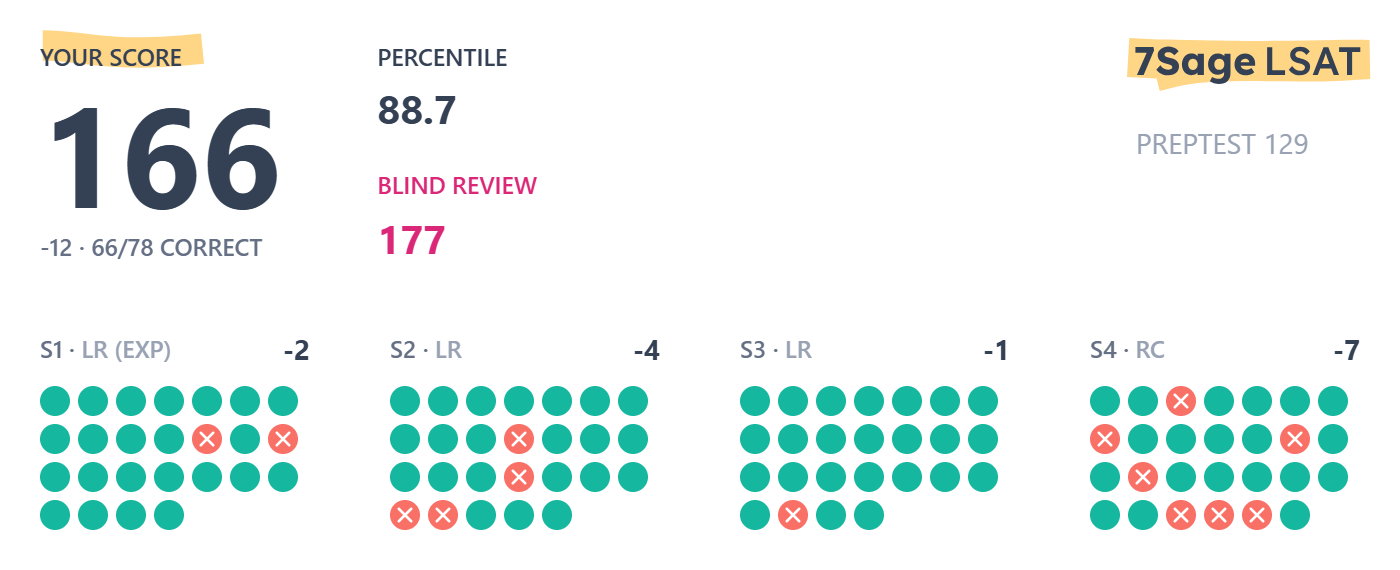
I just scored a 166 on PT129 and got a 177 during BR (yay!) but my timed RC score was -7 and I got a -0 during BR. This is pretty standard for me: I typically get a relatively high number of RC questions wrong and then will get -1 or -0 during BR. I feel like closing that gap will allow me to break 170. Any tips for closing the gap?

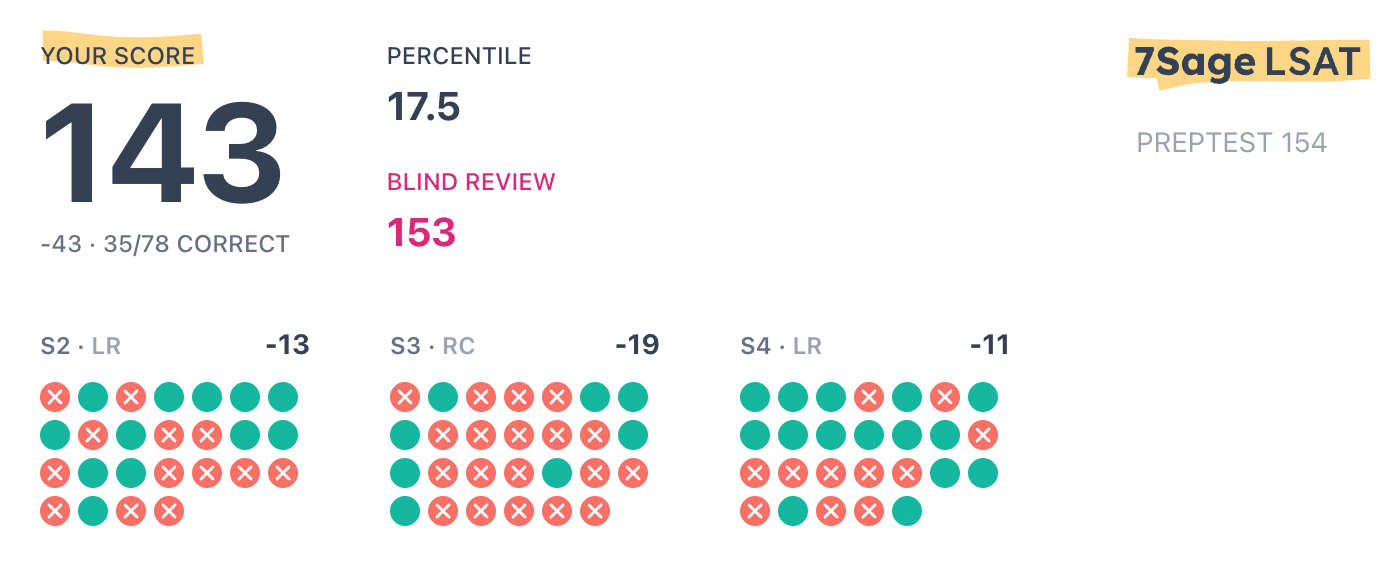
Hey everyone, I had a diagnostic of 140, and my 3 practice exams since then have been 152, 149, and today a 144. I wanted to take a practice test as my exam is Jan 10th, and I am feeling so defeated. Does anyone have any tips? I am so frustrated at my steady decline.

Test Jan 7, wish me luck. General question should I continue drilling or take a break?
Last RC section -2 Last LR section -1.
Key takeaways from Studying
Stop drilling after 5PM , my performance at night has always been significantly worse.
Get a good night sleep
Give the answers that look completely ridiculous a second look, especially after question 11.
Those small keywords that don't make a difference in our everyday lives make a HUGE impact in LSAT world.
Any finally, I hope to never have to take this test again!

I admit I haven't read everything very carefully but here seems like a better way to get answers anyway... I take the LSAT this Saturday online. I have downloaded the ProProctor app to my computer and opened it with no issue. Is the LSAT exam given through the ProProctor app or is it given on Lawhub and the app is just for the monitoring during the exam?
Second question I have a laptop and a monitor set up. I like to use my monitor as its far bigger than my laptop screen but my laptop has the camera on it. So when i use my monitor its clear that i am looking well to the side of my laptop... will this be an issue with the ProProctor? Maybe just depends on the Proctor but worth asking.
Thanks for any insight!!

Hi there! I'm starting the 7Sage study plan today and it's rather long before getting into the practice - I'm wondering, has anyone done the study plan and supplemented drills or sections in along with their daily curriculum lessons? If so, are you doing drills on relevant sections you just learned? Any tips? I think I'd like to drill 5-10 questions on a subject, blind review and answer journal so that I can get in the habit before starting the practice portion of the study plan. Thanks in advance for any advice or tips!

After studying for a few months I just got my worst score on a section (-15). I usually get around -8. Pretty demoralized...

I score around 143-146 in PTs, is there a way that i can get 150 by Saturday????? I know i lack in RC but is there a way that i can improve my LR to reach to 150? in need for desperate solutions.

I have a Live subscription, and I bought it so that I could get tutor responses. However, I asked a question weeks ago and still haven't heard back from my email. Just wondering what is the usual response time for a question.

Been studying daily 6+ hours for 2 months in preparation for the Jan 10 LSAT
I’ve definitely seen progress, I’ve jumped 20 points from my diagnostic
This week has been the worst tho I’m not doing good on prep tests and Im crashing out
I’m thinking I should just take it easy until exam day, focus on timed drills and reviewing cram sheets instead of daily pts so that I’m not dealing with burn out on exam day. Is this a good plan or should I push through with the pts?

When you click that bookmark button at the top of the page isn't it supposed to save the question in some repository? I keep clicking it for unique questions but it never saves them anywhere. :/

Hi! I've only taken the LSAT at a test centre before but I'll be taking it remotely at home for the first time this week. I was wondering if anyone with testing accommodations could tell me a bit about their remote testing experience, particularly with stop/start breaks? Is there a pause button I can access whenever? How do I get the proctor's attention, and do I have to do that every time I take a break, even for just a few seconds?
Additionally, I've read all the information on LSAC's website about remote testing, but is there anything else that I should be aware of/prepared for?
Thank you so much!

Hi and Happy New Year!
I am fairly new here and am wondering if there is somewhere on the 7Sage site that I can take + find explanations for the Drill Sets that we have access to on LawHub through 'drill sets?'
Thanks for your input!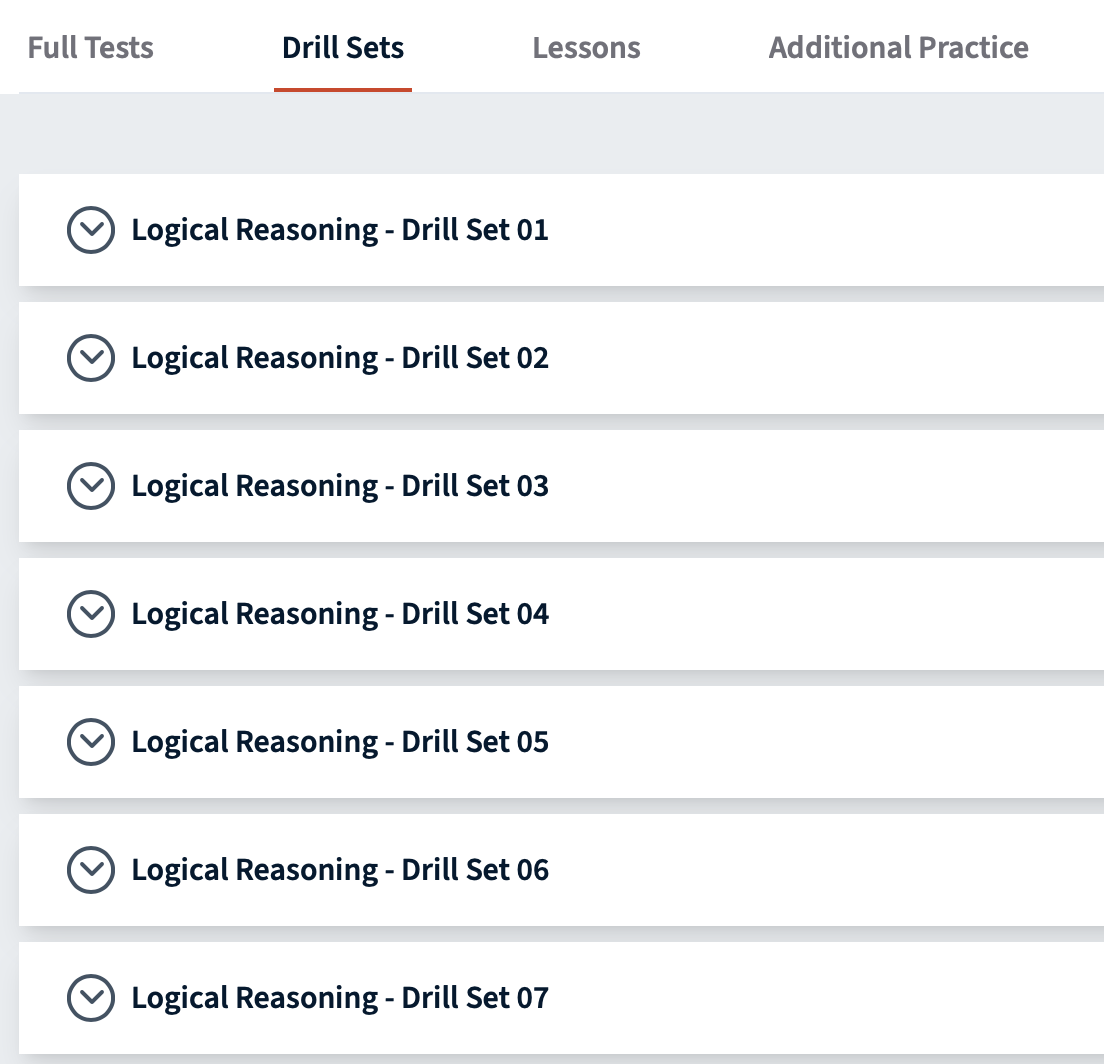

I find myself getting nervous with the time constraints of each section on the test. My score has not improved much since starting the study plan. I feel a huge part of it is because I feel like I need to answer all of the questions as fast as possible, which I feel myself rushing to get to an answer and move on. What is a good strategy for someone who cannot answer every question in the allotted time given? How do you increase speed in answering these questions? I have been studying for several months, reading books, taking test, solving individual problems and nothing seems to be working. I don't know what to do and any strategy to get a higher score would be appreciated. Thank you.

I was wondering if all 7Stage drills are targeting your weakness, even if you did not select any specific filters on what to include in the drills.

Hello everyone,
I am wondering if the appearance of 7sage's LSAT RC and LR sections online identically resemble and map onto the appearance of those sections on the test. In other words, when taking the actual exam at a testing site, can you highlight text in RC and LR sections in multiple colors like we can do on 7sage? Also, on the real test for RC, can you re-read the RC passage on the same screen as the questions like in 7sage or do you have to click back to a different page to re-read the RC passage if that makes sense?
If there are in fact differences, what do you recommend I implement into my studying to account for the differences between how the test presents on 7sage vs. the actual exam?

stressed bc this one was far worse score than my usual average, particularly section 4 (LR). was it unusually bad for anyone else (like ~my diagnostic score from a year ago)? section 1 and 2 were normal scores. 3 and 4 far lower sectional average.
how to address this outcome via studying methods?

Do we have a more concrete sense of how difficult PT159 is? It was a few points below my recent average, but not sure how common that was. I assume that online comments are self-selecting for people who thought it was hard, so curious if we have anything more definitive.