


LSAT
New post298 posts in the last 30 days

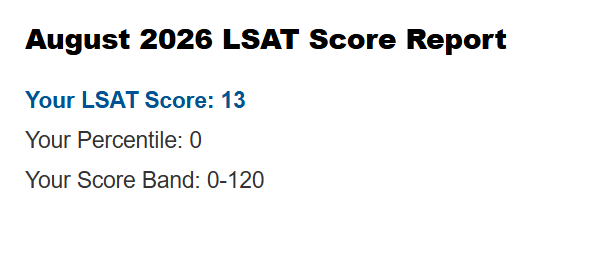

I just scored a -1 (172) on a RC section, meanwhile I scored a -6 (151) on the practice RC drill consisting of 2 passages that I did right before that. I don't think I did anything different - the passages were just much easier for me to understand in the full RC section.
How can I address this type of inconsistency? RC is my weakness. I would greatly appreciate any tips or advice from folks who previously struggled on RC and now slay it.

 actually i'm just kidding because i didn't get a 179...
I got a 180!
Thank you 7sage for being such an amazing resource!
And thank you to my study group on discord (https://discord.gg/P4SYFEjZu) for being so supportive and helping me so much!

Chat live with our LSAT instructor or Admissions Consultant about your specific situation!
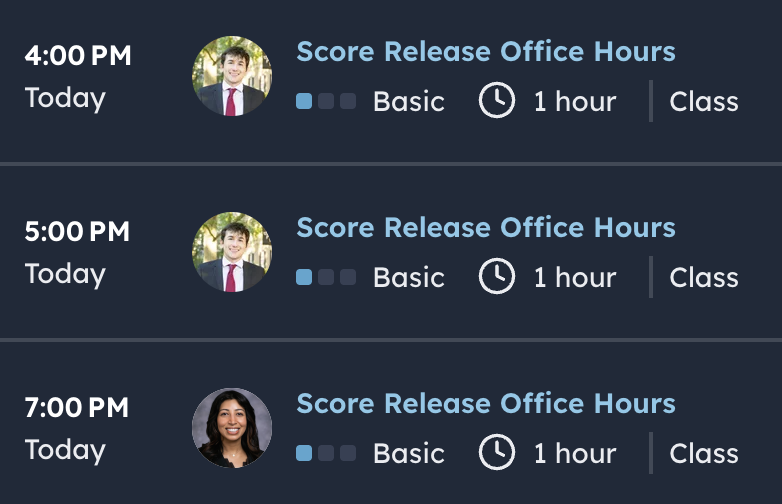
We will be running free Office Hours in our Study Rooms from 4-8 PM (ET) See full schedule below:

Took the August LSAT then took two weeks to travel and stopped studying ( Also was hoping I was done) got my score back and mmmm could do better I think but I feel like I had reached peak studying right before August test now have lost my momentum and idek how to get back into it for October test

Happy (or horrifying) score release day! I've got a message for all of you, especially those of you facing a disappointing result.
Watch the video for more, but here are some core points.
1) You are not your score. Your appeal as an applicant, your promise as a lawyer, and your broader identity as a person are multi-faceted and do not reduce to a single result from a single try.
2) The purpose of practice, including early official takes, is to learn novel, interesting lessons. Regardless of your result, if you thoughtfully pull novel and interesting lessons from this administration, you're set up to be a stronger testtaker than you were before the August test.
3) Heed my advice later in the video about how specifically to address gaps in your blind review, practice test, and official scores.
4) We've got resources for you today. Most notably, we're stacking office hours throughout the day so you can get the emotional and practical support you need. You can find those chat rooms in the left-hand sidebar of this page.
5) See also this special episode of the 7sage podcast where Bailey, Alex, Kevin, and Ethan discuss what you should do today.

Got a 161 last August, then a 163 Last October, to then check my score for August 2026......
178 BABY!
Crazy feeling.
7Sage really has some amazing resources and strategies on here! All of the prep course/materials I used were from here.
To anybody who still has to take it, you got this!

Hi all! I recently took the august LSAT, and I am not too happy with my results. I was consistently doing far far better on my practice tests, so I was super surprised. I want to see if I should change my study approach, and the main piece of advice I am seeing from tutors or well-scorers is to (instead of excessively drill) I should "review." This is probably a stupid question, but what does it really mean to "review"? All I know to do is watch/read the explanations, and wrong answer journal. Is there a process to thoroughly review the question and figure out what I did wrong? What have people found to be a successful tactic? I would appreciate any ideas!

Immediate reaction to the score release is purely frustration... I knew from the moment I walked out of the test center on August 8th that I underperformed. It was my first official test and I'm taking the one in September, and I know that I will do so much better this time around.
But I can't help but to feel disappointed in how it all went. More motivation I guess!
Anyone in a similar boat?

Hey everybody!!!!!
Thought I’d post here in case anyone is in the same position I was and needs motivation. I’d been scoring consistently in the 158 ish range since I started studying. A week before the August test, I scored 165 and then a 152 (I actually posted on here about it). I was afraid the 165 was a fluke and I was somehow doing worse. Plus, everyone says you do worse on the actual test.
I just got my scores back… 166!!!!!!!!! Not as stellar as a lot of amazing people in the discussion, but good nonetheless. Don’t freak yourself out before the exam convinced you’re destined to do worse. You got this, there’s an end in sight. And 7sage is AMAZING!!! Go to the live classes if you haven’t, those helped me jump out of 158 purgatory.
Edit: In case anyone was wondering/ is in a similar boat, my diagnostic was 147 and I started studying May of this year!

I just scored a 176. I never tested above 170. 7sage is so amazing

Hey all! I have started to notice a rather unfortunate pattern with my studying. When I spend 2-3 days focusing on LR or RC, I find my full timed sections land at around a -6 to -4. HOWEVER, when I take a few days off/focus on the other concept (Ie, I focus on RC for a few days instead of LR), my sections drop significantly to -11 to -9.
Has anyone else struggled with this? If so, how did you get over this?!

Hi all — I’m looking for some advice!
I took the LSAT in June after roughly 8 months of studying, but unfortunately fell approx 10 pts shy of my desired score. RIP
Since then, I’ve taken an almost 3 month hiatus from studying. I’m not in a huge rush to apply, so I’d rather take the time to prepare properly and really push myself toward a score in the high 160s before taking it again.
For some additional context, during those 8 months, I only took about four or five full-length practice tests. Looking back, I think one of my biggest issues on test day was mental endurance. By the time I reached the end of sections, I found myself feeling so mentally fatigued that it was almost like I couldn’t read English anymore — obviously not ideal.
I also didn’t drill full sections nearly as much as I probably should have, particularly in RC. A lot of this came from a fear of “running out” of material, so I spent a significant amount of time on individual questions trying to really dig into and understand them rather than prioritizing volume and timed practice.
I’m starting to get the itch to begin studying again. Ideally, I’d like to retake the LSAT early next year, although I don’t plan to schedule an exam until my PT scores are consistently where I want them to be.
I’d really appreciate hearing your advice on where you think my time would be best spent at this point…Specifically:
Whether it would be worthwhile to redo the core curriculum from the beginning
How much emphasis I should place on drilling versus full-length PTs
How to get past the fear of “running out” of practice material
Strategies for improving mental endurance and managing fatigue during sections/the full test
Anything else you think could be particularly valuable given my situation
If you’ve been in a similar position, I’d love to hear what worked for you.
Thanks so much if you’ve read this far!

Just wanted to briefly thank 7sage and this community! Raw score was a 160, first official exam was 169 back in June, and I just got a 180 on the August exam! Thank you so so so much again and good luck to everyone taking future exams!!!

I know a lot of people personally and on this platform that believe jumping up a lot in score is out of reach. I got a 159 in June of 2025 and today I got my August score back and saw a 176. To literally anyone and everyone that needs to hear this, let me serve as proof that you CAN make that jump. There is no barrier that hard work can’t break down. Keep at it and don’t give up on yourself, even for a second. Anyone who wants to follow up with me regarding studying tips or even mental advice for tests feel free. I believe in all of you.

I just don't get it. I study so hard, do everything everyone says to do, and it is now my second test where I completely and utterly underperformed. I approach the LSAT PTs just as the actual exam. I don't take extra breaks, I don't do anything that I am not allowed to do when I walk into the test center on test day. But I have now underperformed from my avg PT for two times in a row - both by like the full 4 points of the score band.
It is so disheartening, because everyone else I see gets their PT average score or gets an even higher score on test day. Like am I just weak in certain question types that are more prevalent on the most recent exams? If that is so, shouldn't other people also be seeing this variance? Idk. It has been my dream for most of my life at this point to go to a top 14 school and really help people that need it through the law, and I feel like I may not even get top 50 now, it feels like my dream is just slipping further away each day.

I AM JOYOUS

I’ve noticed that I tend to get assumption based questions wrong. I think where I go wrong is that I got straight into the answer choices without spot the gap. Does anyone have any tips on how to improve in this skill?

Wrote the August lsat and got no score because of a glitch during the test. It was my first attempt and still counts as an attempt. They gave me a free rewrite in September and I’m also signed up for October. Most recent pt was on Saturday and got a 174 on pt159. I want to be closer to 180 but also need a score by October to apply this year. Should I abandon this cycle and come back next year?

Hey guys the deadline to request full refund for the October LSAT is today, and I'm considering doing that and registering for the November LSAT. I took the August one and ended up with 156. My goal score is 173. I recently did a PT and scored 169. That is the highest I've scored. October would be my 3rd (and last because I don't want to take more than 3 attempts). My GPA is 4.0 and I have work experience in law field as well. I am planning to apply to Ivys. I also need a scholarship. Should I do it? should I do November?
I've heard the timeline matters too. Is applying in November too late for scholarships? I am not planning to apply to any early decisions. I'm thinking it's better to apply with a better score than applying late October.
IDK I CANNOT DECIDE PLS HELP

I took the LSAT for the first time after studying for months, and I honestly feel completely crushed and devastated by my score.
I have a BS in Biology with a 3.96 GPA. Given that English is not my first language I really put an enormous amount of time and effort into preparing for this exam.
I studied on weekends, took 7Sage 12 week course with a great tutor, attended 7Sage live classes during the workweek after getting off work (often from 8 PM until midnight), and used essentially every lunch break to drill questions instead of eating and hanging out.
In the weeks leading up to the exam, I was consistently scoring in the 160–165 range on practice tests. Then I took the actual exam and scored a 153.
I genuinely don’t know what happened. I am shocked because my practice scores were so much higher and I feel like all the time, money, and effort I invested somehow didn’t translate on test day.
I am overwhelmed and honestly don’t even know where to go from here.
I am applying to T100 regional schools, but realistically, I would need at least a 160+ to have a decent chance at the scholarships I need to make law school financially possible.
At this point, I’m seriously considering giving up on applying this cycle and spending the next year studying for a retake.But the thought of starting over after already spending so much money and time preparing is incredibly discouraging.
For those who have been in a similar situation: Would you retake, and if so, when? Would you apply this cycle with a 153 and potentially retake later, or would you wait an entire cycle and focus on getting the score up?I would really appreciate any honest advice or perspective.
Right now, I feel completely lost.

First off will say, 6 months ago my message was help how to stop missing easy questions before #15. Now its how do I stop missing the 4 and 5 start questions later in the section. Good problem I think.
So how do I stop missing the 4-5 star questions later in the section. I am pretty much getting all the questions right before number 15 the 1-3 start questions and getting them right fast. Now I am missing 4-5 star questions frequent misses are in order of most frequent (LinkA, Causal, Phen-Hypothesis), NA, Flaw etc. Now sometimes I can see the gap right away, other times I absolutly cannot even see the gap, and I find that if I dont spot the gap in the stimulus, its basically just a guessing game through the answer choices. Also when review sometimes it just doesnt click for me and I am still not sure.
Any adivce would be great.

I apologize if this is a dumb question, but is there a button to hide answer choices in the new LSAT format? Am I just missing it? Did they take it away? I'm taking the test again in September and couldn't find it in my most recent PT.

I'm so happy that I joined 7sage after a disappointing result in April. The April score was lower than my PTs and I figured I needed a new strategy. The structure, video lessons, and explanations on 7sage really helped so much. I'm so excited!!

158 on August LSAT after scoring 165–172 on recent PTs. Looking for advice for upcoming administrations
Hi everyone! I took the August LSAT, which was my first official LSAT after starting my LSAT journey in May 2025.
I've been studying consistently almost every day (except Saturdays) while attending school full-time, interning part-time, and participating in a weekly extracurricular.My PT progression looked roughly like this:
April 2026: consistently low 160s/June: consistently mid 160/ July: consistently mid-high 160/ Early August: 172 on PT 157: August LSAT: 158
Since the exam, I've taken PT 158 and PT 159 and scored 165 and 169, respectively. So I don't feel like my underlying ability has suddenly dropped to the 150s. Normally, my LR sections are around -1 to -4, and RC is around -3 to -6. On the August exam, however, I ended up missing around 22 questions overall.
What went wrong on test day? (based on personally journaling my experience)
1. Sleep/anxiety: I've always struggled to sleep before major life events. I anticipated this happening before the LSAT, and unfortunately, I barely slept despite being in bed for 10+ hours attempting to sleep. By halfway through the exam I was exhausted, and I caught myself rereading the same words repeatedly. I was also experiencing significant anxiety during the exam (I was literally shaking, crying, and breathing heavily toward the end of each section). I really tried to prepare myself before test day by not going any over any LSAT material the day before, eating protein in the morning, avoiding too much caffeine, etc.
2. RC was extremely difficult for me: The first RC passages were already difficult, and I believe the August RC section I was administered was considered particularly difficult according to Powerscore recap. The comparative passage was especially bad for me. It was extremely philosophical/scientific and unlike the types of RC passages I had practiced. I had a bit less time than I wanted left for that final passage.
When I realized I was running out of time on that passage, I started shaking and nearly hyperventilating. Also, because the RC section was my first section of the exam, it definitely affected my mindset going into the rest of the exam.
3. I started overthinking answers: Even on questions that I normally would have considered manageable, I found myself second-guessing answer choices and talking myself out of answers. This is something I've noticed in my recent review as well. I'll sometimes identify the correct answer initially, but then convince myself another answer is better as I read through the rest of questions or if I'm in between two questions. The only questions I get wrong are ones that I flag.
What I've done since the exam: I took about four days off after the exam, and since then I've been studying again. I've been specifically trying to: stop overthinking earlier questions, trust my reasoning more, pay closer attention to details while reading, practice taking PTs at approximately the same time of day as the actual exam, review my mistakes more carefully rather than simply looking at the correct answer. My recent PTs were: PT 158: 165/ PT 154: 169, so I'm still performing in the range I was before the August exam.
My situation going forward
I'm currently registered for both September and October. I'd really like to apply this cycle because I feel that I have a strong overall application (GPA, significant life experiences, internships, extracurricular involvement, etc.).
However, my semester is starting this week, so my schedule will become:
Monday: Free / Tuesday: Internship 9–5 + ~1 hour total commute / Wednesday: Internship 9:30–1:30 + extracurricular 4:30–7:30 + ~1 hour commute / Thursday: Free / Friday: Free / Saturday: Free / Sunday: Free/ 5 asynchronous classes (workload likely to be completed on mostly on Monday, any remaining could be finished later in the week). I also have ADHD, so I made sure to get all of the accommodations I needed. I am medicated.
What I'm trying to figure out: Given that I scored a 172 only a couple days before the August exam, then scored a 158 on test day, but have since scored 165 and 169 again:
How would you recommend I approach the September and October exam? I'm registered for both.
I'm especially interested in advice about:
Whether my recent PT scores are enough evidence that the 158 was an outlier.
What you think I should specifically work on over the next few weeks based on this experience.
Whether anyone has experienced a similar large gap between PT performance and an actual LSAT score, and what helped them close that gap.
I'm aiming for the 170+ range eventually, so I don't want to rush into September just because I want to apply this cycle. At the same time, I don't want to unnecessarily delay if the evidence suggests that August was simply a bad administration for me.
I'd really appreciate any advice!