


LSAT
New post300 posts in the last 30 days

Hi everyone!
I am in need of some advice about how to stayed focused during a full-timed exam. I can usually get through the first two sections unbothered and locked in. However, after the 10 minute break between the 2nd and 3rd sections I become super tired and sluggish and this causes me to do worse on the last two sections. I know I could do so much better if I am able to stay on track and not become uninterested.
I am not sure if this makes sense or if anyone else has had this issue, but any advice would be greatly appreciated!

is it better to take full pt with expiremental section or without it?

Hi All. I am taking the August LSAT and looking to get to 160-165 for my first attempt. I am currently testing between 154-158. I am struggling to break into the 160s. If anyone can provide me any tips or anything they did that helped them make a leap for these 5-10 points in a month that would be really helpful. Thank you and good luck to you all.

 This was my first ever practice test! I was pretty nervous going into it, due to the fact I had only done 1 timed RC section (-8) and 1 timed LR section (-6). I'm very happy with the results, including the blind review.
It's very interesting how I got 2 early questions wrong in LR, when I usually get the first 10 correct.

Hey everyone,
4 weeks out from my August test and stuck in a frustrating pattern. BR sits at 168-172 consistently across 7 PTs but raw score won't break out of the 155-158 range. Best raw was 164 (PT153), but I keep reverting.
Three gaps show up as uncorrected misses on every single PT:
Causal reasoning (Flaw, Weaken, MSS, PhenHyp)
Conditional reasoning (SA, Parallel Flaw, Conditional Flaw)
RC — Implied and Author's perspective questions
Have 200% time accommodations so test conditions are closer to BR conditions than standard. Currently drilling causal and conditional reasoning specifically since the lessons alone didn't stick.
Three questions:
What finally closed the BR gap for you?
Any advice for making causal/conditional reasoning click beyond just rewatching lessons?
when recording in your WAJ is it necessary to record questions you got right on BR or only ones you missed the second time around?
Appreciate any input.

I am really struggling with conditional reasoning and diagramming. I have reviewed the core curriculum and foundations extensively, but it just has not seemed to click for me. I am not sure what I am doing wrong here, trying to see if anyone has found themselves in a situation before and what helped you get out of this and get better at conditional reasoning/making diagrams.

I just checked LawHub to see the new interface for the August test, and I noticed it's slightly different from the current 7Sage format.
Can anyone explain what the "Keyboard Highlight" feature does? It doesn't seem to do anything on my end.
I also don't see any highlighter or underline tools.
Finally, is it correct that after selecting text, I have to click the "Highlight" button to actually highlight it? Or is this just a bug? It feels extremely inconvenient because the text used to be highlighted automatically as soon as I selected it. Having to click "Highlight" every time seems like an unnecessary extra step. :(

Hi, everyone! I'm between jobs right now and am taking advantage of the situation by studying full time. It's been 3 weeks, and while I'm making progress, I'm starting to feel the burnout creeping in. It's getting harder to force myself through the drills--the days just feel so monotonous. In an attempt to help, I've been studying at different cafes each day and started volunteering at my local animal shelter, but I'm still having trouble. I'm taking the LSAT in September and still have a month or so before starting my new job, and I want to optimize this free time as best as I can.
Does anyone have any tips for overcoming burnout? Any thoughts are appreciated!🩷

Hi y'all, I have been studying on and off for a couple of months, and don't seem to be improving much. I began with a 168 diagnostic, and have been consistently scoring in that range on drills and sections, as well as PTs with the exception of some outliers. My practice doesn't seem to be showing improvement at all, and I'm wondering if anyone has any advice for what to work on. My goal for the August exam is 172.

I am writing this in an attempt to help someone studying/taking the LSAT. Scored 154 in November, started lightly studying again in December and took the January LSAT and scored 149. Stopped studying. In April, I decided to take the June LSAT, leaving two months to study. Scored a 161. Some advice:
Beginning Stages
Don't spend large amounts of money on test preparation courses. I bought a course and made the mistake of extending it. To get the foundations of the LSAT, go to LawHub, review the Lessons, take notes. The issue with test preparation courses is that they can be generic and categorize certain concepts differently than LSAC.
Taking 3-4 months to build a foundation is a good start.
Take the Drill Sets and Additional Practice offered in LawHub (some offer explanations).
Practice
Keep an error log. Originally, this looked like an Excel spreadsheet where I broke down which question types I was getting wrong. I reviewed which were the most common question types I was missing and then put them in a Drill Set in 7sage. Difficulty level was Medium, Harder. I needed to be uncomfortable by being consistently wrong and would reference my notes to expand on areas that needed to improve.
Error log transitioned from an Excel spreadsheet to a doc. Would screenshot the passage and answer choices and write out why I chose the answer that I chose, what part of the passage was missed, and impressions of the other answer choices. The error log was organized based on question type.
Help
LSATHacks (free resource that gives additional explanations): https://lsathacks.com/explanations/
If you are having difficulty with the LSAT, that is a good thing, it means you are learning in some capacity. Some approaches to questions will not be automatic, keep an open mind and sometimes resist your natural inclination towards a specific answer type. Practice whenever you can, I cannot emphasize this enough. Good luck on your process.

We released two new games to train RC microskills:
Think about the purpose of statements as you re-arrange jumbled paragraphs into an order that makes sense.
Practice being specific about what words like it, such, and this refer to.
We're collecting feedback and will improve these games based on it. So far we've seen a lot of calls for more content within specific games to make them more replayable, more difficulty, persistent records for high scores and ability to review past gameplay. We've also seen calls for more games training conditional logic translations and RC skills. Keep the feedback coming.

Now you can change any study day to a rest day or vice versa, so that as your plans change, your study schedule can change too.
Try it on your study plan today!
Feedback? Suggestions? Leave a comment!

I'm struggling with the application of SA because for me- the word "sufficient" denotes- just barely enough..."suffice it to say" for example...when ACTUALLY the meaning is stronger.
How would you explain this concept to me in a more basic way not using the word "sufficient."? Is "trigger" correct? Conclusion enforcer? Powerful premise?
Thank you!

Hi! I need some advice on what dates I should register for. I started studying about a month ago and am looking to register for either a September or October testing day so that I can send in applications by the end of October. Should I...
1) register for the September date (less time to study, more time to work on app)
2) register for the October date
or 3) sign up for both, take the first one, and decide once scores come out if I need to take the other one
I understand that there is a high price for registering so I am hesitant to sign up for both but I do also feel like its a smart choice conceptually. Considering I have only taken the test one other time, I know I have more opportunities to take the test but it's so scary knowing I have a finite number of chances.
Any advice or additional considerations would be greatly appreciated!

hi all, taking the august lsat. in miami dade county area if anyone wants to do a study group

So I took the LSAT in June and didn't get the score I wanted. I can do consistently well on LR (missing maybe 1-3 each section), but then I absolutely goof every RC section (missing as many as 10-12 questions per section). I only joined 7sage a few weeks ago when I got my scores and I'm planning on retaking in September. Until now, I've studied completely on my own using Lawhub advantage.
So in y'all's experience, have you been able to see consistent improvement in your RC sections through 7sage?
Studying on my own, I think I actually declined in my RC scores which has got me feeling bummed, but I just need to know if there's hope for improvement.

Is anyone else encountering the AI coach crashing and saying: "Sorry, something went wrong while generating a response." If so how can I fix this issue? Thanks!

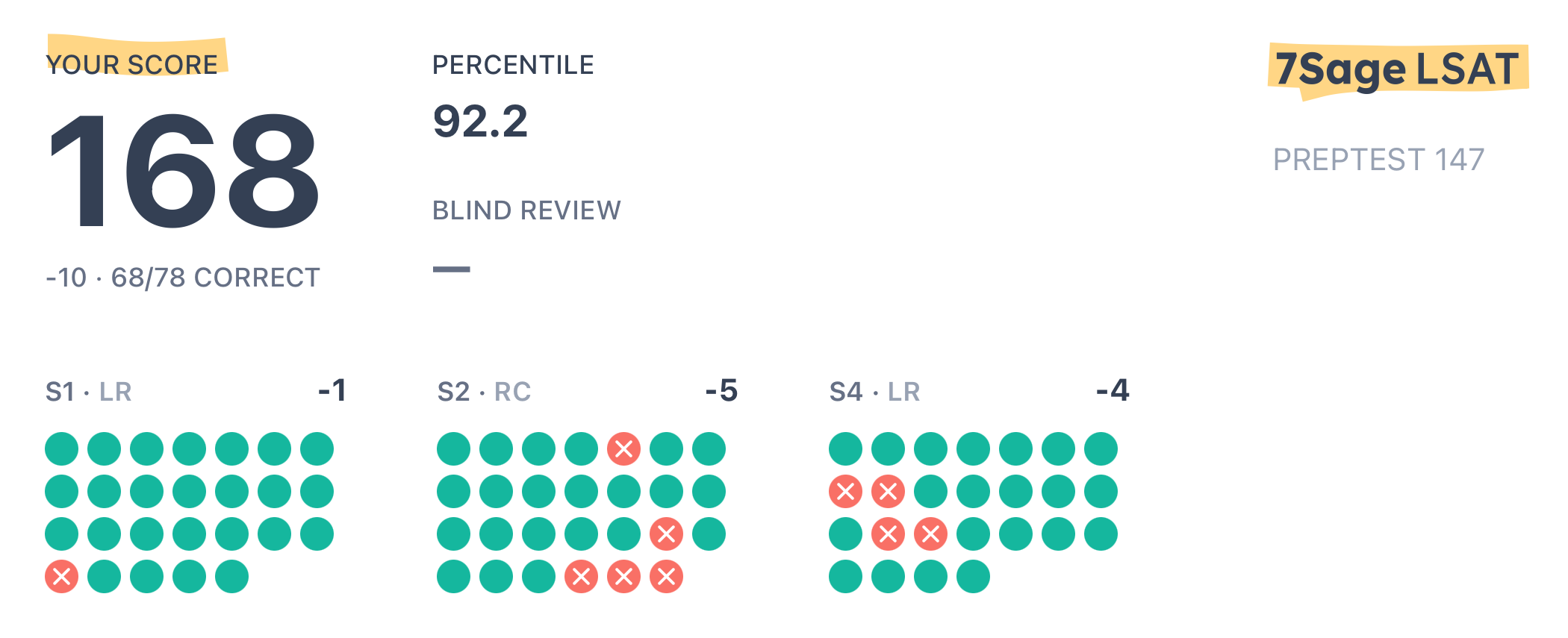 This was 6 points below my average and I couldn’t be happier. I took 2 1/2 weeks off for work and last week did 120 hours “at the job”. I’m happy that with all the work I can put up a decent score under worst possible conditions.

I started my prep earlier this year with not a lot of hours per week due to school, work and internships. I took a diagnostic in April and got a 151. I've been prepping more this summer and took another diagnostic last week. Which only went up to a 152. My goal is 160-165 and I'm taking it in August. Basically, I have a month, I'm honestly losing hope if it is possible. I'm in between two choices, grind as much as I can before August, or take the September test instead. I'm hoping to have all my applications submitted by Thanksgiving.
If anyone is in the same boat or may have any advice, it'll be greatly appreciated.

Hi! I just want to reserve a special thank you to tutors Rahela, Clayton, and James. I improved my score by 16 points and got into the high 160's on my LSAT score and couldn't have done it without them and their assistance. I love 7Sage and would recommend it to anyone hoping to get into law school.

Hey guys! I recently finished the RC module and now I'm on to practice. My question is what exactly should I be doing now? Ive been doing some drilling and following my study plan for the past few days but I feel like I should be doing more. I know I should be taking PTs but I'm not sure when I should start. Should I start taking them now, later, how often, timed, untimed? Should I be drilling alongside them? Should I just keep following my study plan? Also if I take a PT and don't get around the score I want should I be worried about this considering I finished the entire core curriculum? Any advice is greatly appreciated!
Need help coming up with a plan for a somewhat unique study situation. I write the LSAT in one month. I work a day job as a manager and run my businesses at night, this gives me very little time to do PTs or study. So far I’ve done 6 total, one 14 years ago cold diagnostic (168), one 5 months ago on lsac after pounding out the loophole in 10 days (171), one 2.5 months ago on here (174), one on lsac a week later to simulate the actual test better (177), one on here a month ago I aborted because staff called and I had to go in (150, -2lr, -1rc till passage 4, abort), 168 last night after a 3 week study break (worked a 120 hour week). Ended up pounding out a 14 hour study session to get rid of the rust 9/10 lr level 5, 19/20 adaptive, 24/25 lr section. Stats are 90% drill accuracy but over represented with lvl 4/5. Trying to come up with a realistic study plan for the next month with max study time being around an hour a day till test week.

I got a 160 on the June LSAT and was expecting high 160s based on PT/practice sections. Is it a waste to do an audit, as I took it electronically? I will note that I have accommodations if that matters.
Am I just delusional? Or should I do it?

Hey guys,
Does anyone have a spreadsheet format of conditional reasoning concepts they wouldn't mind sharing? 7Sage has a conditionals webpage but not a spreadsheet-style document that I can download. Thank you!

So, I took PT 152 and scored a 159, BR was 162. My goal score is anywhere in the 160+ range, what should I do before my August test? Of course I'll be taking a test every week before my exam, but I wanted to ask how do I approach scoring even higher next time?