


Hi! I'm Ezra, and I scored a 180 on the September 2026 LSAT. I firmly believe that with good study habits and dedication, most people can reach their goal score.
I work best with students who already have some familiarity with the exam and the question types and want to make the most of their practice. I look at how you're studying and testing, we pin down what's holding you back, and build a plan around it.
My specialty is closing the gap between timed and untimed performance. That was key to how I got my 180, and I've put a lot of hours into developing tactics for it. If you're getting questions right with time but not under the clock, I can help.
Book a free 30-minute consultation via this link: cal.com/glasmanlsat
Applications


Discussions

Ezra
Independent Tutor180 Tutor | Closing the Timed vs. Blind Review Gap | Free 30-min Consult
Hi everyone! I'm Ezra, and I scored a 180 on the September LSAT, so the grind of PTs, blind review, and wrong-answer journaling is still very fresh for me. I tutored economics in college, and have been tutoring the LSAT since I took the exam. I love teaching the exam and I think the LSAT can be a fun and engaging challenge with the right approach. I firmly believe that with a strong foundation, good study habits, and proper dedication, most people can reach their goal scores.
My specialty is closing gap between blind review and timed scores, and building personalized and highly effective study plans. These were key to how I scored a 180 and I have put a lot of hours into developing tactics for them. Reaching a high score on the LSAT requires a holistic approach that goes beyond making sure you understand the questions. Success is also largely about tactics for performing under timed pressure. If you're regularly getting questions right in blind review that you are missing under time, or your PT scores are plateauing short of where you know they should be, I am here to help!
How I work:
We start by assessing your performance and how you are studying, to pin down where you could improve. This is a process of targeting gaps and strengths in your understanding, study methods, and execution.
We will work on tailoring our sessions so that they work best for you. Everyone learns best differently, and we will spend time making sure that your study time is spent optimally and efficiently.
I am offering 1-on-1 sessions. I prefer 90-minute sessions, but can do 60-minutes as well if you have less time.
Rates:
I am currently pricing my 60-minute sessions at $60 and 90-minute sessions at $85.
If you are interested, book a free 30-minute consult: cal.com/glasmanlsat
Feel free to dm me here or comment below with any questions! 😁
I found the study plan feature to be helpful, so that I wouldn't have to spend too much time coming up with things to do on my own. I would occasionally supplement those drills with targeted drills in priority areas. I don't think there's one right answer to this because everyone's focus is a bit different, but I would recommend using the study plan feature to get a sense of how to fill your study time, and tuning your drilling from there with a focus on targeting what you are struggling with, both in terms of content and execution.
Ezra
Independent Tutor180 Scorer (Sept 2026) | Closing the Timed vs. Blind Review Gap | $60/hr, free 30-min consult
Hi everyone! I'm Ezra, and I scored a 180 on the September LSAT around a month ago, so the grind of PTs, blind review, and wrong-answer journaling is still very fresh for me. I am new to tutoring the LSAT, but I tutored economics in college and I love teaching this exam. I firmly believe that with a strong foundation, good study habits, and proper dedication, most people can reach their goal scores.
My specialty is closing gap between blind review and timed scores, and working on efficient study plans. These were key to how I scored a 180 and I have put a lot of hours into developing tactics for them. If you're regularly getting questions right in blind review that you are missing under time pressure, or your PT scores are plateauing short of where you know they should be, I am here to help!
How I work:
We start by assessing your performance and how you are studying, to pin down where you could improve.
Whether its pacing, second-guessing, or trouble with specific question types, we will develop targeted solutions.
We will work on tailoring our sessions so that they work best for you. Everyone learns best differently, and we will spend time making sure that your study time is spent is optimally and efficiently.
I work best with students who already have some familiarity with the exam and the question types. If you're brand new to the LSAT, I'd suggest going through the 7Sage foundations, then reach out.
I am offering 1-on-1 sessions. I prefer 90-minute sessions, but can do 60-minutes as well if you have less time.
Rates:
I am currently pricing my 60-minute sessions at $60 and 90-minute sessions at $85.
If you are interested, book a free 30-minute consult: cal.com/glasmanlsat
Feel free to dm me here or comment below with any questions! 😁 (I can provide proof of score if requested)
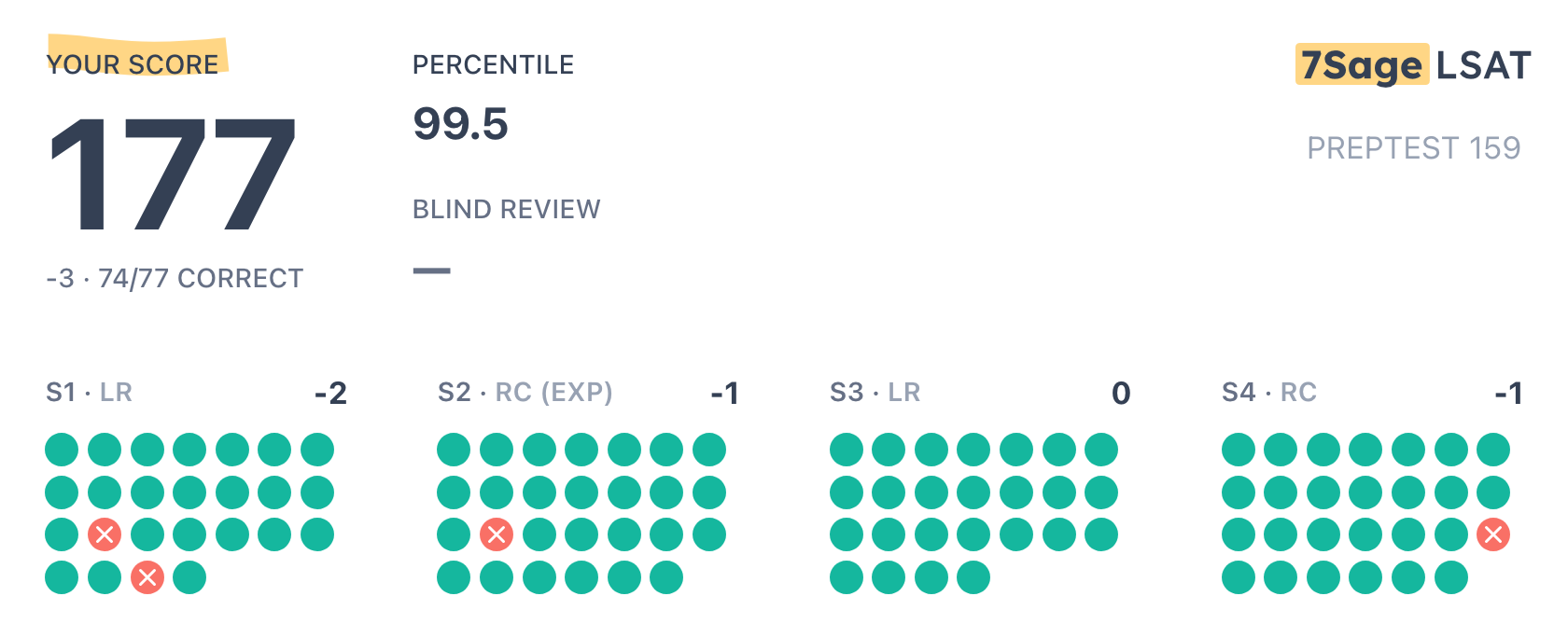
Since the last section was the experimental, it would have been the same result if you had added it, so this is a true 179 IMO
Copying my response from another post asking the same thing:
I think there are a couple things I would recommend based off my own experience with a gap between timed and BR performance.
First, in terms of the timing I think you might benefit from being more willing to make your best guess and skip when a question isn't clicking for you and come back later. Another thing for LR is try to be regimented with your approach to each question. For me this means I read the question stem, then the stimulus, then try to prephrase possible answers if I can, and then go to the ACs. This forces me to be steady and calm which ultimately turns into speed. It might also be helpful doing some untimed drills to try to build this habit.
You clearly know the test well at this point if you are BRing in the 170s, so try to isolate what you can do to improve timed execution based on how you approach questions in BR. Ask, "what about this approach in BR can I bring into a timed section? What could have lead me to the correct answer the first time around?" One strategy that has been helpful for me in that regard is doing untimed sections and recording myself thinking aloud and then listening back to the recording of me getting answers wrong -- this has been really helpful in precisely understanding some of my faulty patterns of reasoning.
I assume you've taken a ton of LSAT questions at this point in your studying, which builds habits. Some of those habits are obviously great, but others can be hurting your performance. I think the LSAT's time constraints force us to rely on muscle memory and habits we form in practice, so it is important to keep note of when your automatic processes don't align with how you successfully approach a question in BR. The goal is to make your BR brain and your muscle memory brain operate the same way.
Since you clearly have essentially mastered this exam's content and also are at peak performance with timed PTs, I think it would make sense to take a more holistic approach to maximizing test day execution. You are prob doing this already, but making sure you are getting good sleep in the days leading up to the exam is the #1 most important thing. In my experience, L-theanine has been a helpful supplement, especially in managing the compounding effects of my ADHD medication and test day jitters. It is proven to be helpful as an addition to caffeine as well. Starting to take creatine regularly could also help for dealing with the mental effects of potential restlessness the night before the exam. It goes without saying, but this is just from my personal experience and research; I am not a medical professional.
Breathing exercises before and during the exam can help you stay centered, calm, and focused during the exam. I like doing yogic alternate nostril breathing for a few minutes before the exam and during the intermission. I also do a couple rounds of box breathing between each section, and take a long deep breath halfway through each section. This might sound kind of silly, but intentional breathing can really work wonders to clear your head and there are studies backing that up.
I will leave my recommendations at that because you have a better grasp of the actual content of the test than I do. I do second Kevin's recommendation, though. Recording myself speaking-aloud sections and then reviewing my thought process on misses is super helpful, approaching from a more macro perspective of "what is the pattern of thought that lead me to that wrong answer"
Ezra
Independent TutorLast PT before the exam tomorrow 🙌🏼 To people who have taken it before: any tips for managing test day stress and the testing center?
@Dagny Taking it a bunch of times is a very minor issue from what I have heard. Your highest score is what affects a school's medians so they really only care about your best score
@austinmatias11375 yeah I find this to be a more intuitive way of thinking about it than the written explanation provides IMHO
I say take it so you have official test experience, because there's really no harm in doing so and it'll prob be a valuable learning experience no matter what
I think there are a couple things I would recommend based off my own experience with a gap between timed and BR performance. First, in terms of the timing I think you might benefit from being more willing to make your best guess and skip when a question isn't clicking for you and come back later. Another thing for LR is try to be regimented with your approach to each question. For me this means I read the question stem, then the stimulus, then try to prephrase possible answers if I can, and then go to the ACs. This forces me to be steady and calm which ultimately turns into speed. It might also be helpful doing some untimed drills to try to build this habit. For your second point with RC, my strategy is to read straight through first and then write low res summaries rather than write them as I go, I find this to be helpful in letting me read for both content detail and structure.
You clearly know the test extremely well at this point if you are BRing in the high 170s, so really try to isolate what you can do to improve timed execution. Ask, "what about this approach in BR can I bring into a timed section?" One strategy that has been helpful for me in that regard is doing untimed sections and recording myself thinking aloud and then listening back to the recording of me getting answers wrong -- this has been really helpful in precisely understanding some of my issues.
I assume you've taken a ton of LSAT questions at this point in your studying, which builds habits. Some of those habits are obviously great, but others can be hurting your performance. I think the LSAT's time constraints force us to rely on muscle memory and habits we form in practice, so it is important to keep note of when your automatic processes don't align with how you successfully approach a question in BR.
This actually kind of exists! I noticed yesterday that if you go to Practice -> Explanations, you can see which questions of a PT you have taken. hopefully that helps
I think it makes sense to just do it in the order provided because you're going to have to read all of it anyway, and passages tend to get more difficult as the section progresses. Something that might help is trying to be more comfortable with uncertainty. When feeling lost or confused, reading the sentence a bunch of times can be less clarifying than just accepting that it was confusing, coming up with some low res summary, and continuing through the passage. I would recommend watching a bunch of J.Y.'s read-throughs of difficult passages bc he does a great job of showing the benefits of not racking your brain over difficult language and knowing when it is ok to rely on broad-stroke understanding
Yeah I agree, but until they add this feature there is an app/website called Toggl for tracking how much time spent on tasks, which u might like
@Ezra Also I'd add to this one thing I do before taking a practice test to calm my nervous system and promote mental clarity: alternate nostril breathing. It is a yogic breath exercise in which you alternate inhales and exhales through each nostril. I do this for like a minute or two before each half of the test
There could be a lot of reasons why you are feeling drowsy or unfocused during the test, but I also have a lot of issues with energy and concentration so here are a few tips I think could be helpful (besides getting 7-8 hrs of sleep consistently):
Caffeine could be a big help, and you can try a beverage with less caffeine if you are sensitive to it. Green tea is really nice because it has a moderate amount of caffeine as well as a compound called L-theanine that reduces the jittery sensation of caffeine and makes it feel more stable. Also, the half-life of caffeine is around 6 hours, so if you take it early enough in the day it shouldn't effect your sleep too much -- ofc this differs person-to-person so do whatever feels best.
Try to get at least some regular exercise in each day. You might already be doing this, but like a 30 min walk per day can help regulate your circadian rhythm and help with focus. Exercise has a similar effect on your brain as taking stimulants does.
Eat something before testing that is rich in both carbs and protein
If you notice yourself losing focus during the exam, pause, take a deep breath, and feel your feet on the ground for a second. Taking a beat to reorient your focus and take note of your mind and body is super helpful.
The LSAT is a test of mental endurance just as much as it is a test of logical reasoning and reading comprehension. Taking direct steps to assist your stamina and mental clarity is crucial to success IMO
@spindlynoodles Ofc! I think writing out my process like this is a great way for me to study too, so it's a win win. Also, I just did
PT140.S2.Q15, which is a great example of a correct LR answer using much less appealing language than the incorrect ones. The language of one incorrect answer was so appealing that I actually saw the flaw in the AC and still chose it lol.
@spindlynoodles To be honest, I have a tougher time elucidating my strategy with LR than with RC. My approach to different question types vary widely, but here are a few things I carry with me into a section:
Like RC, I try to predict the answer when the question type is conducive to it.
I always sketch out the logic for parallel questions. I have a tough time doing these without mapping the stimulus out.
I am willing to sometimes map out the logic of answer choices, not just the stimulus. A lot of the time, the logic in an answer choice is more jumbled or confusingly stated than the logic in the stimulus. Mapping it out can help you identify sneaky contrapositives or incorrect answers (e.g., leading to an impossible conclusion). I would avoid this if I feel like I haven't banked some time on easier questions, because mapping out anything is a time sink.
If I feel unsure about a question in any way, I flag it and come back later. Be extremely liberal with flagging. If there is any inkling of distrust of your answer choice, try to formulate why the answer choice is wrong. However I do not change an answer based solely on vibes. This goes back to what I said in another comment about my RC approach and being accepting of ambiguous language. Many wrong ACs look more appealing on the surface than right ACs. I try to only change my AC if I can explicitly say why the answer is wrong. If I am unsure about an answer, but can't formulate what the issue is, I just leave it and move on.
And finally, by far the most important attribute to my improvement, and hopefully continued improvement, in both RC and LR, is extremely rigorous blind review. This means stating exactly why your answer was wrong, and why the correct answer was right -- preferably writing this by hand. I then try to think of a general rule or tip to avoid the same kind of mistake going forward. That step is not always possible, sometimes you literally just misread something and have a brain fart. But these steps are absolutely crucial. I see a lot of ppl on 7Sage talking about not seeing improvement after a lot of studying, and I look at the profile and see like tons of PTs but zero review. I really think that just reinforces bad habits. When I get a question wrong, it means I made an error, either in execution or understanding. Developing an understanding of that error and how to avoid it through Blind Review is by far the best way to not repeat it.
@NixonAnderson I don't have such a simple answer for this, bc I started studying initially a couple years ago and studied for around 4 or 5 months, but then decided not to take the test until after I graduated. I started studying consistently again at the end of June, and scored a 168 on a PT when I started this round of studying
@sagely In terms of reading, I had been writing a brief low-res summary of each paragraph after reading each one, and I switched to jotting those down at the end to keep the flow of my reading more natural and true to how I approach reading in my every day life. I also slowed myself down while reading a good amount. I realized that the extra time I spent reading is pretty much directly proportional to the time saved once I got to the questions.
In terms of approaching the questions, if I am able to, I formulate what I believe the answer is before looking at the ACs. This can be super helpful with RC questions because it makes me much more immune to carefully worded trap answers. I also read every AC before looking back at the passage, unless the question is about a very specific moment in the passage. Trusting my memory as the first line of defense really saves time compared to looking for textual evidence for each AC.
A big struggle for me has been RC inference questions. When I get to one that I am uncertain about, or am deciding between two ACs, a big help has been asking myself, "what would it look like if the author had inferred this?" I know that probably sounds pretty self-evident as a strategy, but forcing myself to formulate what I would have wanted to see in the passage for a given answer to be correct has been helpful in eliminating those more ambiguous or weirdly phrased traps.
The number one thing for RC that has been indispensable for me is not ever eliminating an answer choice purely based on the synonyms it uses for something in the passage. This might be more of an individual problem that doesn't apply to a lot of ppl, but I would eliminate correct answers because they used less directly equivalent wording compared to wrong answers. I would think "well those aren't totally the same thing..." and then choose a wrong answer that looked better on the surface. This would especially happen when I did not have much time or was rushing through a question. I have realized that this is basically never a reason to eliminate an AC. The LSAT will almost never have an answer be incorrect just because phrase X is a little bit different from phrase Y. Obviously there is a degree at which an AC will be wrong due to a false equivalence or part v. whole confusion, but I would get tripped up on synonymous phrases that I would judge to be not equivalent for no good reason. I can try to find a question I've gotten wrong that exhibits this if you'd like, because IDK if I am explaining it super well.
I didn't take the October test, but in terms of tips not to freak out: Try doing box breathing before each section -- 4 second inhale, hold for 4 seconds, 4 second exhale, hold for 4 seconds, and repeat for a few cycles. During a section, if you feel like you're losing your focus or rhythm, take a second to pause for a deep breath. Also, if you start feeling anxious or your heart is racing, think of it as your body entering performance mode. Try to get a good nights sleep tonight, and remember, you can always take it again. Good luck tomorrow!!!