


All posts
New post518 posts in the last 30 days

Hey all- I did PT.141.S2 yesterday and I was wanting to do an in-depth review for my wrong answers journal. However, my results still have not transferred to 7Sage. Anyway to fix this?
Do we keep the header on every page or just the first page? Also, I have everything in 12 point times new roman but is there any other formatting things I should do such as margins, etc?

Hi all! I am looking for help/detailed instructions for adding a recommender to my LSAC account. A past professor told me I can add them as a recommender on my account. I began the process once and seemed to have no issue, but then had to get some follow up information. Now, in my LSAC account, I simply cannot figure out how to just add a recommender without paying for the CAS registration. It feels a bit early to pay for that -- I'm not planning on applying until next fall and I don't want to deal with that right now I just want to add this professor. I am 99 percent sure there is a way to add a recommender without paying for CAS yet, but every time I try I get routed on the website to my LSAC shopping cart and am prompted to pay for CAS registration. Any tips?

Did anyone have an aha moment for these, I can't figure out how to differentiate main conclusion from the summary type ACs
Hey all!! I just recently started really locking in on the LSAT (for 2-3 weeks now). I am planning on taking it in August but hoping to maybe also take it in June (haven't decided yet). I feel so stressed because I feel like I was really understanding the content more, but I don't feel I have seen any improvement. Anyone else feel this way? I was curious if maybe my studying could be improved as I am also worried about burnout. I am trying to do a test/week by doing 3 sections spread out throughout the week, with a day after the section to review mistakes, learn from them, and then drill ( a method I learned from a 180 scorer youtuber). In addition to this, I am following my "balanced" 7Sage study plan and doing the lessons each day, along with 2-4 drill sets of 5. I study for about 4 hours daily, usually. I am really hoping to get to a 175+- anyone have any critiques or suggestions? Also, is my panic and anxiety based in reality or my OCD?????
Listen and subscribe:
Struggling with Reading Comprehension—even when you understand the passage? In this episode, @AlexJacobs breaks down one of the most frustrating RC problems: answer choices that all look the same.
If you’ve ever been stuck between two “jargony” answers or felt lost on inference questions, this is for you.
We cover:
1. Why understanding the passage is already most of the battle
2. How to attack confusing, abstract answer choices
3. The “disqualifier” method for eliminating wrong answers fast
4. What to do when you’re stuck between two nearly identical choices
5. How to approach inference questions with confidence
The big takeaway: your job isn’t to find the right answer—it’s to kill the wrong ones. If RC feels overwhelming, this episode will simplify your process and help you focus only on what actually matters.

Does anyone have Bailey's PDF she drops from her Spot the Gap lessons? It looks super dope but I have unfortunately missed it the last couple times and have been dying to get a hold of it for review. So if anyone has it and could email it to me or drop a link in chat, it would be greatly appreciated:)

Hi all,
Hope everyone is doing well :)
I'm just starting my LSAT journey with 7Sage and was wondering if anyone has a recommended study guide or work plan! {ie, Monday drill tests, Tuesday watch lectures, etc.}
Any advice, etc.
Thanks & best of luck to all
Happy studying !!

Hi,
I haven't seen any post about Houston study groups so, I decided to put this out there and see if there's anyone out there in Houston looking for a study partner(s) hopefully! I am planning on taking the September LSAT. We can do Zoom or meet in person whatever everyone prefers.


Looking for a serious study buddy! I don’t mind if you’re a beginner as long as you’re serious and committed to this test. It would be nice to work with someone who’s willing to keep each other accountable.

I'm moving on. I studied and improved my score. It was hard work. I got into my school. It's weird how I want to keep studying. I know I should take this opportunity to attend. I'm little conflicted because if I studied more and got higher score could apply for a reach school next year. But I think I should be happy as I worked hard. Good luck everyone.

I'm interested in hearing from people on how they go about doing their wrong answers journals. Do you find it helpful? Do you go back and read it? What's your process? I'm looking to start doing this after prep tests, but I want to know how to do it effectively. Thanks!

Looking for a study partner or partners in the East Bay (Or Bay Area in general)! Just finished the CC and looking to take LSAT in June or August and want to find some people to work with and share strategies and ideas.


Hopefully what I'm saying makes sense

 If I don't add any customizations when making a drill (just setting the question number, time, and show answers), are the questions selected still based on my analytics? Like, is 7Sage choosing some amount of NA questions, Weaken questions, etc., based on my data, or is it choosing random questions from the drill pool? I am asking because I want to drill with my worst question types, and I see the customize button that lets me do exactly that, but I am wondering if 7Sage does this automatically.

hi yall! im curious about things to keep in mind for the writing section
-how personal should we be? are anecdotes allowed, or should we try to stay professional?
-should we use pronouns like "I" or keep it academic?
-anything else you can think of
If I am writing an essay that will hopefully get me into a T-14, what is crucial to display in the essay?
Listen and subscribe:
A full-time teacher. Weekend studying. Mid-160s. A 171 goal. So… should you take the LSAT in June, or wait until August?
In this episode, we break down one of the most common (and misunderstood) decisions LSAT students face: timing your test. We explain why June vs August doesn’t actually affect your application timeline, when it does make sense to wait, and how an extra 2–3 months can impact both your score and your scholarships. If you’re balancing a busy schedule and wondering whether you’re “ready,” this episode is for you.
📌 Topics covered:
1. Does taking the LSAT earlier help admissions?
2. When to delay your test (and when not to)
3. Why more time = more points (usually)
4. How to structure studying with limited time
5. The smart way to plan multiple test attempts
Have a question? Drop it in the comments—we’re pulling questions from YouTube.
Subscribe to the podcast:
Big announcement: the podcast is expanding beyond just the LSAT.
In this episode, we introduce Ethan from the 7Sage admissions team and start zooming out to the bigger picture—law school, applications, and what comes after the test. Ethan shares his path from philosophy major to Yale Law, what actually matters in LSAT prep (hint: consistency > grinding), and why starting too early can backfire.
We also get into:
1. Why reading matters way more than you think (and how to actually build that habit)
2. The biggest mistakes students make with LSAT timelines
3. What law schools are really looking for in your application
4. How to approach your personal statement without forcing a “hook”
5. Why your story is harder to see from the inside—and how to fix that
If you’re deep in LSAT prep or starting to think about applications, this episode is your reminder that the test is just one part of a much bigger journey.
And yes—we’re keeping the LSAT front and center. Don’t worry.

Hey everyone! I have small ears and was wondering if anyone had a really good recommendation for foam earplugs. The last time I took the exam in the testing center, they gave me these over-ear headphones, but they weren`t enough, particularly when the proctor came to help a student next to me. The closer to noise-cancelling, the better. Thanks!

I’ve been working through The Loophole by Ellen Cassidy, and it’s been extremely helpful so far. I’m hoping to find similar resources, but specifically geared toward Reading Comprehension—would love any recommendations.

Hello! I'm taking the April LSAT & it'll be my second time. When I took it back in January, I opted for In-person testing, but didn't get the score I wanted, and kind of attributed some of it to being in an unfamiliar location (obviously, needed more studying, but beyond that...)
Just wanted to see what everyone's experiences have been like taking it Remotely? I've heard some horror stories so wanted to get a wide variety of stories before I make my decision this week~

Hey all,
Very specific question here. Basically, I’m going to be part of a local research team for a study being done by a large national non profit. I’m just wondering how I would put that in my resume.
To give more detail, I wouldn’t be listed among the primary authors, but my name would be in the appendix listed under my team. I suppose I’m curious how one cites that in a resume, or if I even should.
Thanks!

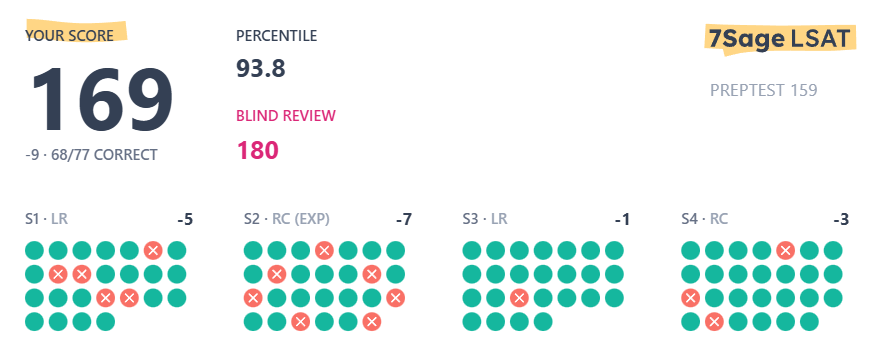
I just scored a 169 on PT159.

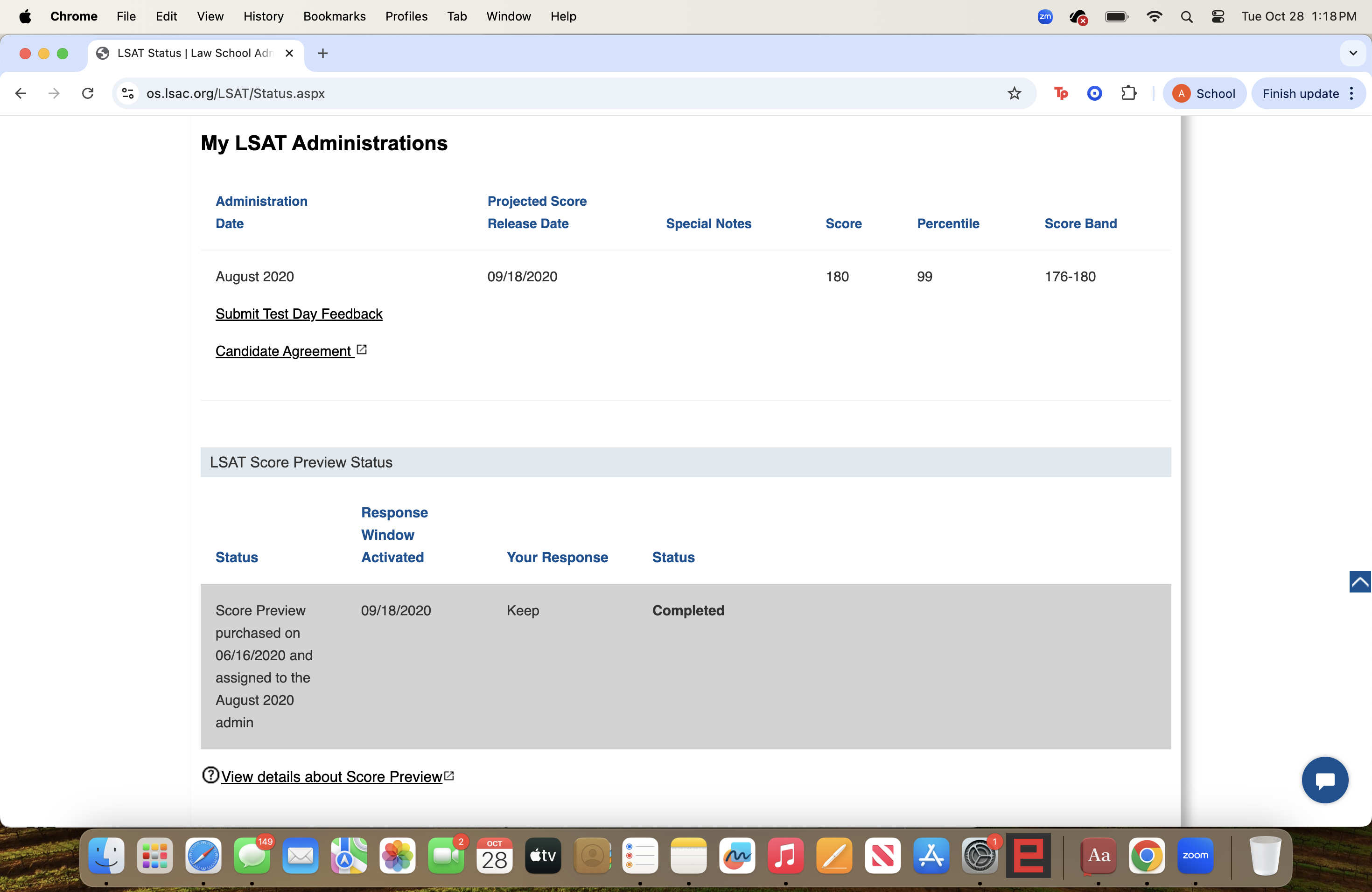
180LSATTeacher
Independent TutorHow I went from the 150s to a 180 using Wrong Answer Journaling (5 years tutoring, $50-75/hr)
SCORE INCLUDED AT END
Hi everyone, if you find this post insightful, please upvote!
I’ve been tutoring the LSAT for about five years and have a few openings, so I’ll be taking on a few new students for the March-August test window. I am very passionate about teaching and learning the LSAT, I’ve worked with 100+ students across a wide range of starting scores, but I especially enjoy helping people who feel stuck in the 150s-160s finally break through with a structured and sustainable study approach.
I scored a 180 while balancing LSAT prep with a heavy course load and a 20+ hour work schedule, so I understand how difficult it is to study for this exam while managing real life. Because of that, I focus heavily on efficient studying, clear weekly structure, and consistent feedback outside of sessions rather than assigning busywork.
THE WAJ-
Before getting into tutoring, I want to share the single biggest study change that helped me improve and that I now teach every student I work with: structured wrong answer journaling.
Most people keep a wrong answer journal that’s basically just a list of questions they missed. That kind of journal feels productive, but it rarely leads to real score increases. What actually moves your score is reconstructing your thought process and understanding why a trap answer made sense to you in the moment.
This was the tool that took me from the 150s into the 170s and eventually to a 180, and I used the same process again while studying for and passing the bar exam last year.
What a wrong answer journal should actually do:
A good journal should answer three questions every time you miss a problem:
1. What did I think the argument/question was asking?
2. Why did the wrong answer look right to me?
3. What specific thinking habit caused that mistake?
If you’re not answering these three questions, then you’re logging mistakes instead of learning from them.
The Wrong Answer Journaling Structure I teach and used myself:
1. Handwrite it Writing by hand slows you down enough that you’re forced to actually process the reasoning rather than just copying explanations. It feels tedious at first, but that friction is what creates retention.
2. Rewrite the argument or passage in your own words Before even looking at the correct answer explanation, summarize the stimulus in plain language. If you can’t restate it simply, you didn’t fully understand it the first time and that’s often the real issue.
3. Watch the 7SAGE explanation videos or read a written explanation Watching the explanation videos or reading a written explanation is crucial so that you are able to see a different approach to a given question and learn something that you can try going forward.
4. Write why your answer looked attractive Most students only write why the correct answer is right. That misses the real lesson. You need to capture what the trap exploited, be it strong language, partial relevance, reversed logic, etc.
5. Diagnose the mistake type Every wrong answer usually falls into one of a few areas:
misreading a quantifier or conditional
assuming outside information
trusting an answer that “sounds reasonable”
rushing and not evaluating all choices
Over time, patterns emerge. That pattern recognition is where score gains come from.
6. Include near misses and guesses If you guessed correctly or were stuck between two answers, that is just as important to journal as a wrong answer. Those questions show where your understanding is unstable.
7. End with a forward looking rule Every entry should end with a sentence that you can apply on future questions, like:
“On Necessary Assumption questions, I will negate each contender before choosing.”
“If an answer introduces a new comparison, I will treat it as suspicious by default.”
This turns the journal from a diary into a training manual for your future self.
The step most students skip
Once a week, go back and reread your previous entries and look for repeated mistakes. If you keep missing questions because of quantifiers, conditional logic, or scope shifts, that’s not a one time error, but instead that’s a reasoning habit that needs to be fixed directly through targeted drilling. Many students never do this step, and while the purpose of the journal is not to reread it constantly or refer to it often, this step is very useful for most.
Why this works
Doing more questions doesn’t automatically make you better at the LSAT, instead what improves your score is changing how you think about arguments and answer choices. A wrong answer journal forces you to slow down and confront your reasoning patterns instead of repeating them.
When I was studying, I filled hundreds of handwritten pages with this process, it sounds excessive, but done gradually it becomes a daily habit that builds self awareness. Over time, your decisions on the test start to feel more automatic because you’ve already trained yourself to recognize the traps. That’s what helped me break out of a long plateau in the 160s and start scoring consistently in the 170s.
If people would find it useful, I’m happy to make a separate post on how I structure wrong answer journaling specifically for Reading Comprehension, since the approach there is a bit different than LR.
Tutoring with me:
In sessions, I teach students how to turn their wrong answer journal into an actual learning system rather than just a notebook. We review practice tests together, break down difficult questions step by step, and I check in between sessions so improvement continues throughout the week. The goal is to make review productive instead of repetitive.
I’m very hands on and stay responsive over email between sessions. I remember how frustrating it was to be stuck on a question with no one to ask, so I try to be available when students are actively studying rather than only during scheduled calls.
Spring 2025 rates (discounted)
Free 20 minute strategy call
• $75/hr single session
• 5 hours - $350 ($70/hr)
• 10 hours - $600 ($60/hr)
• 15 hours $825 ($55/hr)
• 20 hours - $1000 ($50/hr)
I keep my rates in the $50-75/hr range because I want tutoring to stay accessible for students who are serious about improving but can’t justify paying $150+ per hour.
If you’re aiming for more consistency, struggling with LR assumption/flaw questions, or feel like you’re doing a lot of practice without seeing meaningful score movement, feel free to reach out. I’m always happy to look at your PT history, talk through your current approach, or answer questions about study strategy even if you’re not sure about tutoring yet.
Email: 180lsatteacher@gmail.com

Diagnosed at a 149 in December and now is the time to prove that I can break 160. Hasn't happened yet but I am going to go all out these next 2 weeks and do my best. How are we all feeling? Nervous? Confident? What do y'all think?