


All posts
New post518 posts in the last 30 days

Hello everyone,
My goal from the start of my LSAT journey has been to get a 173-175, I took my preliminary towards the end of October and got a 155. Since then I have been studying for about 1-2 hours a day during November and about half of December before taking a bit of a break until mid January. My current score is a 164 but I have gotten -2 on both LR and RC and -0 with blind review. I have taken 5 full length PTs including the prelim. My goal is to ramp up my studying and take the exam in either June or April. My greatest weakness thus far has been being consistent on my RC sections and my score seems to swing wildly from -2 to -7 (though usually falling between -3 and -5). I don't have any issues with timing and usually finish sections with 2-3 minutes to spare. I want to be more accurate with RC and more precise with LR. What would anyone recommend I focus on, what should my study time look like and how much time should I spend per week? Thanks all and good luck!

I want to take the test at home to mimic the conditions that I have been studying with. To do so would mean I take it on my laptop that's hooked up to a monitor (bigger screen has been easier for me). Because I keep my laptop closed so that I only have the one screen, that would mean I'd use my external camera on top of the monitor that is hooked up through USB to the laptop instead of the laptop's built-in camera. I have heard stories that the proctors for tests at home and the rules they follow are quite strict. As I am taking the LSAT for the first time in February, can any of you who have taken the test before or would otherwise be insightful let me know if this might pose an issue for me come test day? Thanks.

Hello guys, I have a rough draft of my personal statement and need feedback. Should I stick to one "story" or should I explain the many things that make me who I am today?
The idea of becoming an attorney has always been a reoccurring drive for me, stimming from me being told that “you’re a good arguer, you should be a lawyer”, possibly being an insult to me being stubborn, or me having a trait of pulling through hard times and exceling. Another drive is seeing firsthand how the legal system works in moments when people are vulnerable and need guidance. My first experience with an attorney was during family's divorce, I saw how legal representation can bring structure and resolutions to emotional situations. Even as a young teenager, I got the understanding that attorneys do more than just argue but create a pathway through uncertainty. That kind of experience gave me motivation to drive myself towards legal education, and a profession that needs both discipline and resilience.
At sixteen my life took a dramatic turn when I was hit by a truck while walking, temporarily putting me in a wheelchair and struggling with my speech and memory. At first, I thought I couldn't pursue the life I dreamed of (at the time being a psychologist or lawyer), but instead of focusing on the negative, I pushed myself with persistence and patience. I studied more than the average person to get the grades I wanted. Instead of going to the sleepover, or going to games, I stayed home, retraining myself how to form words again. My memory slowly got better, I lost around a year and a half of memory including what my teachers in school taught me. I had to work extra hard to be where I needed to be, pushing myself to the best of my abilities. I returned to high school committed to facing every challenge thrown at me, from learning how to speak clearly and walk again, to keeping up with my classes and returning to my extracurricular activities like soccer. This wasn’t something I was open to talking about with my piers at the time, maybe coming from a thought of embarrassment, but I soon came to realize this experience single handedly taught me the significance of persistence, patience, self-discipline, and critical thinking, which are traits I definitely carried through college and that I know will help me prosper in law school.
I went into college knowing I wanted a career that focuses on helping people, which brought me to psychology, which I loved learning about, but soon realized what I wanted more was to help people using the law to help guide and support them, similar to my personal experience. To build off my interest, I added a minor in legal studies, advancing my desire to help people with using practice legal skills. Being the first in my family to attend and graduate college, and being a child of nine, I had to manage most of my challenges independently. From figuring out applications and LSAC procedures, to managing finances. Since freshman year of college, I have supported myself, working up to three jobs while keeping up with classes, balancing responsibilities, and learning the importance of persistence, endurance and time management, which were hard earned and deeply ingrained skills I know I will bring in my studies and future career.
These experiences, overcoming personal setbacks, challenges, and balancing responsibilities, helped shape me in who I am today. They have taught me important attributes I have and need to be successful in my goal of becoming an attorney. I am hoping, as a first-generation college graduate, to not only achieve a goal, but pave my next path with the attributes given to me to make a difference in the lives of others as a resilient, persistent, critical thinking attorney.
(I am going to shorten it up, this is a DRAFT)

Hi just started studying for the LSAT and I'm finding the blind review function that 7sage offers really helpful. I'm just wondering in terms of best practices should I utilize the peek function that 7sage offers that will let me know how many questions I missed before doing the blind review, or in order to really make sure I'm working through the entire section properly should I try not to look at the peek function?

I am not a particularly eloquent writer so I know the writing portion of the LSAT may give me some trouble. I decided to complete a practice writing prompt to help give me some real practice and would like thoughts and opinions on how I did. The prompt was "What role should parents play in deciding what gets taught in public schools?"
The education system has always been an institution in our society that is rife with controversy. Finding a balance in a rigorous system is a delicate endeavor. One of the current balancing acts at the forefront of this system is what role parents should have in choosing what their children are taught inside the public school system. As a parent myself, I recognize the need to protect our children from values and beliefs we may not agree with, however, I also recognize the limitation that should be implemented. A parent's role is not to decide the content of the education system but to leave that to the experts in the field, while also monitoring and offering input in appropriate ways.
I would not want someone who is not knowledgeable in the field of education to be making choices that affect our children's education. When a doctor performs surgery, we do not walk into their operating room and demand they do things our way, instead we rely on their education and expertise in their field. I feel like this is transcribable to the role a parent plays in the education of their children. Teacher undergo years of training and learning to be able to teach our children. They also gain real world experience in dealing with children while inside the classroom. What qualifications do most parents have to be able to dictate what curriculum should be taught? Depending on generation and socioeconomic level, ones level of knowledge can vary greatly. This is why people who specialize in education are the decisionmakers for the overall curriculum of students.
Some parents state that schools may try to indoctrinate our children, but is it indoctrination just because you do not agree with it? I understand a parents need to protect their children from content they may deem inappropriate, whether due to age or just generality, but we are responsible to teach our children how to navigate these types of situations at home so that it can be applied in the real world. Also, what one parent deems inappropriate, another may not. Curriculum is a thought out process. And if a teacher was to overstep in an inappropriate way, there are ways a parent can intervein, such as filing a complaint with the school board. This assures there are checks and balances. Parents are also able to voice their opinions and concerns in school board meetings and even get some content on the ballet to be voted on for addition, or removal, to the curriculum.
If a parent is concerned the education their child is getting inside of a public school is inappropriate, they also have other options available to them, such as changing schools or home schooling their child. Some people have expressed concerns that a drop in enrollment of the public school system could cause irreversible damage to the system and will use this opinion to try and strongarm the system into letting parents have more input. But if a parent wants more input and control they can home school their children. Home schooling children gives the parent more control over the environment their child learns in and the way the content of the education is dispersed to their child.
Being a parent is hard, and sometimes letting go of control is even harder. We all want what is best for our children and for society in general. When it comes to the education system, parents have to learn to let go of the control, and allow those with the knowledge and expertise to construct our education curriculum. Parents have avenues to offer their input through appropriate channels. And if a parent still feels their child is not getting an appropriate education they have options available to them, such as home schooling.
hello guys! I have been really trying to figure out what is best for me and need advice.
I took a gap year to save money, hoping to get into school. I took my lsat in November and got a lower score (not too low to were I can advance), I am taking the February lsat and hoping that this score is what I need to apply to a couple schools. These schools are not prestigious and are is my budget. The deadline for applications is March and June. Im not so worried with scholarships but more worried about acceptance. I really don't want to wait till next cycle.

NOTE: Decisions are rolling in! Make sure you're logging them so you're eligible for the drawing in June.
----
UPDATE: We've pushed the deadline back to January 30th, 2026.
----
We just launched application tracking on 7Sage, and we're giving away $10,000 to get it off the ground.
The prizes:
1 grand prize: $5,000
5 runner-up prizes: $1,000 each
How to enter:
Go to My Schools and add the schools you've applied to by January 30, 2026 at 11 p.m. ET
Update your applications with decisions (interviews, acceptances, waitlistings, etc.) as you receive them
Have all your final decisions recorded by May 31, 2026
See this short video for a demo.
That's it. We'll draw winners by lottery in early June.
Why would I want to do this?
The application process is a black box. We want to shine a light inside it. This new free feature will let you see which applicants get interviewed, accepted, rejected, or waitlisted—and what happens after they’re waitlisted. It’s also a convenient way to keep track of your apps and connect with people applying to the same schools!
Note that we’re rapidly improving this feature, but we wanted to put it in front of you as early as possible.
Questions? Drop them below.

Hey guys! I’m taking the LSAT on February 6th, which is about three weeks away. I’ve been using 7Sage since September and have been drilling every day. I took one diagnostic early on, and today I’m taking my first full practice test now that I have more knowledge than I did during the diagnostic.
Does anyone have tips for how to best use these next couple of weeks leading up to the test? My plan is to take this practice test, review all of my mistakes tomorrow, and then drill throughout the rest of the week on the question types I struggled with. If anyone has additional advice or strategies, I’d really appreciate it!

Hey all, I got a -4 on PR 128 for the first time. I am still struggling with level 3-5 Conditional reasoning, Causal reasoning, and Link assumption questions. I was wondering if I should continue drilling and reviewing, or if someone could point me in the right direction.
Thank you

Hey! I started to study for the LSAT in mid-December. I took my diagnostic test and made a 137. I’m still going through the cc and at times I do struggle and feel defeated. What do y’all recommend me to do to bring up my score by my test in June? Thank you! 😊

Since starting my practice drill I have seen soooooo many sentences in LR that feature the use of a Group 3 and Group 4 indicator in one sentence and truly cannot (see what I did there) figure out how to translate them into lawgic. Does anyone have any tips or loopholes on this?
Here's an Example:
"Major meteor impacts and mass extinctions cannot be consistently causally linked unless many mass extinctions have followed major meteor impacts."

Hello,
Im trying to get my fundamentals down, and want to get good at lawgic. Any tips?

is there a way to find a question (PT # and all) by using a word from the stimulus as the search word?
For example, if i recall there was a tricky question about monkeys that i had attempted a while ago, but i don't remember the PT # and stuff, can I search for the question from the search function?

I was curious when we should be able to see the analytics of each question on PT 159? Would like to know the difficulty.
Listen and subscribe:
This week’s episode continues our conversation with 7Sage instructors ZeSean Ali and Nicole Agranonik as they dive into the academic and extracurricular side of 1L life. They break down what law school classes are actually like, how cold calls and exams work, and the role student organizations play in shaping the law school experience. Tune in to learn how students balance coursework with involvement outside the classroom—and what’s worth prioritizing during your first year.

Cant look it up during LSAT right? I just had to look up "dearth"

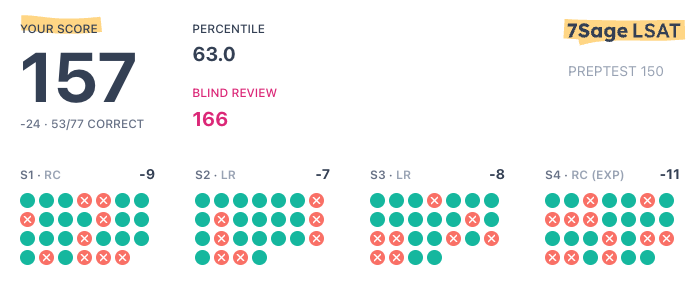
I just scored a 157 on PT150. I'm feeling very discouraged because I was previously PTing in the low 160s and trying to break out of that plateau. My test is in February and I do not want to reschedule or cancel because I have already applied this cycle and am taking the February test to improve scholarship and admission prospects. Does anyone have any advice or tips for between now and February (less than 3 weeks)? Should I take any more PTs or will it just stress me out and discourage me further?

Hi, I changed my subscription from Live, to Core .
I noticed a few questions which, I could have promised, had explanation videos now no longer have the videos . Is anyone else experiencing this?
Could it be due to the subscription change?

which are the best tests to practice with weekly in the months leading up to the test! I have done all of the 150s and the high 140s and havent scored exactly where I want to yet.

how does smart drilling work? Is it based on previous weak points? Is it differentiated from random question pool drilling?

Can someone please explain where/how to blind review? I see that blind review is a section of the analytics on 7sage but don't see where it can actually be completed. Thanks!

Hi everyone! I’m looking to join or start a study group near the Broward County FL area. I’m motivated, consistent, and open to virtual or in-person sessions. If anyone is interested, please comment or message me. Thanks!


I have been using 7Sage for a while now, and I just want to say that I absolutely love it! I think it’s an awesome platform that clearly passionate people have put a lot of work into. As I am nearing the end of my studies, I have one suggestion...
When creating a drill or when looking at my analytics, I wish I was able to filter out by question stem and stimulus logic. For example, let’s say I want to review or drill all weakening questions that involve causal reasoning. I have to filter both causal and weakening and then, one by one, manually select the questions that contain both tags. I think it would be great if there was a way for 7Sage to automatically group filters like this as opposed to showing me questions that only contain either the LR stimulus logic or question stem.
Thanks!

Any way to do this? There arent enough PTs for me to do one every week. I will run out. But I also dont want to leave the gap in my study plan because not seeing the 100% will keep me up at night.

Hi! I'm planning to take the LSAT in April and would love to find people in the Denver area to study with. I will be focusing on strategy and timing. I work M-F (9-5) and am broadly available outside of those hours.


