


LSAT
New post305 posts in the last 30 days

Hi Guys, I work full time and study and I find it hard sometimes to be able to dedicate a lot of time each day, only because I cannot get myself past brain fog and inability to focus. Does anyone have any tips and tricks that have worked for them?

Was PT155 comparatively more challenging than other PTs, or is it just me? I specifically really struggled with the first section (LR Exp) and third section (RC).

January scores released today and I bumped my score up 22 points from my diagnostic in early October 2025!!! The reading comp on January was tough which I think drug me down but overall am happy with the results! Thanks to 7sage for the studying help...couldn't have done it without you!
For reference I studied about two to three hours a day after my 9-5 M-T (I'm a legal assistant at my county's prosecuting attorney's office). On Fridays and Saturday it was more like 4 hours. Took a PT every Saturday starting at four weeks before the test.

A bit of a vulnerable discussion post. I was wondering if there's anyone else that on multiple real LSATs has scored lower than their PT average by a significant amount, and how they were able to overcome this? I consistently score 17mid-high, and cannot break out of the 160s on the real tests. What might the issues be? I'm always struggling to finish but only on the real test. SOS :(

I never performed well on my practice tests to be honest. My best score that I got was a 162 and I was averaging around the 150’s. I just got a 171 on my lsat I took which is up 8 points from my first one in November. I did that increase in around one month as, if I’m being honest, didn’t study much before I got my November score back on the 28th. Prior to that test I only had about 3.5 weeks to study.
Ask me any questions you like! If you are nervous about your practice test scores, there’s definitely still hope for you to get a better score than you think!

I’m not sure what happened my first exam. Nerves maybe? I have drilled over 2000 questions in 3 months and was consistently able to get even the most difficult questions correct within a minute.
Do I cancel my one and only score? I am registered for February already.

Is there a way to reset the core curriculum and redo it all over again? I am trying to do a second pass of it to really solidify my knowledge.

Hi,
Quick question for the 7Sage team: I heard there will be free live classes on 01/29. Will we be able to watch them back for free too?

Hi! I just got my January LSAT score back, which is one point above my average PT score (yay!) I am currently registered for February but, to be honest, I’m not sure how much I can improve on the actual thing in another week and a half. I was wondering if anyone had guidelines on whether or not it is beneficial to re-take the exam? Thanks!

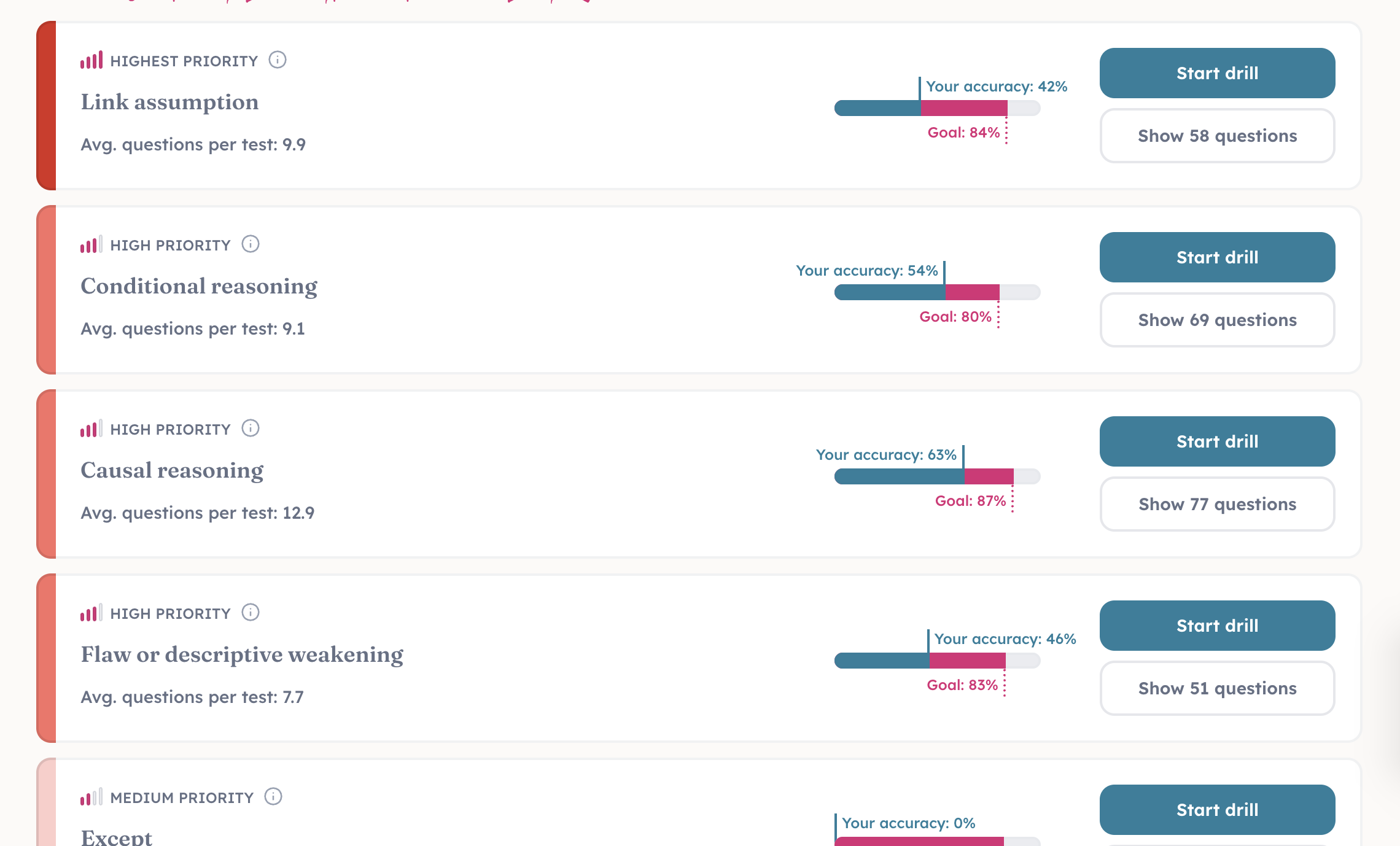
Im having trouble with causal reasoning it's my highest priority and I have a test in a couple weeks. Does anyone know specifically what vids i should re watch? or does anyone have any quick tips? thank you!

I got a 173 on the Jan test and I'm super excited. But also, I am a junior and have a lot of time to retake. I want to be competitive for the T3 schools. I have PT'd at 174 and could probably get higher if I study more. Is there a real difference between 173 and 174 for the best schools?

Hey everyone! January LSAT Scores just came out today, wanted to create a thread for people to speak about their experience. Feel like reflection now can help a lot of people in the future.

i got a 143 even though i was scoring high 150s on pt... feeling super defeated and im registered to take the feb one. should i just reschedule it. does anyone has tips on timing, i finished no sections on this test, partly due to stress and rereading over and over.
i had a tutor for the last couple weeks and have been self study for a month before, got a 134 on diagnostic and brought myself to high 150s before this exam.

Am I the only person who sometimes, no matter how many times I read a passage or how hard I try cant understand what the passage is saying and end up having to just guess and search up key words in the passage which sometimes, I actually dont do as bad as you would think by guessing. Does anyone have any tips or tricks, or maybe Im just dumb and am the only person that cant understand some passages.

I have been studying for a few months now and have taken a few PTs. I feel like I need to be preparing for these prep tests in the same way I would for the actual thing (i.e. good rest the night before, environment I take it in, time of day, etc...). I was curious if anyone has any tips or advice how to simulate taking a preptest to make it as similar to the real thing as possible. My goal is to make the actual test day feel like I have done it before and go in there and handle business.

I feel so discouraged. I had to take a break from 7sage due to financial matters for about a month and I've been using books and practice tests in the meantime and I feel like I am doing so much worse. With 7sage it took a while but I managed to get a 163 twice, once untimed and another timed and now I'm getting like 12 questions wrong in a row. I am so angry

I just got an email saying my score is on hold (email came Monday; score release is supposed to be Wednesday). I am hoping that it's because my score went up (from my prior 174), but does anyone have any insight into causes of a score hold based on past experiences? I did the argumentative writing on a prior administration, so that's not the holdup.
Listen and subscribe:
Before they were teaching the LSAT, Levi and Emily were figuring it out side by side as study partners. In this episode, the two look back on what it meant to prep together and how that shared experience shaped the way they now approach tutoring and teaching.
They talk about finding community during LSAT prep, why untimed practice matters more than most students think, and how to analyze questions with real intention instead of rushing to the answer. Along the way, they unpack their study philosophy, the balance between mechanical drills and organic understanding, and what changed for them when they transitioned from students to instructors.
Whether you’re studying solo or with a partner, this conversation is a reminder that the LSAT doesn’t have to be isolating and that the right process and the right people can make all the difference.

Hi! I don't know if this is a dumb question lol, but I saw a method on TikTok that said each week to do one section of a PT a day and then review after each section that same day. I just did one section in the PrepTest section of 7Sage, but it won't let me see the score and answers for that section until I finish the entire PT. Does anyone know if there's any way to do this on here? It lets me on LawHub, but then I have to manually input all of the answers into 7Sage, which I guess I'll do if there's no other option. Thanks!

I started out with -17 wrong in August on drills. I am now at -5 on LR. I test in June and am still studying. Thank you, 7Sage, for the entire platform. I should have started my LSAT prep journey here back in October 2024.


Hoping to get some advice. I am planning on taking the LSAT in June, shooting for a 160 score. I've been studying for about 3 weeks, and I've taken a diagnostic test, where I was at 141.
My question is how often should I be taking practice tests? I have heard a lot of conflicting answers from one a week, twice a week, or once every three weeks. THANK YOU!!!!!

Hello, having issues accessing lawhub because of a “sign in loop” where once I sign in It takes me back to the Home Screen as if I didn’t sign in at all, has anyone dealt with this in the past? I saw some people have on Reddit but no one seemed to have an answer/resolution. Any Info would be greatly appreciated, thanks!

Hi,
I'm restudying for the LSAT and want to make sure I am retaining all the foundational concepts and theory from the core curriculum. I am taking handwritten notes as I go through the modules, but does anyone have any tips for retaining/reviewing this info? I want to keep up with my 7-sage curated study plan, but I also want to make sure I am revisiting and truly digesting the concepts.
Thank you, and happy studying everyone!!

Seeking advice: I took the LSAT in November 2025 and only got a 153. My target score is 165 and I take it again in June. After the holidays I got back into study and decided that if I wanted to improve that score I needed a disciplined, regimented plan returning to the basics and building a base again. Which led me to 7Sage and I'm using one of the study plans right now. Until mid to late march I am in the foundations phase and it doesn't (as far as I've been able to tell) direct me to take bi-weekly PTs or drills beyond the modules.
Should I be doing more than just the study plan or am I just allowing my nerves to get ahead of me?