


- Joined
- Dec 2025
- Subscription
- Live
Admissions profile
Applications


Discussions

This answer would be wrong in another universe: it swaps "would be harmful" for "would benefit people" which are not the same thing.
@EthanMadore Thanks Ethan! It seems like the essay workshop could be a valuable intermediary step. On a side note it is a bit surreal to see you responding to this because I am at this moment watching your podcast and you are wearing a pilgrim hat (witch lawyer) and that is how I am picturing you writing this.
I plan on doing the mock application review. Would this be redundant? (do they do essay recommendations in the app review)
E is clearly a trap. How do I not fall into it next time? Also, I tossed D because the argument was about why the testimony should be excluded, not necessary conditions for testimony to be included. This often makes and AC wrong. Is it the "only if" part? Like the only if should have tipped me off that it was actually talking about excluding the testimony?
This question is like algebra, which i suck at. maybe if i had 5 minutes to draw out a diagram i could figure it out, but obviously i dont. Does anyone have recommendations on how to do these math questions intuitively?
How is this a 4? You have to evaluate 10 different arguments - check each statement twice to see who agrees and disagrees with each one, and of those points not all are explicitly stated so you have to make inferences. Took me like 4 minutes to go through each one in BR to get it right. How could anyone do this in a minute or two? Vibes?
But the conclusion is that the instructions should be written in such a way, not that they will guarantee that it will be easier if read. Whether or not they consult the instructions has no bearing on how they are written. If they were to read them, they must make the assembly easier.
I call BS on this explanation Eleanor Roberts. How did you make the jump from more kinds of plants to using them in different ways? This makes me think you wrote the explanation after already seeing the answer. The only strongly supported conclusion is that "whether the plants were cultivated or wild, the people who lived at the site ate a wider variety of plants than other people at the time" not that they used them in different ways. But after reading the explanation under the answer choice I see that you are interpreting "use" as like eat, consume, grow, etc. And the word "use" can be applied to either scenario; if they grew them, they used them in a new way, if they ate a wider variety they were "using" them differently, ie. they were consuming them in a different way. No one would ever say you are "using" a plant by eating it, but the LSAT can use words however they want, even changing the meaning, and if you dont know then your screwed!
Assuming that the painter followed etiquette is a totally fine assumption, but assuming that the painter in the self portrait was actually a model and it was in fact not a self portrait totally not realistic. hmmm...It seems like a lot of these level 5 questions are level 5's because it is anyones guess what the hell the test writers decide was the "right" answer. I guess this is kind of like the law. The judge could be completely full of shit and wrong, but what he says is ultimately correct. There is no capital T truth, that is what the LSAT has taught me.
"the few seven-day cycles that occur naturally" WTF does that even mean? WTF are they even talking about?
It could be argued that the "intrinsic value" of parking and that he "misrepresents" the criticism are just as relative as not enforcing parking is "implausible". My takeaway for this is that when forced to decided between relative interpretations of logical language versus meanings of words I will favor that they will never misuse a logical word like talking about what someone did in the argument, whereas saying that something is implausible is a judgment call.
My humbly offered two cents: you are not at a ceiling, but rather a plateau. To breakthrough will require a foundational change in your underlying understanding and ability to process the questions quickly, which will only come with lots of time and practice and deep review. In addition, figuring out how to do all of those things in a way that works best for you is a process in and of itself. For example, WAJ doesn't help me at all, so I don't use it. (Many people will present a flaw in reasoning by assuming that what worked for them is the best way for everyone, but that is a tangent for another day). You will almost certainly continue to improve with more study (if done effectively), but the trade off is waiting a year. On the other hand you may have some sort of epiphanic breakthrough in the next weeks and pull off a crazy score in November.
I think the build up and the unknowns were the biggest factor and now that that is behind us we will be able to forge ahead! You got this!
Same, had a full blown anxiety/panic attack and completely bombed the first half.
You are correct, the answer is wrong. The first thing is laptops and the second the higher pay, which is the flawed correlation. If it said one thing causing another thing it would be correct.
This answer is wrong. It says the evidence is consistent with the first causing the second. The first is the laptops and the second the high pay, which is what they are falsely concluding, The order is backwards.
Can we increase the amount of anxiety caused by the 5 minute warning to match lawhub?
 Also interesting is the real time capture of me getting this question wrong Lol.
@Kevin_Lin Thanks Kevin! Although, asking type A future lawyers to leave tasks incomplete is a big ask...
I changed my study plan to one hour a day, yet it always builds 2 hours worth of work. I have tried everything, deleting the plan, changing the hours, starting over, delete the block, create a new block, nothing works. It always gives me two hours of work. What am I doing wrong?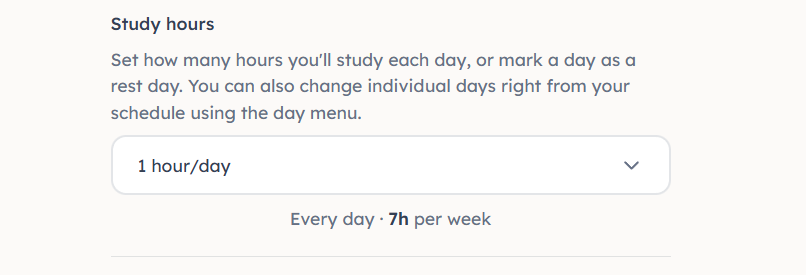
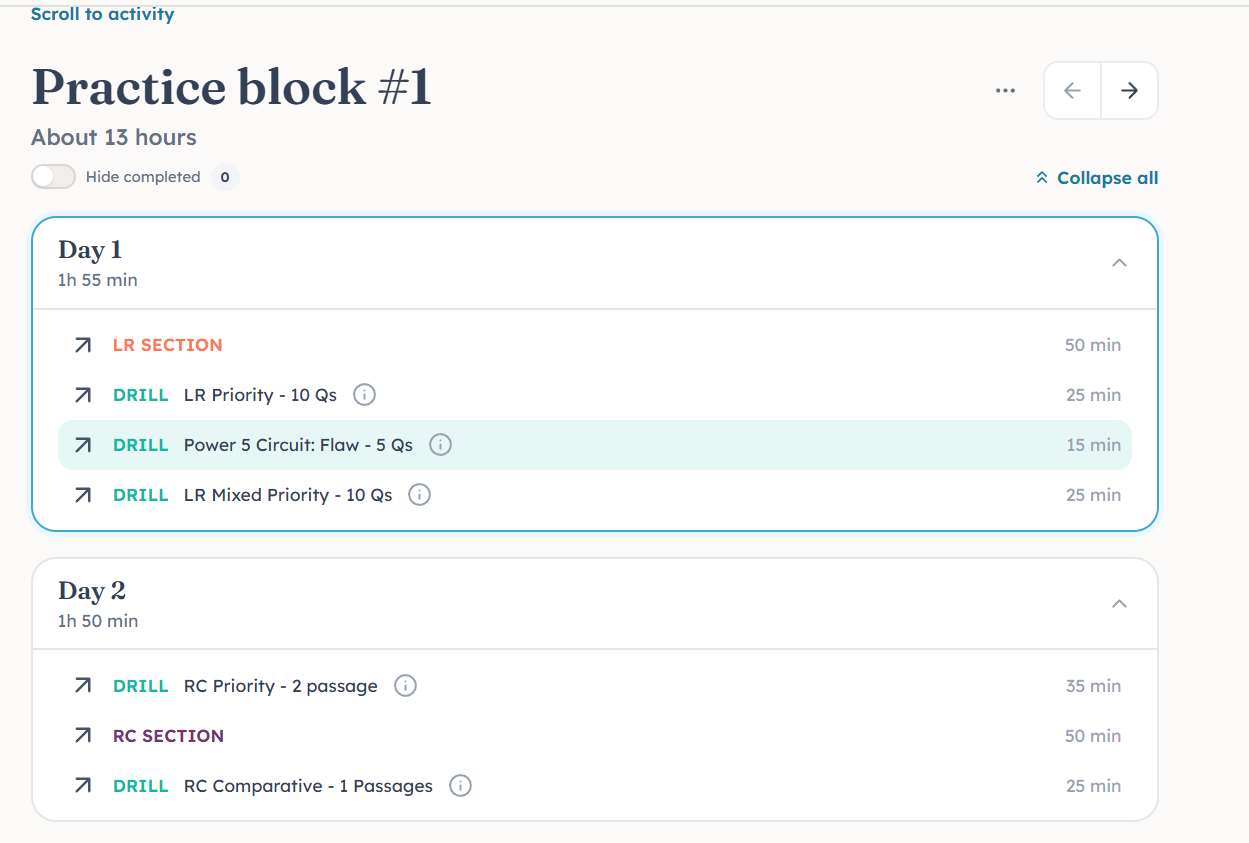
For me the interface at the testing center was essentially identical to when I change the font size to large on 7sage. To me, the font on 7sage is tiny and I have to change it to large. I was pleasantly surprised that I did not have to do this on test day. But yes, it is definitely wider at the testing center, filling the full width of a standard computer monitor screen. I don't know if that is helpful LOL.
I love this question! (dont kill me). I got it wrong the first time, chose E. Battled over what the difference was between E and D. Then on BR I saw it: the whole language method doesnt teach the thing, they learn it despite it not being taught, and therefore doesnt prevent it from being learned. Elegant!