


- Joined
- Jan 2026
- Subscription
- Core
Admissions profile
Discussions

@AndrewHolau it's the bare minimum i could've hoped for you and whomever else

i have a lot of beef with this one.... assuming B is true, i feel like that has nothing to do with the decisionmaking of the ranchers.... it's not like we're buying a fence per cow if that's the comparison/analogy they're making....

biggest key for finally cracking this was the cursed use of the word "may". none of the instances or examples given were triggers for things to happen or whether or not to do something.
A, C, E all have these. All of them, in some form or another are stating the above trigger, saying something happened so we need to take action. On this alone, we can rule all of them out. They're saying just because a condition was met, like archaic spellings and styles of punctuations occurred (ding), so we should/have to add an explanation but nope.
B is a softer candidate and whether you get there before or after eliminating A/C/E, it would be close but archaic spelling =/= typographical errors in the last sentence of the stimulus.
D is one that hits all the boxes and is in some ways, a really great example of a key. In order for the key to go into the keyhole, it has to match all of the individual grooves. if it doesn't, it won't go in and unlock the lock. D functions as a great key in the sense of meeting both of the conditions as well as the language, issues that ruled out answer choices above. A lack of "should", matching the language of the stimulus with "may", as well as meeting both conditions that were mentioned and it matches with the stimulus.
(missed this on the first pass and BR initially)
please don't assume we don't want more.
because we all know what happens when you assume...
video could have been shorter to really drill that point home.
be aggressive!
misguided vs "not shared".
A was my initial pick and then i thought it was wrong so i went with 2 wrong answers instead.

thankful for these examples so i can make the connections from breaking down the passage to how i can then use those to answer the questions
"Autonomy of the Individual" -basically all of Aeschylus' work according to B. Snell, the scholar: (brain started crafting a visual while reading and making a mental note of the first paragraph HAH)
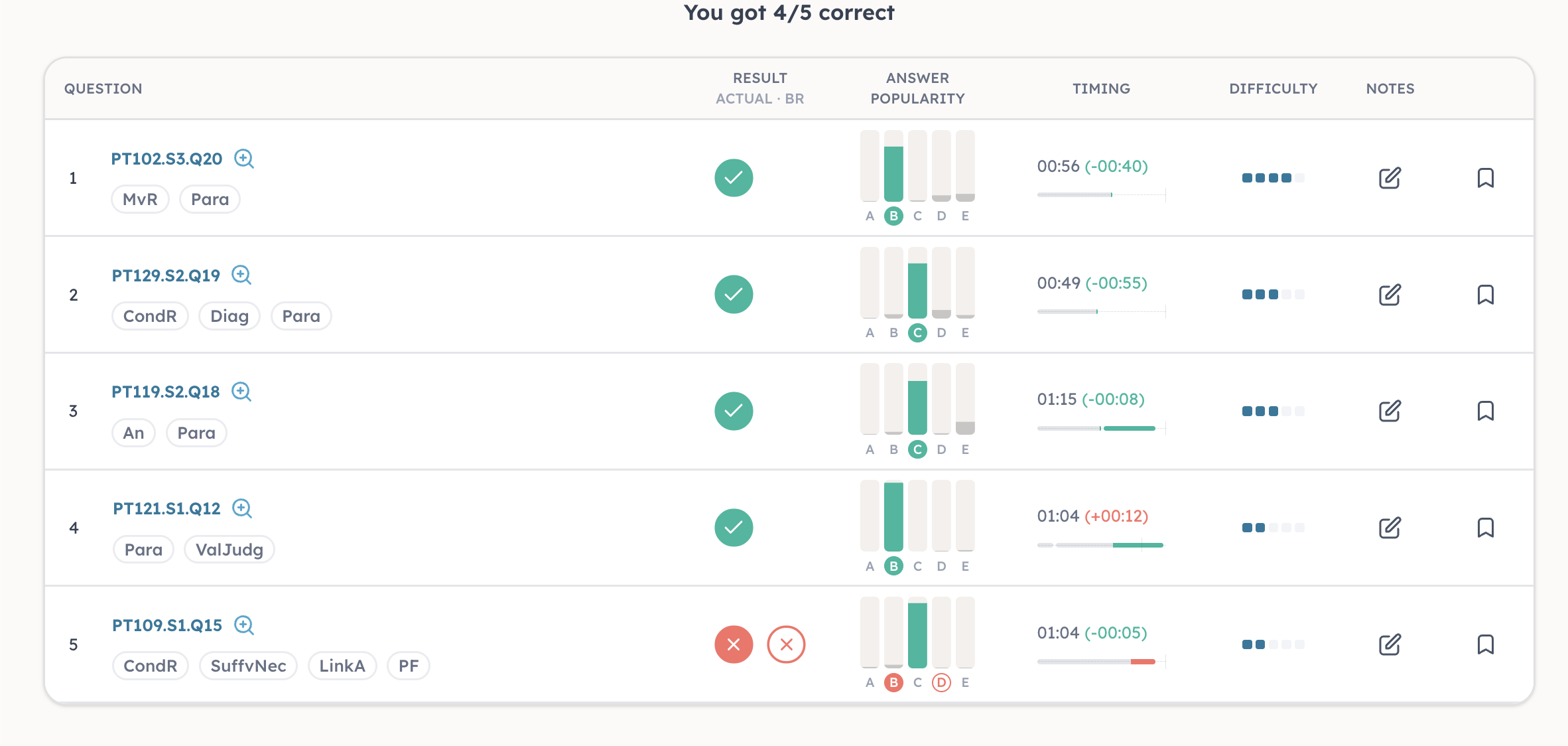 kind of psyched myself out on 5 because C was my initial feeling and then it felt too obvious.
these were one of the questions i hated the most before
 this one felt a little confusing but a nice nudge to reinforce and sharpen the edges.
while the sentences weren't 1:1 here, i had to understand the overall flow and make my own little buckets or stages
premise that has a bit of a stance/connotation, gives explanation and reasoning for alternative or discrepancy
C didn't explicitly state their argument like the stimulus ("But this would be a misleading...") and rather meshed it together with the premise. While the sentence by sentence structure wasn't the same, it still had the same flow.
trying to think less about sentence by sentence and more overall architecture (or maybe just depends on the question :D)
loving the method. i'm not even sure what i'm reading half the time now because all. i'm doing is looking at it from the skeleton/structure and matching that 1:1.
sentence 1: some statement ("A just system...")
sentence 2: the theory/claim/some ol' bs ("For purposes of...")
sentence 3: conclusion ("Therefore, each person..")
Looking at choice A
sentence 1: some statement ("cars should be taxed...")
sentence 2: the theory/claim/some ol' bs ("most reliable measure...")
sentence 3: conclusion ("therefore cars should be taxed...")
-------------------
one thing i noticed was the word "solely" from the stimulus. that was the deciding factor (cars should be taxed ONLY) for me. 
finding the tip of predicting and eliminating to be one method for these.
full stop once you hit a bump that makes it not follow the argument/stimulus and onto the next choice
last lesson and this lesson are really keeping my afloat through these. bless
I went with C and my thought process was I read the stim as them saying SUV's showed up a lot on the analysis that was done.
That whole second half of the stim sent me on my own collision course....