


All posts
New post619 posts in the last 30 days

On this podcast (https://7sage.com/blog/admissions-podcast-zero-offers-to-full-ride-at-berkeley-law-school) they mention a service where you can submit your application materials and have them review to see what went wrong/what can be improved. I can't find the link to this service anywhere- I was wondering if anyone has it?
Thanks!

Hi everyone! I somehow only recently realized that LSAT Argumentative Writing is a separate part of the LSAT, and I’m trying to figure out the best way to prepare for it.
For those of you who have already taken it or are currently preparing:
How much time did you spend preparing for the writing portion?
Does 7Sage have specific lessons or practice prompts for Argumentative Writing that you recommend?
How many practice essays did you do before taking the real thing?
Is there a particular structure/template that worked well for you?
How seriously should we treat the writing sample given that it isn’t scored but is still sent to law schools?
I was planning on taking the LSAT in October, but after my recent PT I decided to hold and take my time to prepare, so I’m trying to figure out how much of my study time I should dedicate to this versus LR and RC.
Would really appreciate hearing about your experiences and how you approached it!

Are we allowed to bring our own highlighters, colored pens, etc into the LSAT testing center?
While taking practice tests, I see that I am using these tools extensively. I just wanted to make sure it was allowed so I can mimic the environment as closely as possible.

I’m honestly making this group because I need people to push me, and I want to push others too! If you got a low diagnostic score like me, don’t let it discourage you. A low score is not a stop sign, it’s just our starting point.


Hi everyone!
I’m currently studying for the November test and everytime I take an untimed section I’m getting -4 and -5 consistently, how do I translate this to my timed tests? 🤔

Does anyone have a good source for Abstract feminist/art articles?

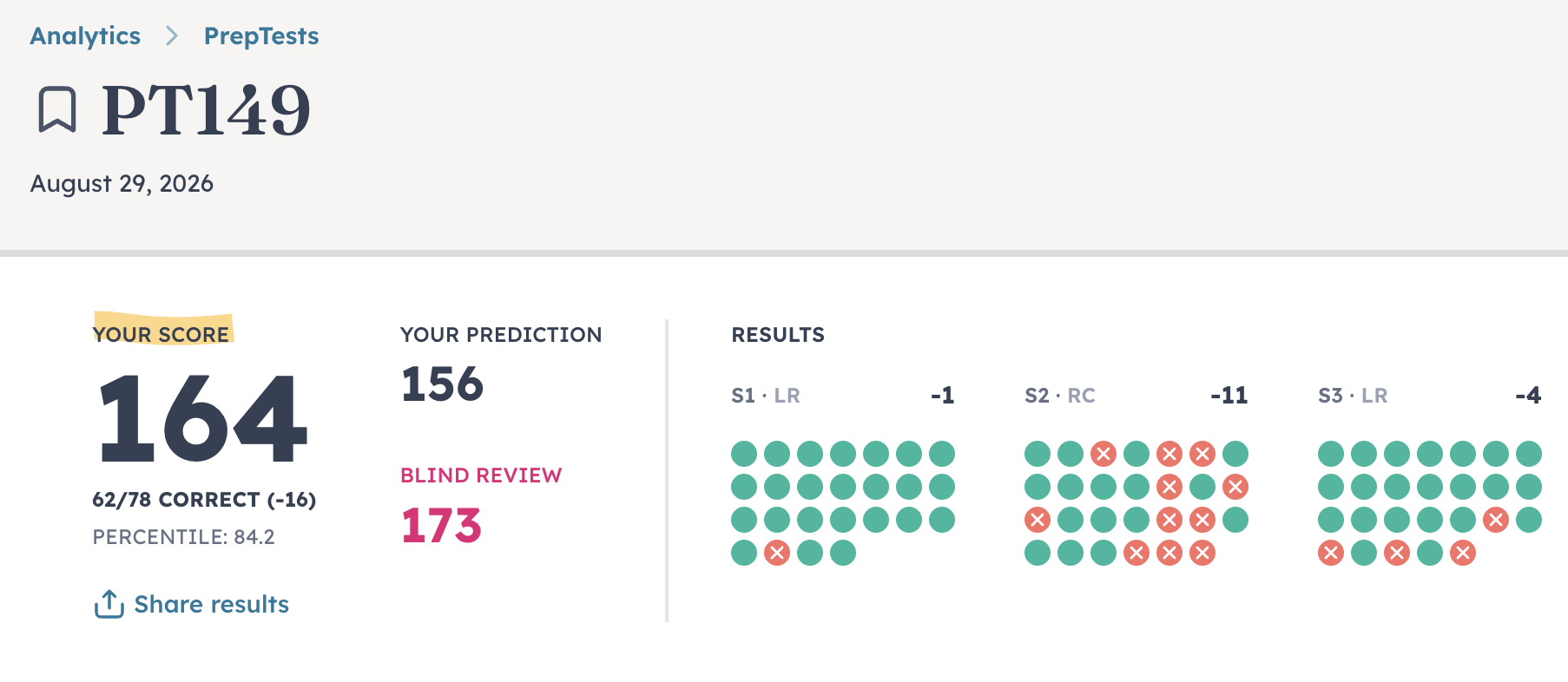 For the most part i got LR locked down (just silly misreads in S3). RC is where i've been -7/-10. i feel like I burn out too quickly in RC which I feel may be why I sometimes don't understand a passage. any tips? I would hate for RC to be what gets in the way of getting to my goal score :(

Hello! I recently found a tutor I am planning to work with (180 scorer) to prepare for the November LSAT. I scored a 171 on the August LSAT, and my goal is as close to a 180 as possible in November. If anyone is in a similar testing range as I am and is interested in being my study buddy for tutoring, please DM me! It will be $90/hr each for a two-person (joint) study session with the tutor. I am also interested in studying together outside of the tutoring sessions!

Hi everyone,
I've taken four LR drills and one RC section today that haven't saved to my analytics. Is there something that I'm doing incorrectly or perhaps a browser issue that could be causing this?
For context, after a drill, I usually close out of the pages with the results by going to the Analytics page or closing the tab. I filled in BR answers for each of these drills and the RC section. I could see the results for each of them, but I couldn't access my answers and results again through the Analytics tab.
Thank you in advance!

Hi all! I'm registered to take the September LSAT and I am wondering if it's better to be consistently drilling every day or if I should focus on taking more PrepTests. I've heard conflicting things, but my biggest concern has to do with stamina (although I'm also afraid of being burnt out come test day...)
Any advice is greatly appreciated! Thank you :)


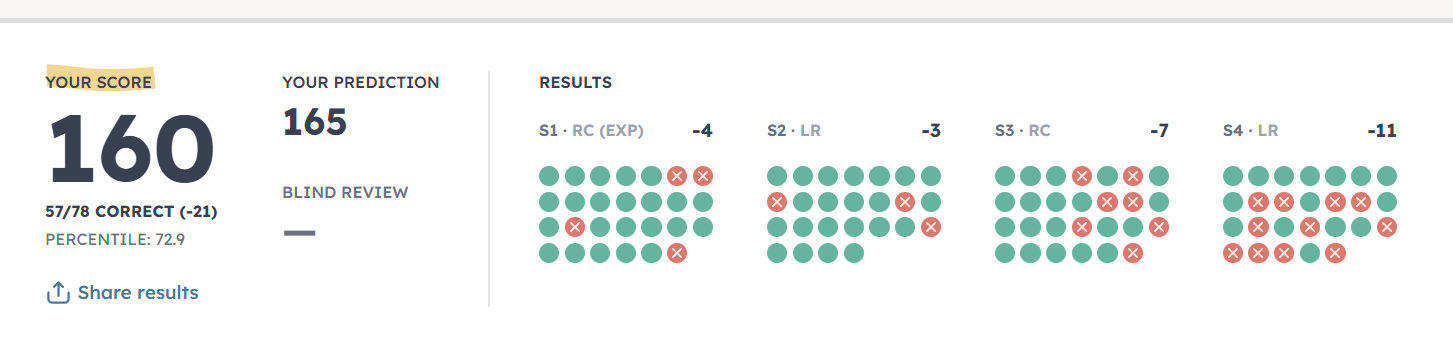
I’m feeling pretty frustrated after taking a PT today. I’m consistently unable to finish even one section, and lately, it feels like my performance is getting worse rather than better.
I’ve been making a conscious effort to apply what I’ve learned from analyzing question types in my wrong answer journal, but I’m struggling to translate that into better pacing. I often feel like there simply isn’t enough time to work through the questions carefully, and I end up leaving more questions unanswered with no time left to even guess.
Blind review has also become discouraging because I’m frequently having to revisit what feels like the whole section. I’m often flagged for spending 2–3x the recommended amount of time on questions, which makes it difficult to get through blind review efficiently. By that point, I’m mentally exhausted and honestly pretty discouraged by seeing all those darn pink circles.
Has anyone else been in this position, particularly after putting significant effort into reviewing and analyzing mistakes? If so, what helped you break through this and improve your timing without sacrificing accuracy?

Is there any way for me to still blind review a practice test after I submitted it? I went fish brain after sitting down for 3 hours to take a PT, and figured I could just blind review later because I wanted to take a little break...but now I just have "-" for all my BR scores.
Would like to go back and blind review so I can see if my score gaps were time-based or concept-based.
Anyone know if there's a way to do so? Or would I have to "retake" the same PT (copy original answers) then do the BR?

Quick q - should we put the amount of time per week worked at each job? The struggle I'm having is that I worked about 17 hours at this job during the summer, and then kept the job during the school year and only worked about 3-5 hours a week. That being said, there's no non-awkward way to write that out.
Any advice?

I have been studying pretty consistently for a few months now, and when I do normal drilling, I am getting most of the questions right. My blind review scores are even better. But when it comes to taking a PT my score is consistently low, and it has been for as long as I can remember. Its always been in the 140's but my. blind review or untimed scores are in the 160s-170. I am so confused on why I'm not improving at all. It's been a very long time, and I have never really seen any improvement on a timed PT. idk how to fix this. I've tried slowing down because the clock gives me anxiety, but I suppose that hasn't worked either. My anxiety is through the roof...I feel like i'm the only one on the planet who's been studying for over 6 months and has not seen any improvement on my score. If anyone has any tips, please let me know.

Hi!!
I've been studying for the LSAT deliberately for about 3 weeks, and each PT I've taken the last 3 times have all scaled out to a score of 161.
I'm trying to not feel discouraged, but I really want to know if maybe there's something I could to break out of the 161s, if this is something other people have dealt with, etc.? Because it always feels like I understand the LSAT, and perform well in drills and sections until I get to actually taking the PTs

Seeing a lot of "stuck in 170s jail" posts. Yall make me feel dumb.
Hello! I recently found a tutor I am planning to work with (180 scorer) to prepare for the November LSAT. I scored a 171 on the August LSAT, and my goal is as close to a 180 as possible in November. If anyone is in a similar testing range as I am and is interested in being my study buddy for tutoring, please DM me! It will be $90/hr each for a two-person study session with the tutor. I am also interested in studying together outside of the tutoring sessions!

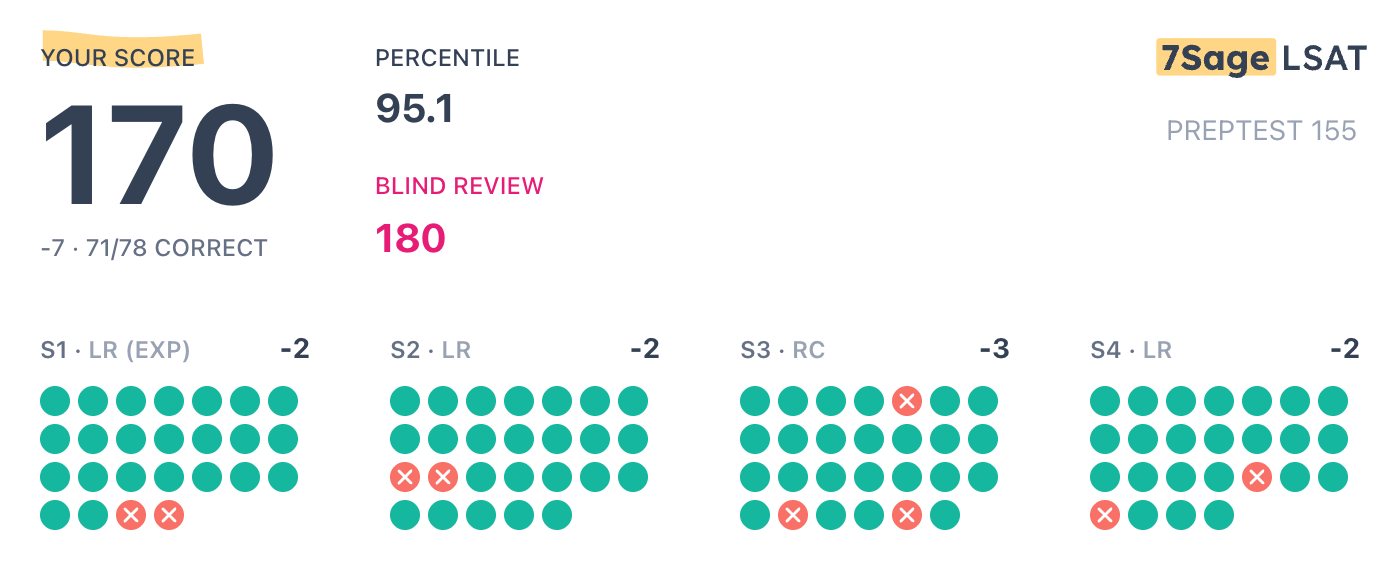

I increased my preptest score by 14 points after doing every 7Sage lesson thoroughly. 7Sage you are awesome!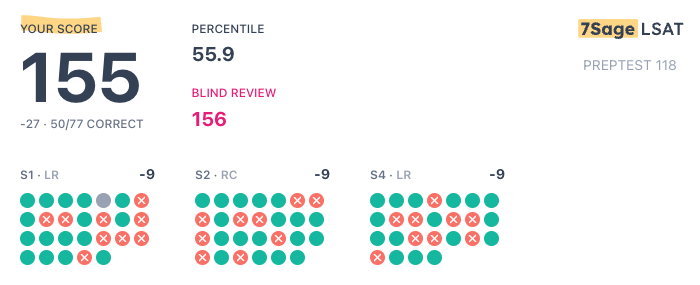
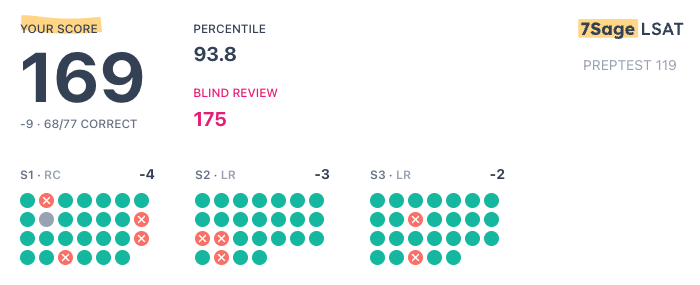

My best score is 162 but I'm not scoring that consistently. I have a major issue with stamina. The longer the test goes on the worse I become. To be fair during section 4 someone at library started talking near me which threw me off completely for the rest of the section but this is a pattern for me. How do I keep my accuracy up as the tests progress??? I am not improving and its been about two months that I've been studying daily and PTing weekly. Any insight or tips appreciated because i feel like a failure.

Shameless plug for Katie Mae's sufficient assumptions class! I just did a 12 question sufficient assumption drill and got 100% on the first go, doing it in half the time I had (I get 1.5x), thanks to the skills I learned in her class! I highly recommend everyone struggling with sufficient assumptions to go to her class or watch a recorded one!

Why is there no Live Takes module? These videos are very helpful, especially for quickly reviewing different question types, but I can only find them when I happen to come across one in a question explanation during a drill. This is quite frustrating, and hunting them down wastes time and energy that would be better spent learning from them.
Thanks,
Joseph

Hi! I don't know if anyone else has been experiencing this, but I am taking the September LSAT and just cannot seem to lock in. When I take a practice test or a practice section, I find myself being really lazy when I go through it. Like, I know what diagramming I need to do, or what steps I need to take to figure out the situation, but I just do not take them. I'm not sure if I'm just being lazy or if I feel so crunched for time that I feel like I cannot do it. For reference, I just did a LR section and went -8 the first time and blind reviewed -0.
I try to do the first 15 in 15 minutes and then go from there. Any tips would be appreciated!

Hello all, I'm currently 2 weeks away from testing and FREAKING OUT. I was getting mid 160s in my PTs all summer long, and got 169 on my PT last week which I was super happy about! This week I did my PT and got 158....which is what I got as my diagnostic score 4 months ago. I noticed that in my last two sections I got around -10, which is really abnormal for me.
I really think that this is due to fatigue. I'm working 20 hours a week at my job plus studying a lot and am really burnt out. I'm having trouble focusing and studying for the LSAT which is reflecting in my PTs. I wanted to know if anyone has any advice, since it is really hard for me to take rest days and I want to bring my score back up before I test Sept 12, but also don't want to tire myself out more. Any advice is appreciated!

You see this a lot on LSA: a random Reddit account that makes some point with way too much confidence. LSA is full of randos who have read so many blog posts and gazed at LSD for so many hours, they imagine that they themselves are practically Admissions Officers.
I’m just so tired of trying to get some balanced opinion or advice and having to deal with some reddit throwaway that thinks the random opinions they’ve rationalized are the real and true thoughts of an HYS AO.
I also have an inkling that some of the people on the subreddit who will say ‘I’m an AO’ are not, in fact, AOs.
At least here I can get some good advice from Jacob.
TL;DR stay of the subreddit