


All posts
New post618 posts in the last 30 days

Im starting back up after taking August LSAT. I was 6 points below my PTs little dissapointed but I knew i was gonna have to take it again. So should I start back with lessons or go right back to drilling? I scored a 155 but was PTing low 160s.

Hi hi. I took the test twice last year in Oct and Nov, and got a 159 and a 158. I took a year to study and did the August test and got a 160 today — my PTs were in the 167 range. I was so crushed this morning, it was rough. I’m taking it again in Sept, very nervous. I’ve been trying to do everything recommended for anxiety (I meditated, got a therapist, etc) and I felt okay on test day, so this lower score feels like such a setback considering I felt less panicked than last time. I also have a tutor and I have been using 7Sage after moving from Blueprint so I feel double the set back in a way. Anyone have any recommendations on how to combat test-day anxiety and just overall disappointment + recommendations on next steps? Thanks!
I haven’t studied since the August test and the Sept test would be ideally the final time I have to take it.

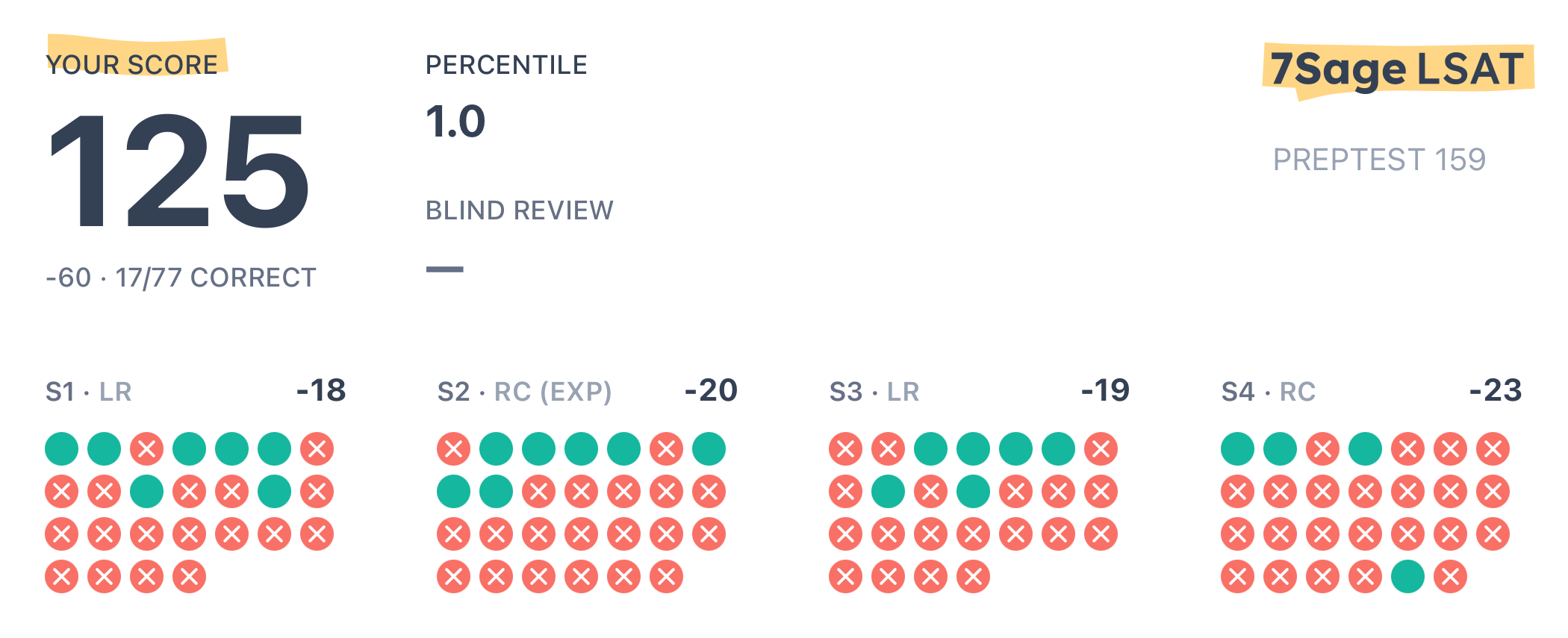 This is my first PT.
I struggled mostly with time and with RC.
Is it realistic to think that I could reach the 170+ by October 7th test day?
I plan on studying for 4h every day until test day.

Hi! I recently received a fee waiver from LSAC. yay! Am I able to backdate payments on7Sage using 7Sage's fee waiver platform? This would be a huge help!

MileHighLSATPrep
Independent TutorAce the LSAT with Greg! | A 177 scorer & Practicing Attorney
Hello! My name is Greg, and I specialize in personalized LSAT tutoring tailored to each student’s unique needs and learning style. Since 2020, I’ve helped multiple students achieve perfect 180 scores and guided dozens more into the 170s through an adaptable, supportive, and results-driven approach. Admitted to the bar in 2025, I also provide guidance beyond the LSAT, including law school admissions strategy, school selection, and application navigation.
Outside of tutoring and law, I enjoy hiking, biking, skiing, and playing chess. I believe balance is an important part of success, and I encourage students to build sustainable study habits alongside their academic goals.

Got my lowest score ever for August release day even including my practice tests idk what happened. Any tips for me retaking in October especially now working 8-5 all day unlike the summer when I had time. Cannot believe it to be honest. Any tips would be greatly appreciated!

Hey guys!
I finally started studying for the LSAT today! I’m hoping to attend law school in Fall 2027, but I’m honestly feeling a little overwhelmed and worried that I’m starting too late to give myself the best chance of getting into the schools I want.
I’m a first-generation college student and aspiring first-gen law student, so I’m trying to figure out this entire process on my own while working a 9–5. I just started using 7Sage today, and I’m trying to figure out whether I should aim to take my first LSAT in November or January.
For those of you who have been through this process, what would you recommend? Would taking the January LSAT put me at a disadvantage for Fall 2027 admissions or scholarships, or would it be better to give myself more time to properly prepare?
I’d also really appreciate any advice for first-gen students navigating the law school application process or anything you wish someone had told you before starting this journey!
Thank you!!

I just recently took the August test for the first time. I am looking for someone to tutor me for the upcoming October test.
I would like to meet at least twice a week if possible.
My target score goal is: 160-170
Please send any information my way or links for consultations and prices.

I applied for an LSAC fee waiver and I'm trying to figure out roughly how long it usually takes to hear back. If anyone has gone through this recently, I'd appreciate knowing what your timeline looked like.
Separately, my LawHub subscription is set to expire in 5-7 days. I still don't have a decision on the fee waiver yet, so I'm not sure if I'll be able to renew it in time. Does anyone know if 7Sage charges you or freezes your account if your LawHub subscription lapses while you're still using the platform? I want to know if I need to do anything on my end before it expires, or if there's a grace period.
Thanks in advance for any info.

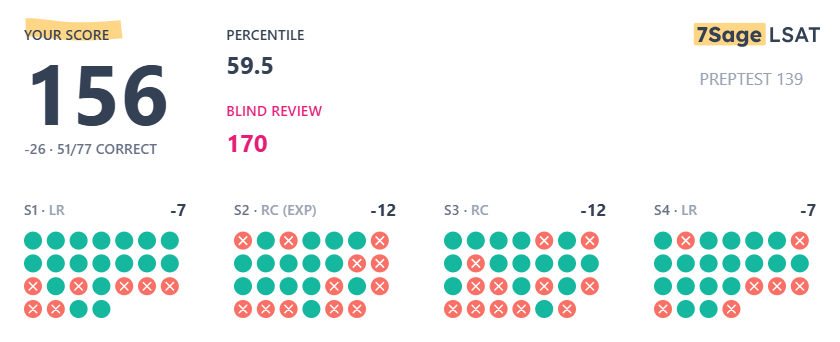

I took the August LSAT for the first time and scored lower than I wanted, so I'm planning to take again in October. However, I've taken nearly all the practice tests on 7 sage. How should I pace my PTs over the course of the next month?

I have been studying for about 6 months, went from a 153 diagnostic to a 168 preptest before the August test. I scored a 160 in April and then a 161 in august and I'm just at a loss for how little it feels like all the work I've put in has materialized in the official test. Feeling completely dejected as I'm only applying to NYC schools where I live and this doesn't really cut it for most schools here. I'm also blind reviewing around 179-180 on most prep tests.


I am a reapplicant this cycle, after an unfavorable outcome last cycle due to a very low LSAT score (140's), and am wondering about my personal statement. I am applying again to the same schools I got denied/ WL from, and do not know whether or not I should change my personal statement, or just revamp what I already have.
The personal statement that I submitted last year dealt with a very specific part of my undergraduate experience, and now that I have graduated and am taking a gap year, I do not know if I have to change it, or if it still could apply post graduate. I want to maximize my chances of getting into the schools I want, but I also do not want to have to go completely back to the drawing board. Any advice or help?
Thanks everyone!

BenjaminSegal
Independent TutorSelf-Studier Turned Tutor; From 149 to 169; 5 years of Tutoring; 1000's of hours experience; Starting at $70/hr
My accolades are above, but here's a few more: students of mine have gone on to break into the 170's, and have been accepted to Colombia, The University of Chicago, Stanford, and Harvard.
I was where you are now: I had a test to crush and a gulf between my skills and achieving that T-14 goal score. Well, I did what any person would do who didn't know what they were doing; I went searching for advice from people who had already achieved success. I read for hours and hours, the accounts of people who had received perfect and near perfect scores. Their advice had a very few common threads:
-Find a major prep company and completely work through all of their strategy lessons and drills
-Take many sections and tests both in untimed and timed formats
-Blind review all timed tests (taking them again entirely without a timer)
-Carefully dissect all incorrectly answered questions
At the time, the LSAT was still on paper and so explanations for LSAT questions were scarce. This was to my benefit and it can be to yours as well. That means relying on the explanations of 7Sage should only be done after you've exhausted considerable effort trying to dissect the questions yourself, given the correct answer. If 7Sage's explanation doesn't make sense or you are curious to hear a question explained in a different way, well that's what a tutor is for! I'll add just one bit advice to that which I found in my research: learn and understand any vocab word related to argumentation that the LSAT uses, which you are unfamiliar with.
If you'd like a tutor to help you through the rough patches and plateaus, I'm eager to join you where you're at on your LSAT journey. I use an "I do, we do, you do" approach to new materials. I'll model the appropriate techniques, whether that means stem analysis, argument analysis, passage annotation, answer prediction, answer choice selection, or trap answer analysis. From there I'll check to see if you've got the basics and ask you to take the next step at various points. Then it will be your job to walk us through an example. Finally, I'll only observe as you begin a new example and work through it beginning to end, giving my analysis or commentary at the end.
Sessions are typically two hours, once or twice a week depending on availability and the student's timeline. We'll often spend the first third/half of the session reviewing any questions that have been flagged for review by you. From there we'll jump into new materials.
My hourly rate changes based on whether you buy a package of hours or seek to pay session by session. It is as follows:
20 hour package - $70/hr
10 hour package - $80/hr
Session by session - $90h

Hi guys! Looking for a study group to either sit together and hold each other accountable or group practice drills. Please let me know if interested. My schedule is flexible.


ITTutoring
Independent TutorLongtime Professional LSAT Tutor - $100/hr (with package discounts) - 178 Scorer
Hi there,
My name is Carl, and I've been tutoring the LSAT since the early 2000s, online and in person. These days I mostly work online over Zoom.
I would never tell someone that it's impossible to self-study for the test or that a tutor is absolutely required, by any means. I would say, however, that having the right guidance at the right moment in your studies can both save you a lot of frustration and streamline the process of improving your score. I can guide you from the beginning of your studies or step in as a troubleshooter when you hit a sticking point. I can take a look at the work you've done recently and try to diagnose what's holding you back and provide you with a recommendation of the best next steps to take in the short term and in the long term.
Two people scoring in the 170s might tackle the test in completely different ways. My job as a tutor is not to turn you into a carbon copy of me, but to help you find the combination of techniques and methods that will get you the score you want. Sure, there are certainly some required skills on the test--some questions are impossible, for example, if you don't know what a contrapositive is. But there's also a lot of leeway. There's no one-size-fits-all approach, and I tailor my lessons to you and your needs.
I specialize in helping people move the needle who've been stuck on a plateau for a long time. I offer a free one-hour evaluation session to all potential clients, an hour for us to meet, discuss your troubles, have me demonstrate my tutoring style, and have you ask any questions you have. So, please, reach out if you'd like to schedule an evaluation with me to see if I can help you.
The easiest way to reach out is to use the scheduler at my website: https://www.ivorytowertutoring.com/schedule/ . You can also shoot me a DM here.
Since scores came out today, I'd recommend taking a quick breath before scheduling an evaluation, though. Process that score before booking a dozen different evaluations. Once you're calm and ready to move forward, it'll be easier to decide between all the different options out there.

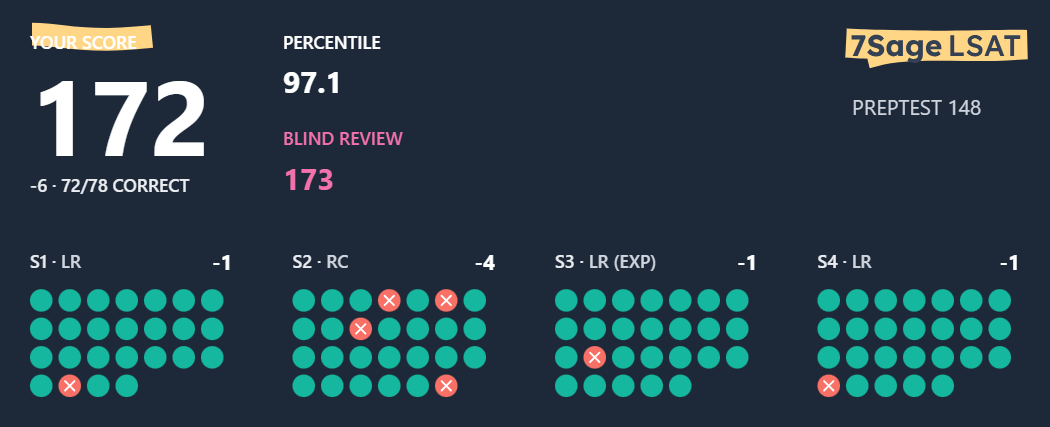
Five point score improvement. May take again because why not but in disbelief at my score. Which is basically now way beyond the 75th at any school I'd be interested in. Didn't even feel too hot coming out of the test.
For the record, I hated diagramming and conditional logic the entire time but still went way beyond my expectations. We are all gonna make it.

Hi all! I’ve just returned from a Fulbright, and I’m currently studying for the LSAT. I’m aiming for a score high enough to help compensate for my 3.84 GPA and give me a realistic shot at the T-14 (with an Ivy as the dream).
The job market sucks, and I’m in a bit of a predicament about what to prioritize during my next gap year. Ideally, I’m trying to find a job that:
Is involved in the legal field or otherwise makes sense with my interest in law
Is close to home so I can save money before law school (in Texas)
Gives me enough time/energy outside of work to seriously study for the LSAT
Still adds something meaningful to my resume/application rather than taking a job solely for the sake of being employed (I'm worried about not having something prestigious)
With all of these things in mind, my opportunities seem pretty limited...
My work experience is already fairly law-oriented, but I guess my question is: how much should I actually care about what my gap-year job “looks like” to law schools?
Would it be better to hold out for a legal assistant/paralegal/policy-type position, or is it completely reasonable to take a less relevant job that lets me live at home, make money, and prioritize getting the best LSAT score possible- especially if I’m doing research/volunteering on the side?

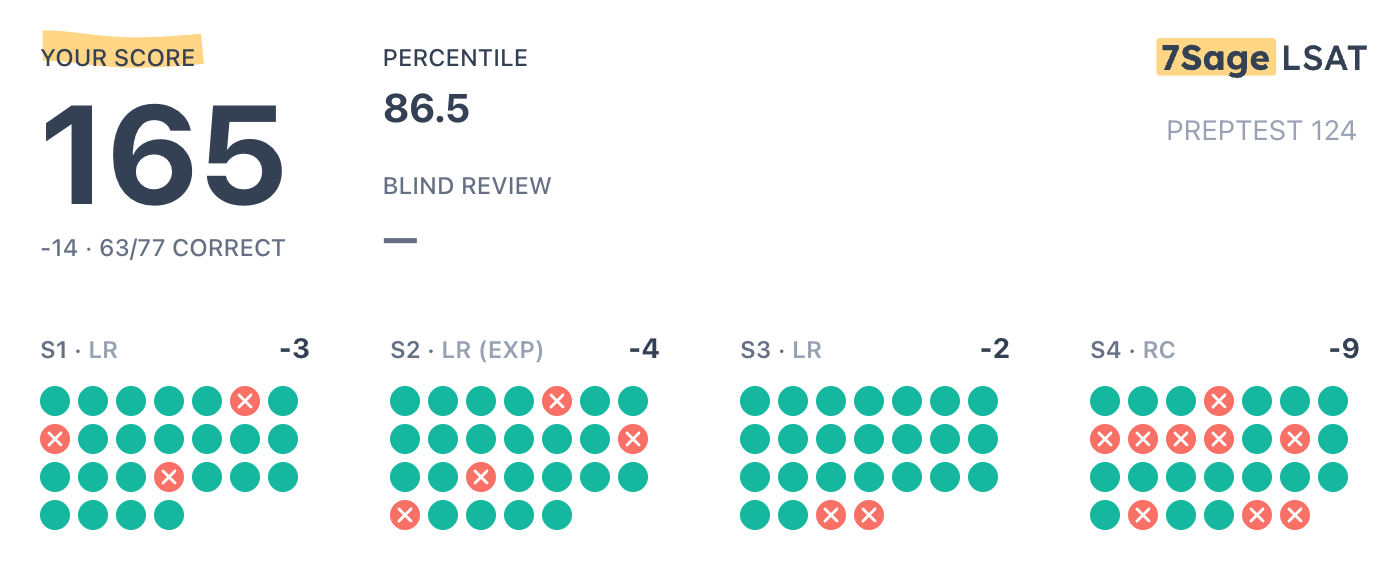
I have hovered around the 159-165 mark for so long now. I need to change something in my habits. I just got a 161 again on August, same exact score I received in June. I have two weeks until Sept. What should I adapt my study style to look like? Consistently -6 on LR and about -7 on RC but it varies wildly.


The law school admissions process can present a tremendous burden for many students, including those who do not recieve an LSAC fee waiver. I think that a way to track application fees, CAS fees, and application fee/CAS report fee waivers would be a very useful feature for many 7Sage users.
A user could toggle on the "Application Costs" option and see each school's application fee. It would be incredibly useful if 7Sage could compile information on each school's waiver system (for example, Georgetown has a merit-based waiver application or Duke often sends out unsolicited offers). Whatever information 7Sage can access could be shared with students to help them lower their application costs.
Then, a user could input any fee waivers that they are issued (and the code that they're given, if applicable, so they always have access to it) and the cost could be subtracted from their "Total Application Cost" at the bottom of the page.
Currently, I do this exact thing in a Google Spreadsheet. However, the ability to do everything in 7Sage would be very useful.

I appreciate the games section in the community tab for practicing conditional logic but was wondering if anyone had other ways of studying conditionals. I like doing a lot of repetition and was wondering if there were other online resources that gamify and throw lots of conditionals at you.

Take this with a grain of salt, but this from my experience taking the exam on the first day of June and the last day of August: If you can manage it, schedule an exam date as far from the first day as you can (ideally the last day).
By that point, LSAC and Prometric will have had a few days under their belt to get the kinks worked out. Most - if not all - of the people there on your day will be there exclusively for the LSAT, so the process will hopefully go smoother when you step up to bat.
Prometric's software/hardware setup isn't top of the line in terms of speed, but it will get the job done. The proctors will hopefully be in a groove by then/less uptight/in a better position to assist you if you do have any issues, and any software issues with the exam that would potentially impact your performance will hopefully be ironed out.
Your experience will not be perfect. The missteps and horrible events will be the loudest on social media, and the good stuff will be nearly silent. You'll hopefully be too tuned in and focused to notice much else around you, and that flow state will be epic.
It's a very stressful time, but it's just an exam.
"But it's an exam that... "
It's just an exam. The first step in a marathon.
You'll get there.
I'm taking it again in September with you guys :)
---
Also - after the exam: You will want to not have an obligation keeping you from sleep after you leave the testing center. When that adrenaline leaves, it's going to take a lot of stress with it. Get some sleep!

Hello!
I'm sure like many other people, I'm not very happy with my LSAT score. I was averaging around mid to high 150's on my PTs, and my official score was way below all my PTs. I was expecting my official score to drop below my average but I did not expect this. I'm registered for the October exam, but I'm not even sure if that's the right move at this point. For added context, I am a senior in college and I'm currently working with a tutor in preparation for October, but again, I'm not sure that I'll be ready or able to hit my average or even my target. Would November be a better option at this point or should I look at other options such as potentially taking a gap year? Any advice is appreciated!