


All posts
New post591 posts in the last 30 days

Hey guys,
I am in the process of writting my personal statement for some of my canadian schools, can anyone share please maybe any resource they used? or ideally, how they approached it? I just feel I am listing experiences but not fleshing it out can someone please assist me.
Thank you

The PrepTests page is back as its own standalone page. You’ll find it under Study > PrepTests, and it’s the same as it was before last week’s menu change.
Thanks for all the feedback that got us here!

LiaWang
Independent Tutor180-Scorer: Small Group Tutoring (3 to 4 Students) for $40/hour
Hello! My name is Lia, and I am offering small group tutoring (3 to 4 students) for $40/hour.
How it works:
1) First, I will wait until I have 3 to 4 interested students (first-come first-served).
2) Next, I will create a group chat with the confirmed students.
3) Finally, we will schedule lessons through Lettuce Meet.
I keep a strict cut-off for the number of students because I want to ensure that each student will be able to get personalized assistance and have all of their questions answered.
Some background info:
My diagnostic score was 163, and I scored a 180 on my first LSAT after studying for 6 months on 7Sage. I did not have a tutor and relied on teaching each question to myself (using the written and video explanations for support). I have tutored the LSAT to many students, and my clients have seen consistent progress. I have been a tutor for college students since 2022, mainly tutoring math and computer programming. An example of group tutoring I've done was statistics for a group of 4 nursing students. Even though it was not the LSAT, it means I have years of experience conveying and teaching complicated subjects to others.
If you're interested in joining this cohort, comment or send me a DM! Let's do this together!

hi everyone,
I am currently stuck in low 150s I have been doing untimed an i get -3 to -6 on my LR and -8 on RC but then when it comes to timed i can't get more that -9 to -11 on LR or -12 to 14 on RC. I am really trying to improve my score by November for the LSAT but I am not sure how to improve. LR I feel that I am not understanding some of the flaws, and making simple mistakes. On RC I cannot seem to stop missing implied questions and i am going back into the passage thinking that I have the imformation to support the answer choice im choosing and then I get it all wrong. If someone can help. I have been studying for over a year now and I am stuck.

Does anyone have examples of what they have put for the skills/interest sections on a resume? I’ve heard, mostly from Dean Z, that this section is appreciated. I’m curious what others have put and how to toe the line of professional but personal.

I just found out about the Journal page!!!! I have been waiting for this for the longest time!! Absolutely in love with the ability to filter through notes based on question tags, practice, and results!!! This is gonna be a game changer for my entire review process! Cannot express how grateful I am with all the work the team is putting in to help us students. Ahh, THANK YOU 7SAGE!!

Hey all! I'm looking for a couple students at USC and Pomona for an upcoming project we have — is anyone interested? Reply here or shoot me an email (sean.gallagher@7sage.com) for more details!

Hi- I am finishing my resume at this time for application. How many pages is your resume?

Hi all, I finished the LR curriculum at the start of summer, and I am now nearing the end of studying 7Sage's RC curriculum. In anticipation of this, I cannot help but to begin brainstorming the direction that my studies should take next. I do not take the LSAT until August 2027, so I have ample time; however, my issue here seems to be a lack of direction on what to do after I am done studying both the LR & RC sections on 7Sage. I believe 7Sage had a little breakdown section on what to do next after RC, which included a breakdown of the wrong answer journal and other techniques, but I cannot seem to find them on 7Sage anymore, so now I'm highly confused about what to do.
I have a steady plan for LR, where I plan to start by taking only one LR section a day, and then reviewing every single question I get right or wrong, plus noting my reasoning behind them(aka Wrong Answer Journal). This is to help me build extreme accuracy before I begin to increase the sections per day for endurance and then, lastly, introduce time constraints. I believe I could be approved for accommodations, but I am studying like I have none until it is solidified.
The RC section, on the other hand, I find quite intimidating; it wasn't as straightforward for me to study. While I was going through the curriculum, at the end of each lesson (e.g critique & debate), I was unsure of whether to keep drilling the passage styles till I saw an improvement in accuracy, or just be okay with simply understanding the thought process to have whilst reading the passage, knowing what each question type is actually asking and how to do a low-res sum.
To cut to the chase, once I am done with the RC section, do I simply keep drilling passage styles at different levels till I notice a trend in high accuracy, or do I just follow something similar to my LR tactic by taking just one RC section a week in this case and focusing heavily on review? idk i'm overwhelmed with confusion here. PLEASE help a girl out.

if i have technical skills as a computer science major (java, python, etc.) should i include them on my resume? i feel like i heard dean z say in a podcast that she doesn't want to see those since they are not relevant to law school, but i just wanted to double check.

I'm reviewing my RC section of my Practice Test and I am wondering if it would be helpful to have a space to write low-res summaries next to each paragraph? I write out my summaries on my scratch paper while I'm doing the questions, but I think being able to see each paragraph and being able to write directly next to it, and seeing it while I am answering questions, would help me get more questions right. Idk, it could be wishful thinking lol.

the "I don't know how I did" people was right

Good morning, everyone!
I hope you're having a good start to the week. I need some advice on the additional addenda for my applications, particularly the Gap in Resume and Explaining LSAT Score.
I have a gap in my resume since I graduated from college back in May to focus on my LSAT studies, and the funny thing is that I got hired yesterday for a new job. However, I know I cannot add it because I actually haven't worked yet or gained experience. So my question is: Do I write an addendum explaining why I haven't worked since grad? Or is this only for a year or so gap in my resume?
I have a lower LSAT score than some of the schools I'm applying to (cause their median is in the 170s, high 160s). Do I write an addendum explaining my lower score and how my high GPA shows I can be a great student? Or is the addendum just for increases in my score if I took it twice?
Any guidance would be greatly appreciated!

The only D's on my transcript are from Spanish. This was due to attendance where we had several afterhours, late evening meetings that I could not attend due to my conflicting work schedules. (I was working multiple jobs) Unfortunately, this had a huge impact on my grade for the course and my GPA. Should I write an addenda or will it look like I am a poor planner/making excuses? Happy to provide more context if needed.
For reference, I was on the President's List before taking Spanish courses and bumped down to having under a 3.0 GPA after taking and retaking this course. It also was a required course for my major so I could not have taken an alternative.

Hello! I was wondering if anyone else was seeing a big difference in between when they took a timed PT vs when they did the BR. On this PT for RC, my blind review score was really good, but how do I translate this into when I am taking a timed section? Does anyone have any tips of what helped them, or is it just more consistent practice. I am taking the November LSAT, so I want to be as prepared and confident as I can be. If anyone replies back, thank you!! 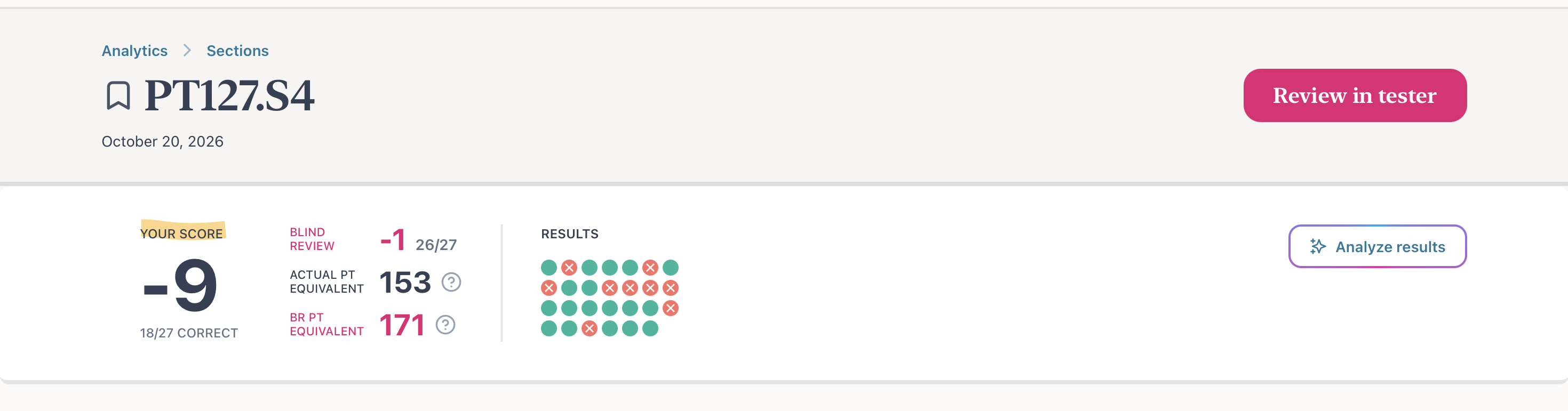

Ive seen somewhere in this discussion that the newer LSAT exams are using older RC material or style. Is that so? Should I incorporate those in my studies considering im running out of fresh RC passages?

I've been studying for the LSAT for over a year, and have seen a majority of the questions at least once now. But when I go to select questions for drills, there's no way for me to differentiate between a question I saw last week (and am quite likely to remember) and one that I saw a year ago (which feels basically brand new). Would it be possible to group questions by how long ago they were last seen? That would be helpful for maximizing the limited questions that LSAC provides for studying.

Since starting college, I've earned most of my income by working for my school in various capacities. As a student, I held a part-time work-study position during the school year, and then I also worked 40 hours a week for them on campus for my summer job each year. After graduating, I continued to work for them as a full-time employee in their office (I know this sounds a little crazy, but they're just a great organization and awesome to work for!).
I feel confident that I can configure my resume to explain this history in a way that's not too confusing, but I'm struggling with how to fit it into the more rigid formatting of the employment questions found on many applications. They ask you to list all employment, including internships, so I kind of assume they want to know about work I did as a college student, but since you have to add all the entries by employer, rather than by position, I'm unsure what the best way to go about it is. Overall, I've worked for the same organization for over six years, but it's not like I've been doing the same thing/number of hours there for all that time, so it doesn't feel accurate to just list "X University, August 2020-Oct 2026".
There also was one random summer after freshman year of college when I went home and worked as a waitress instead--should I be listing that here, or on my resume, or not at all? Please tell me if I'm overthinking this! 😅

Hi all, ive been studying for the lsat since 2025 august. I did pretty bad in April and am taking November. I just feel the same that I am feeling in august which is this immense level of stress and burnout. I feel guilty when I dont study during week days because I work and I only get an hour in the mornings. And then I ruin my own weekends because I lock myself in my room and use the 3 free days I get to study all day rather than going out with friends. Im at a crash out level lol. But wanted anyones advice oh how to manage stress and when I should stop studying before November.
Im also just pting in the mid 160s but I wanted to end up in the 170s so ive accepted I need to take another exam.

Just commenting to desperately try and get the PrepTest page back. The new format is so restricting for PT info. It was so helpful to see the info about previous PrepTest's on one page, and now we've lost all that valuable info. Thanks

The subject line says it all :/ how can i break out of the 150s? I am doing untimed drills but feel as if NA and Flaw questions get me and a huge chunk of the LR section test on these question types. Also, sometimes the explanations on 7sage do not make sense to me. My goal is literally just to break 160. Getting a 165 would be a dream, but 160 is my goal.
Is there anyone that broke out of the 150s that could offer some advice? I would greatly appreciate anything you might have to offer

Hello JYPing and others,
Can we please have video explanations for PTA and other non numbered PTs please?
A few others have raised the concerns in the comments section of certain questions.
Thank you! 🙏🏼

alright y'all THIRD 167 IN A ROW. how do I get out of high 160s land? what made the biggest difference for those of you who finally got into the 170s? and yea. haha. 67

Hi guys! I'm prepping for the November LSAT, and have been consistently testing at -1/sometimes -2 on LR. I ALWAYS catch my error(s) on BR, but I never flag the questions I get wrong as I'm taking them. I'm trying to close the BR gap, but am struggling since I can never tell when I get questions wrong in the first place!
Anyone else worked through this problem?

Admissions,
I am writing my makeup LSAT tomorrow, and yet have managed to become very stressed right about now. I have already applied to the three schools I hope to be admitted to, as our deadlines in Canada are early. I was checking the status of everything today to see if my transcripts had made it, and realized I may have made a terrible error. During my 90ch degree, I chose to take 6ch through another university, which happens to also be one I'm applying to this time around (which is how I noticed this error in the first place). These classes were entirely distance, I didn't even write the exam in person. These classes were also transferred to my transcript at my degree granting institution as Pass grades, so I have no letter or percentage to go off of, and therefore most schools won't even include them in GPA calculations.
Since I took these courses entirely through distance and they are just transfer credits, I didn't even consider myself to have 'attended' that university and therefore didn't put that school as an institution I attended on my applications. Plus, the transfer credits will be on my transcript. I am quite stressed right now in thinking that I may have ruined my applications to those two other schools (this one that I took classes through is my third choice out of all three), and am hoping for any advice or words. I have already written the two schools where this potential error has occured; I have scheduled them to send tomorrow while I am writing my LSAT, so in case a response comes back bad, I don't see it right before I go into the test.
Sincerely,
A stressed, confused, and tired law school applicant.