


All posts
New post621 posts in the last 30 days

Hi, I am currently seeking an affordable tutor who would be able to help me improve my accuracy on LR and (more so) RC. I am planning on taking the September and November LSAT, and have been studying on my own since July. My diagnostic was a 160, but my most recent PT was a 163. I hope to sit down and go over the questions I've missed so that we can both come up with strategies that would help improve my accuracy, build my stamina, and overall help me reach a 170+.
If you have any questions, feel free to comment or DM me.

I keep getting them wrong no matter how many questions is do. What helped you ace these questions?

Hi guys! I’m looking for someone to study with on the east coast, preferably in the NJ / NYC area !! I’m currently studying 3-4 hours a day to take the LSAT in November and willing to study together online or in person! We got this guys 😁


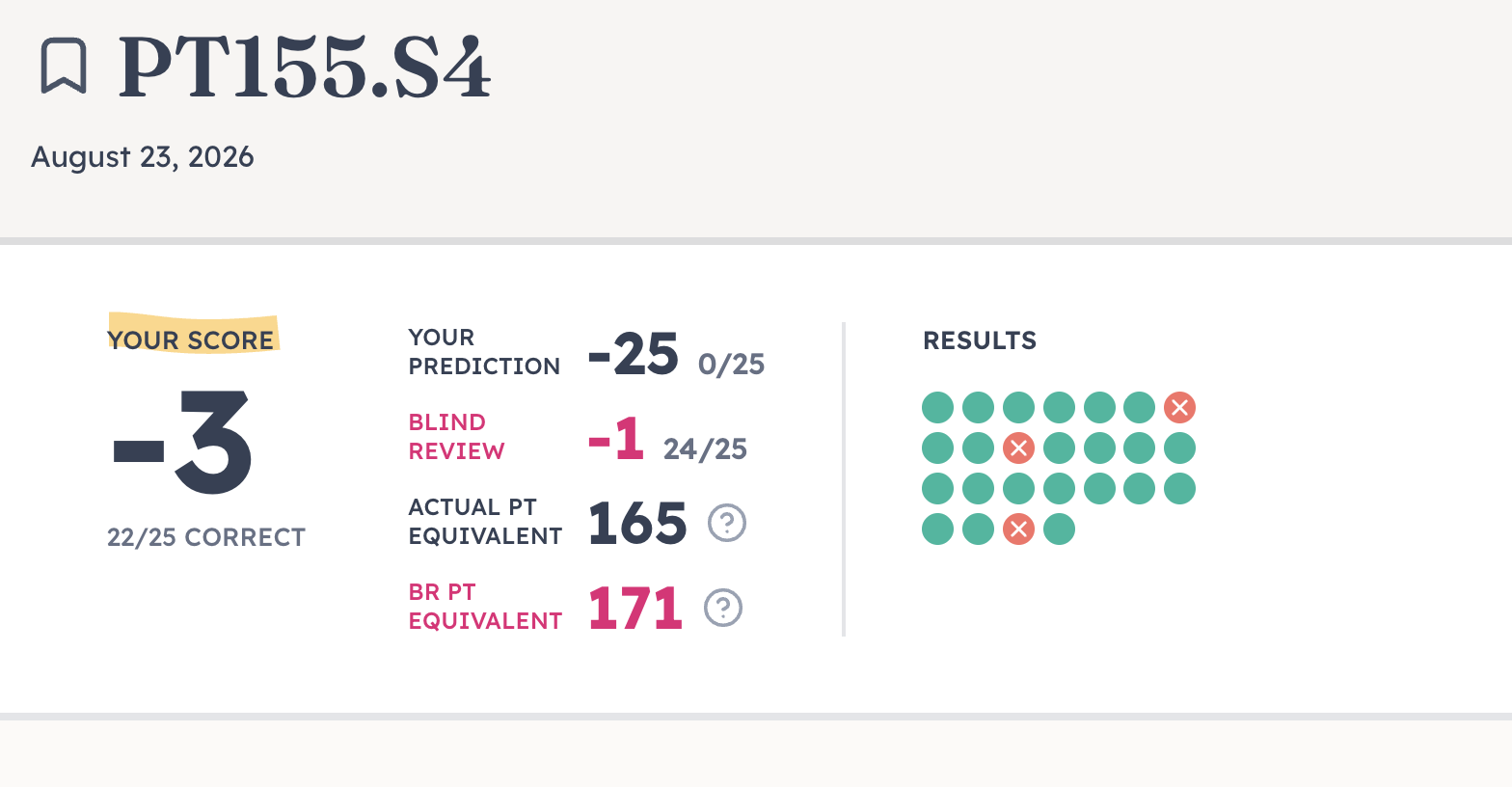
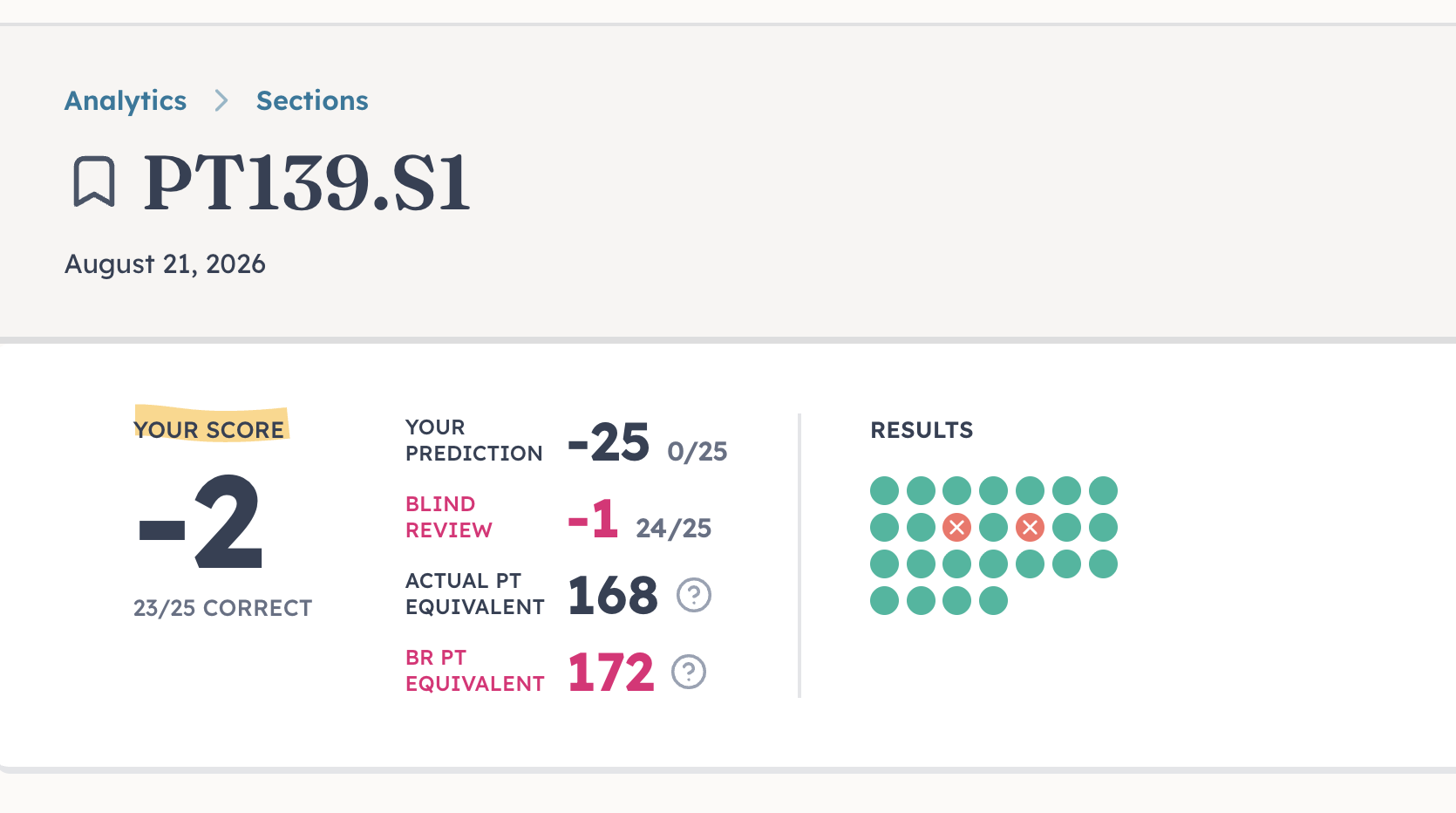

Hello everyone, this is my first time making a discussion post, as I was curious if anyone could provide tips or strategies for improving one's score on PTs. I feel like I have all the pieces to a puzzle, but I can't seem to get the pieces to fit, which is why I'm posting here to get advice and help from everyone here.

Hi guys. I need some help and advice on what to write about and how to make a good personal statement. Please let me know.

Recently, I have turned on even older PTs in my test prep pool (labeled "Bonus Preptests" in the PrepTest pools) for more practice.
In these sections, I've encountered questions phrased very differently from what we are used to seeing. I've also noticed that these Bonus PTs have a significantly higher number of 5-star questions than some newer sections.
I understand that these are not the most representative of the modern LSAT and should be used for extra practice. However, I am trying to better evaluate my performance and am wondering how 7Sage determines what constitutes a 5-star question.
It's encouraging to realize that I am getting a better percentage of 5-star questions correct, but I can't help but wonder if there are more 5-star questions on the Bonus Preptests because fewer 7Sagers have taken these questions?
(I am also generally curious about the differences between older PTs and newer PTs, if anyone has anything to share!)

My goal score is 164-168. Right now I am PT'ing at around 159/160, but my biggest issue is that I KEEP changing my correct answers to wrong ones. On my last PT, I would have gotten a 164 EXCEPT I changed 6 CORRECT answers (LR and RC) to wrong ones.
Being self-aware (and relying on 7SAGE AI), I can hypothesize that this is me not trusting my logic and falling for traps. However, I feel like there is more to this. Do I need to read slower or recognize traps better? I am interested in how others have overcome this issue. My goal is to take the October LSAT, and I know I have enough time to fix this issue if I had the correct guidance

I have started using the SageAI and find it quite helpful. Is there a way to open SageAI to view previous chats without asking it a question? I end up "wasting" some of my monthly SageAI questions just by clicking on the available buttons to open the chat (e.g. "Analyze results", "What should I do?"

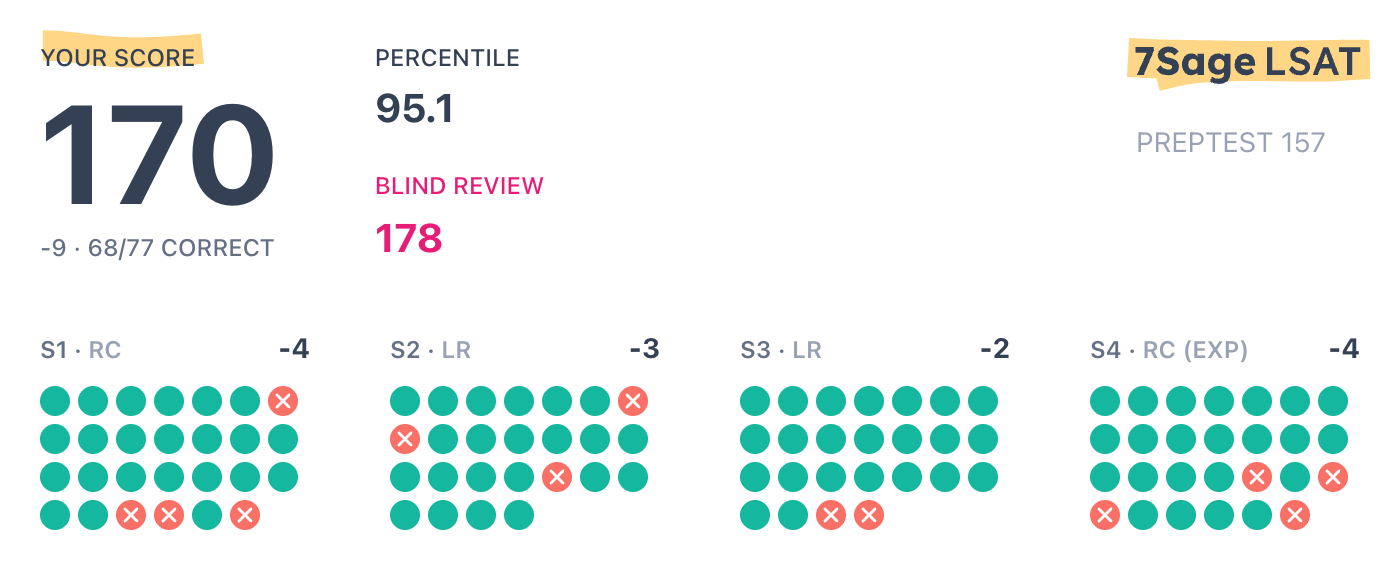 My first 170 after being stuck in the mid-160s for the last month. I made big improvements on my RC this time and actually got to half-attempt my final passages in each section. Motivated to keep this up as I get closer to my September test. Anything is possible!! - Kevin Garnett

I'm 75% through a practice test and my testing platform is slow, unresponsive and not loading well. The timer just keeps ticking down. Anyone else experiencing this? I tried switching wifi networks with no success.

Hi everyone! I am looking for advice on a topic I want to pursue for my personal statement, and was wondering if anyone could help or direct me to someone/somewhere that can help! I don't necessarily have the money to spend, especially since I currently just need some quick advice on my potential topic. Thank you!

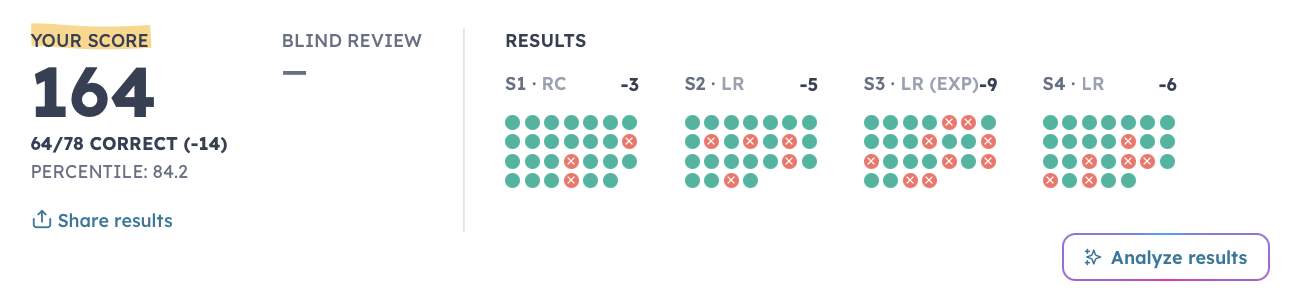 My baseline on 7Sage, LawHub, and Blueprint was in the mid-150s, and my last full mock was 151. Since this was PT117 (with material from 2004), do you think that the later PTs are harder?

I’m taking the September LSAT but I’m not feeling too confident so I’m thinking of taking it in October or November as well. Would submitting in November affect my chances to get into a school?

Hello everyone, I'm really lost at where I should go moving forward with studying. I have taken the past month and a half off of full pts to focus on the core curriculum and just learning the material overall. I have been taking timed LR sections and been doing fine, but when I just took pt 117 I scored 151. I wanted to take the Oct LSAT, but I'm doubtful that I can hit upper 150s in time now that I got this score. Before I was hitting around 5-7 questions wrong per LR section and usually having my projected score in the low 160s or upper 150s. Also, on the exp section I only got 4 wrong on this pt.
Is anyone in a similar situation or has been in one?
Thanks

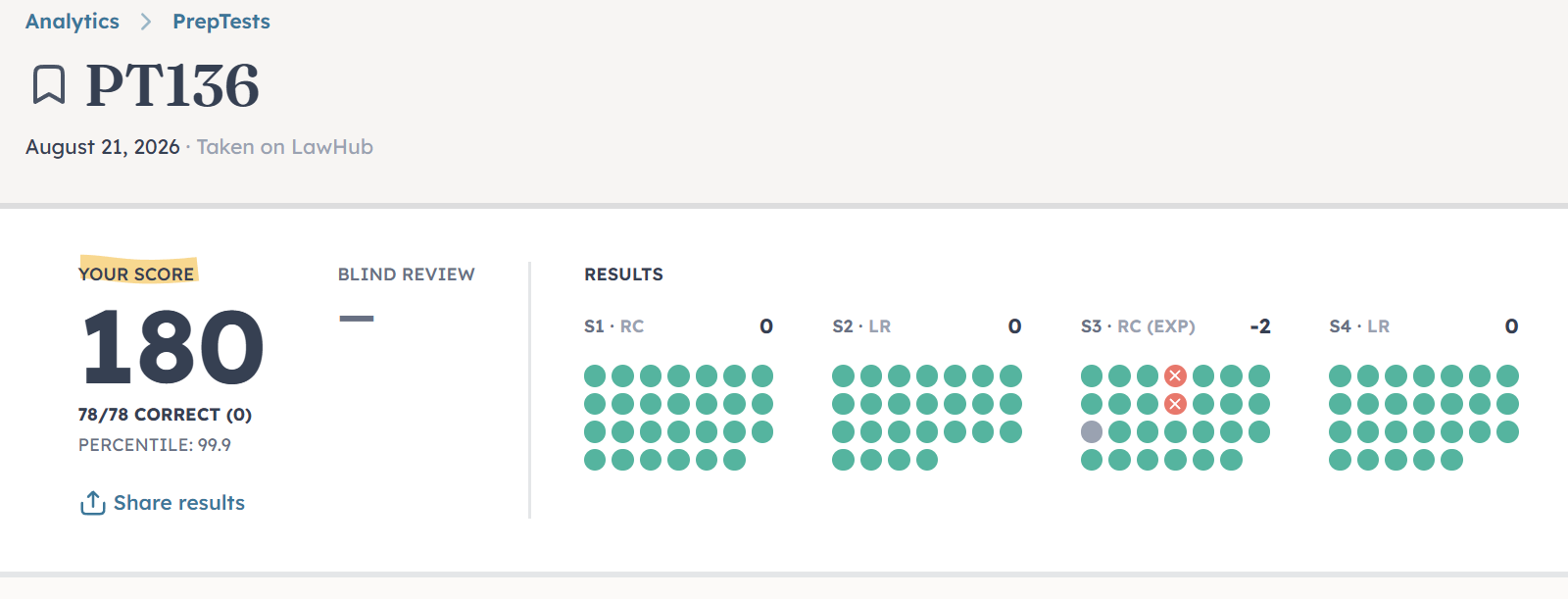
Techniques that I thought really helped:
RC
When you're choosing between 2 narrowed down ACs on RC that both seem like they could plausibly describe what's going on, ask: if I had to rewrite the passage based on what this AC says, would I land on something that actually looks like the passage I just read? If you wouldn't, then eliminate it.
After every paragraph on RC, re-tell yourself what the gist of the paragraph is and why the author included it, the overall type of piece (spotlight, argument, weighing two arguments and evaluating, etc.) and the point the author is trying to make. At the end of every passage you read, summarize why the author wrote the passage. I had this advice given to me across countless video lessons and question explanations but hadn't actually honed the practice of doing it. Actually doing it makes a big difference.
The LSAT will punish you so much more for not tracking the purpose of a paragraph or who said XYZ in any passage, than it will for you failing to comprehend exactly what XYZ means. Especially on dense scientific or humanities passages that seem to be talking about very abstract and esoteric things, focus on contextualizing why the author/the voices within the passage are saying particular things, and don't let failure to understand their particular subject matter throw you off.
LR
I had a tendency of leaving 2 ACs alive on hard LR questions and then spending a bunch of time trying to choose between them. Resist that pattern and just narrow it down to one AC on the first pass, as much as possible. You can usually find something wrong with 4 out of 5 ACs as long as you're discerning enough.
If you're really stuck between 2 ACs, reread every single word of the question and ask which one answers the precise question better.
If you're spending more than 1:30 on a question and you're trying to choose between ~2 ACs and you really can't decide, just make your best guess based on your gut and move on. I made 3 guesses like this on the last LR section here and they all turned out to be correct, but it left me with so much more time to tackle the harder questions at the end and do them well.
I was plateauing in the low 170s for a while, and I think today helped me realize that the true gap between that and a high 170s score, once you've drilled enough to have most of the concepts down, is just being really disciplined in your execution. The formula for every question is read the question first, read the stimulus with the question in mind, predict the answer, assess ACs. If you catch yourself straying from that formula at any point, on even one question, just take 2 seconds to close your eyes and re-anchor around it.
I previously sped through the first ~17-20 questions of a section with maybe 10 minutes to spare at the end, and tried to move quickly to then use remaining time to double-check questions, but then I would not be able to catch questions I got wrong because I was speeding so fast I didn't even realize the trap I fell for. It was helpful to recalibrate to target actually just having 3-5 minutes left at the end, and taking enough time going through the questions the first time that I could catch those traps instead.

I am having major gaps by 10 points for every PT I am doing. It is so annoying because my blind review is my goal score. I find myself just taking too long to answer questions or reading the stem and just getting lost because I feel time pressure. Its so annoying and I want to over come this stupid hurdle. Ultimately, I've come to the conclusion that its probably due to my shaky foundations/non-existent confidence. This is beyond frustrating.

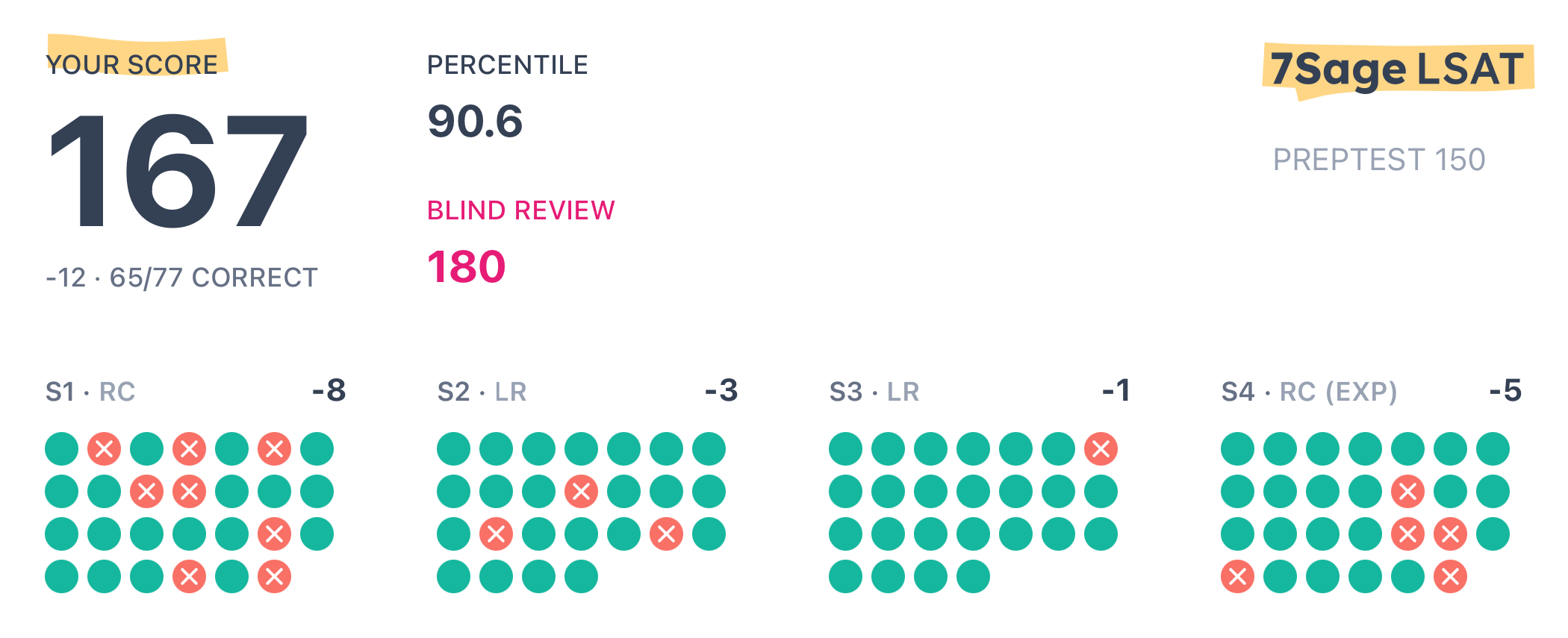

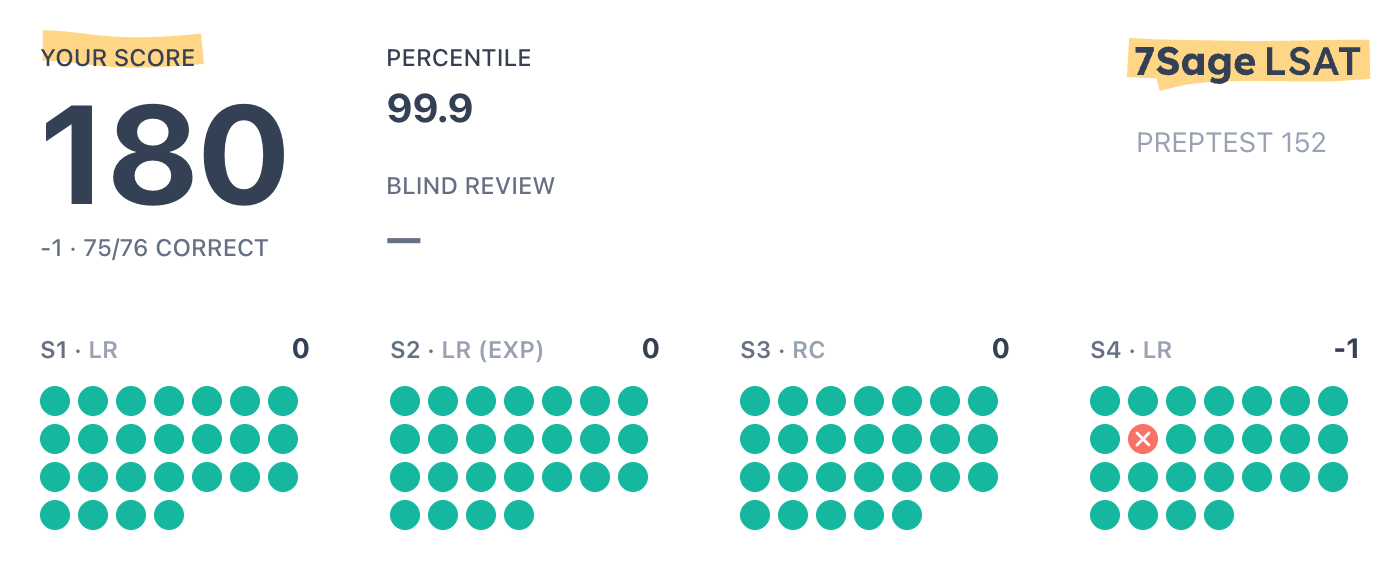

The site won't let me change my payment method with "Update payment method." It just takes me to a site that says "This page couldn't be found." Since my previous payment method is invalid, I will lose access to m7Sage features on August 30 :(.
Is anyone else having this problem? I reached out to studentservice@7sage.com just now.

 I did soooo much better than I thought today - the only questions i got wrong were 5 stars. I just CANNOT comprehend them. I was so used to getting -12 to -8 on RC sections since that was my typical trend a month ago, so this is a HUGE relief that I'm growing and improving! Super happy and excited today. Big up's to the goats JY and Kevin for those explanations too!

I took random classes based on my interests after I got my BA at various extension schools from UCs, community colleges and at UCLA as part of their summer program where the community members can take courses. Do I need to include these in my CAS report given that I received no credit for them towards an actual degree program? Thanks!

Hi everyone! I have timed break accommodations, so my breaks are not 10 minutes, the same as the standard break. During my practice tests, I am only able to have the standard 10-minute break in between sections. I wanted to suggest adding a customized feature so that I, along with anyone else who has timed break accommodations, are able to properly stimulate our test day conditions. I think that it would be really helpful!
Thank you!

Hi everyone, would love to get some perspective on my letters of recommendation! I currently have 3 letters in LSAC and am contemplating getting one from my current employer, but don't know what distribution would be best (2 academic & 1 professional or 1 academic, 1 professional, 1 current employer).
Currently, I have 1 from a close professor (will definitely use this one), 1 from a more distant professor (4.0 in class and was a capstone advisor but didn't know me super well), and 1 AMAZING letter of recommendation from the city manager of the city that I did civic volunteering at (i served on a city council committee and worked very closely with him).
For context, I am 3 years out of college and had a lower GPA than the average of the schools I am applying to (3.67). I plan to definitely use the close professor and the professional volunteering letter. I'm conflicted on if I should include a letter from my current employer or the letter from my more "distant" professor that may be more generic.
My question is: How much would T50-70 schools value current employer letter vs a second academic letter? Since my GPA was lower, would they want to see more from my academic side or would it be better to get context to my current role (does have some overlap with real estate law).