


LSAT
New post298 posts in the last 30 days

I can't seem to go under 1:15 per question. Very rarely I'm at 50 seconds. I seem to be stuck at 1:30 - 1:50. What are some tips you guys execute?

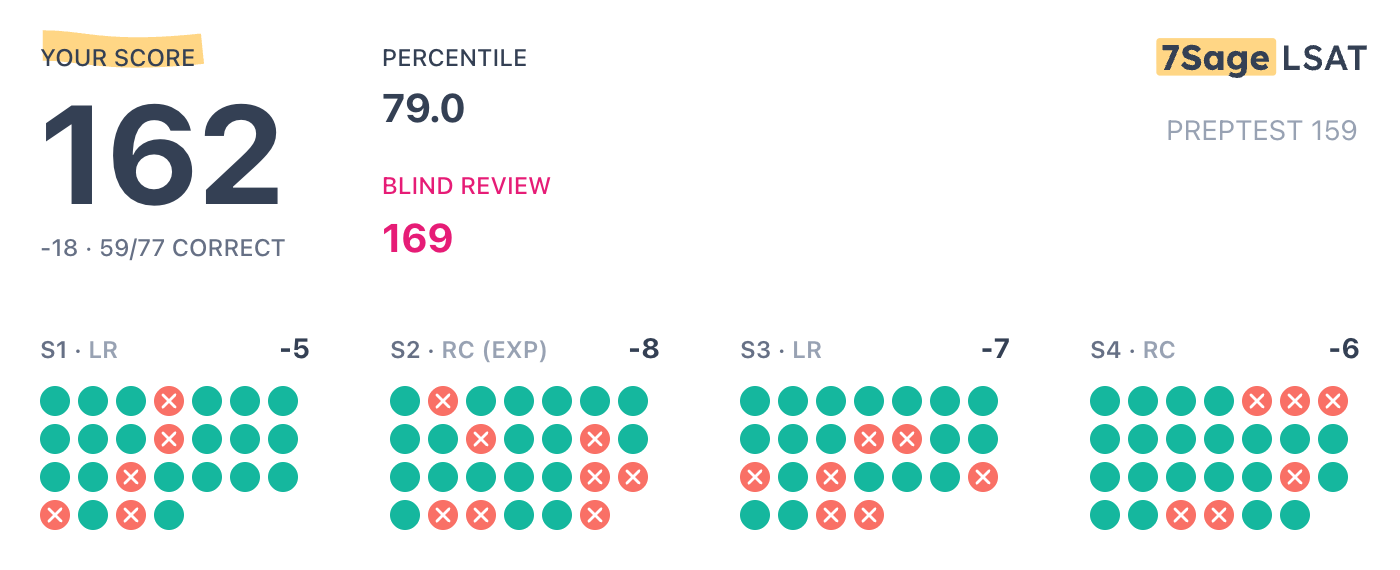

Feeling very proud and excited about my most recent PT score (166) on PT 156.
I scored a 163 on the August exam and am confident I can score similar to this in October or November (manifestation to the umph degree). I would squeak out if I got this score on either of those tests!!
While I am clearly not close to a perfect score, I am happy to try walk through some specific questions with folks who struggled with this PT. 

Finally figured out how to best review my drills (yay) and I realized how I generally have a lot of problem with correctly identifying the force of an argument and am just not very sensitive to it in general. How can I drill/practice this? Any specific exercises/games?
For example, I'm almost always good on MC/NA/SA questions, but Strengthen/Weaken/MSS/MBT/MBF (which is a massive list) are either a hit-or-miss or takes 2:30.
Any advice is appreciated!

9/17 EDIT: Thanks for your feedback! We're planning to increase the width and decrease the height of our tester to bring it more in line with what you'll experience on test day.
-------
OP:
We got conflicting reports after August about whether our current tester looks right.
If you took the official September test, could you let us know what you think? Check out how an RC drill looks at 100% zoom (so ctrl/cmd + or - until 100%) and your desired font size (change through accessibility options) and tell us how it compares. (If you took the test remotely, please let us know your laptop or monitor size.) Thanks in advance for the feedback!

Took the August LSAT - got way lower than my typical practice exams but now I am just completely traumatized by how difficult it felt for me and am worried this'll be a common reoccurrence for upcoming LSATs....

What are your top 3 RC tips to get better and faster?

I did my Sept 2026 LSAT and the first two sections felt great. Then after the break there was a HUGE technical error and I got kicked out after FULLY reading passage 2. The technical error lasted about 40 minutes and then we got placed right back where we were - so I had to
1) catch up on the reading because after 40 minutes it becomes foggy
2) Answer all the questions with the passage
3) do this in probably 4 minutes to keep on track of my timing.
To say the least I was freaking out. The testing centre was confused and it was just a mess. I finally get my anxiety calmed down and go to passage 3 - WHICH I GOT KICKED OUT AGAIN FOR 40 MINUTES. This is where it started to go downhill, shes crying in the test centre, doesn't know if i will finish the test and also has things to do which did not account for a 2 hour delay. Once i finally got back i was in the last section - which people were leaving at this point and it was very distracting. Anyways, I got approved for a retest date but i am feeling DEFEATED. I am working so much now and have to retake the test in 8 days – ugh.
Need motivation to start studying again for 8 more days while I work 7 of them leading up to the test 😔
(also this is my 3rd time taking the LSAT and first time I had felt confident going in)

I've recently hit a plateau in my PTs. In the past month, I have gotten 163-160-162-161 with blind reviews in the low to mid 170s. I'm anywhere from -3 to -6 in LR with my typical section being -5. RC is all over the place but I see myself improving a lot (even if it's not translating to PTs yet). I feel like I need to switch up the way I'm studying in LR. I struggle the most with flaw questions and questions with heavy conditional reasoning. Under timed conditions, I make small mistakes in my diagrams and chains that cause me to get the question wrong. Untimed I feel fine. Does anyone have any tips to grab a few more points? I'm taking October and November and my goal score is a 165+ to be a competitive applicant at my top schools (I'm a splitter). Any advice is very much appreciated!

Do you guys find it useful to watch the videos explaining questions even when you get them confidently correct? I have been debating watching them on the lessons or just moving past in an effort to get more practice in when I felt the question to be easy.

Hello, LSAT peeps! 👋🏾
I’m 37 and officially starting my LSAT study journey tomorrow! 🎯 My goal is to take the exam in January 2027, and I’m excited (and admittedly a little nervous) to see where this journey takes me.
It’s been a long time since I’ve been a student, so getting back into study mode feels both unfamiliar and exciting. But honestly? I’m absolutely loving the process so far. There’s something really motivating about challenging yourself to learn something new and pursue a goal that once felt so far away.
I’d love to connect with others who are currently studying for the LSAT or starting their journey, especially anyone working toward a high score. 📚🧠
Let’s encourage each other, share strategies, celebrate the wins, and push through the inevitable moments of frustration. 😂
January 2027, here we come! 🚀
Who else is on this journey with me?

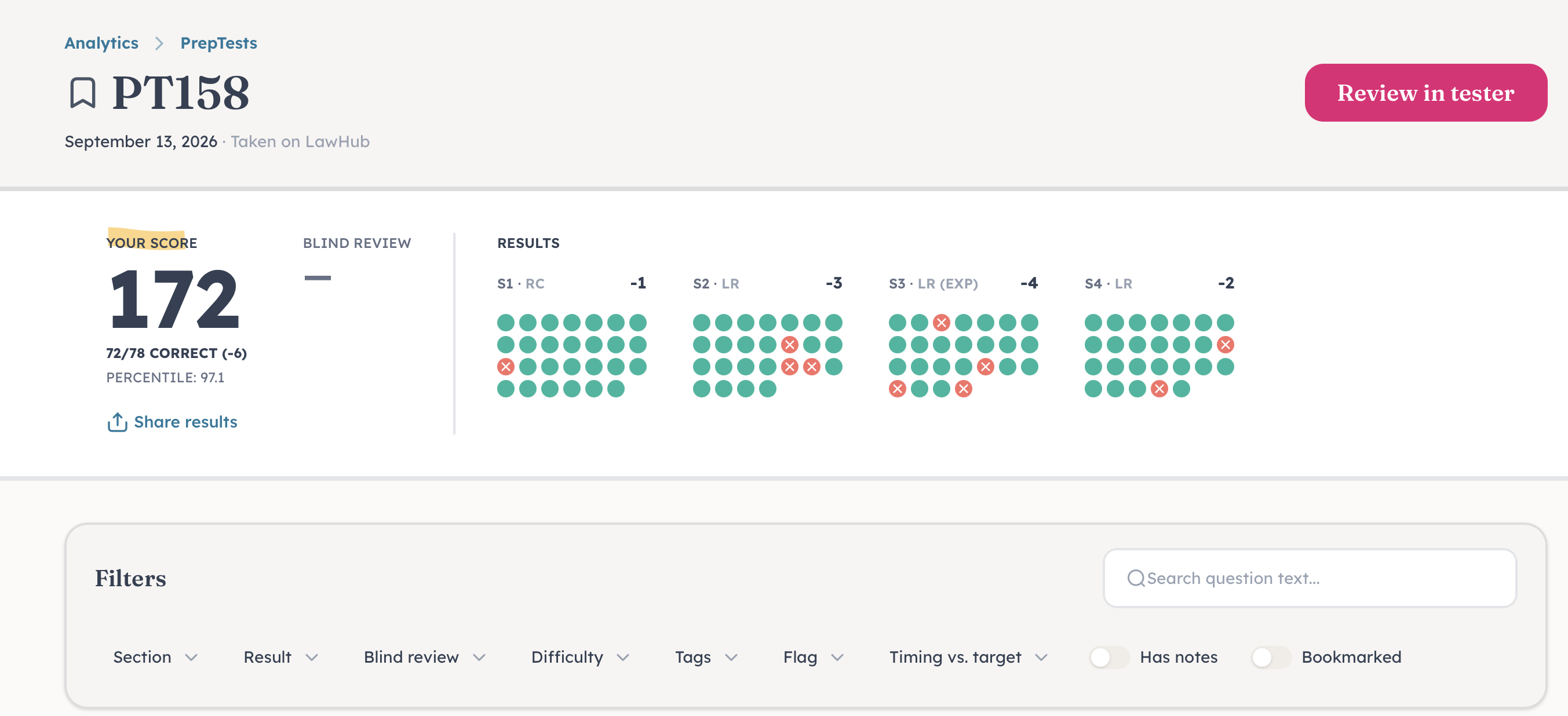
I'm so so so happy right now I can't even breathe

I am at the point in my LSAT journey that I decided to write letters to the future children (I don't even have, mind you), telling them that they had better appreciate all the mind-numbing, gut-wrenching, self-abusive work their future momma is doing right now.
I demand respite!

Good evening everyone!
Hope y'all are having a good start to the week! I need some advice on how to format my resume & what to include.
Here is how it is currently formatted:
Education
Work Experience
Skills
Achievements & Awards
I have been looking at all possible examples online and they are all so different its hard to pinpoint what I shouldn't and should add. I haven't seen many with the skills section and the achievements & awards are apart of the education. Any help with this is greatly appreciated!

I just started test prep with 7Sage, but I had previously been studying on my own for about 1-2 months. I was wondering if I should study for 4 months and take the January LSAT. That would leave me with three months to fix problem areas before I take the April LSAT. My other option would be taking an extra month to study before I take the LSAT for the first time in February and having two months before I take the LSAT in April. If I take the February LSAT I will not get my score back until a week after the deadline for the April LSAT registration. I am currently doing 3 hours of studying per day Monday-Saturday and taking Sunday off.


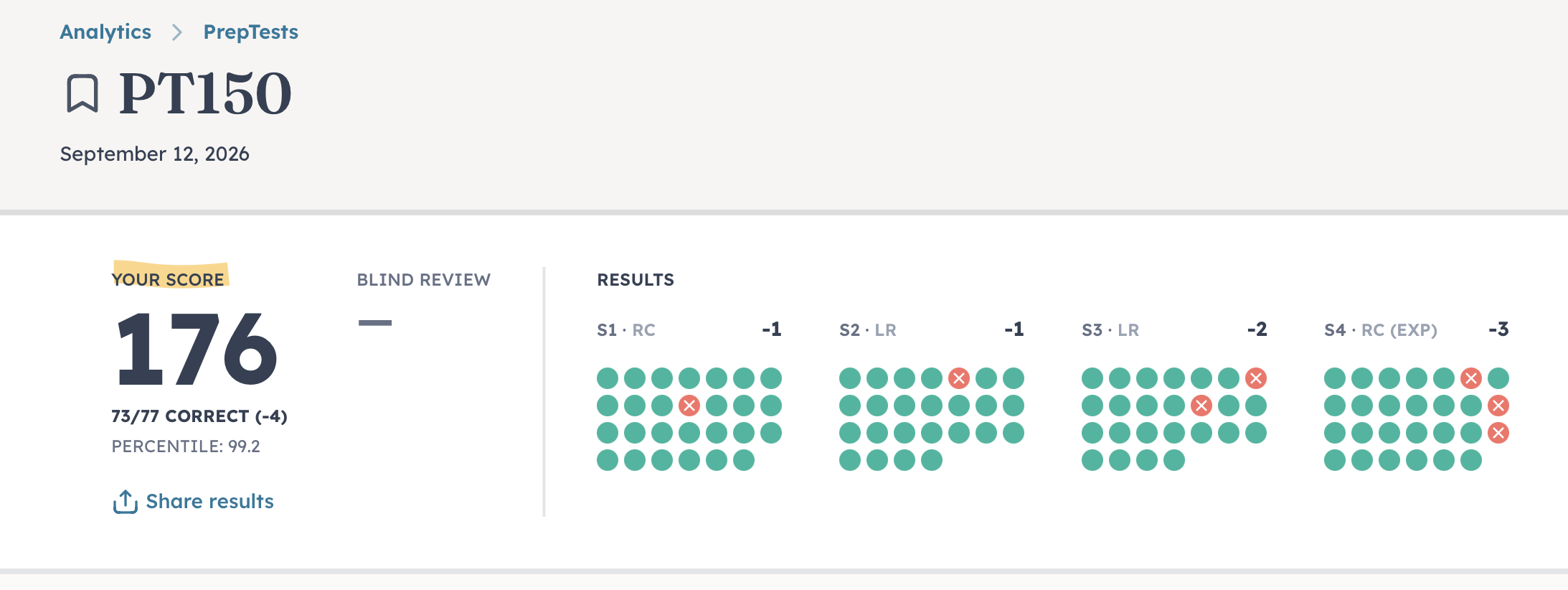 Taking my Last (3rd) attempt in October. Pray for me.

Recently, I hit a plateau where my PT scores were in the lower 150s. Thinking that my studying wasn't really getting me anywhere, I started to second-guess how serious I was about the LSAT. After taking todays pt and seeing my score 5 points higher than the last I am still in shock. So glad to see that all of this hard work is finally paying off!!!! 😊 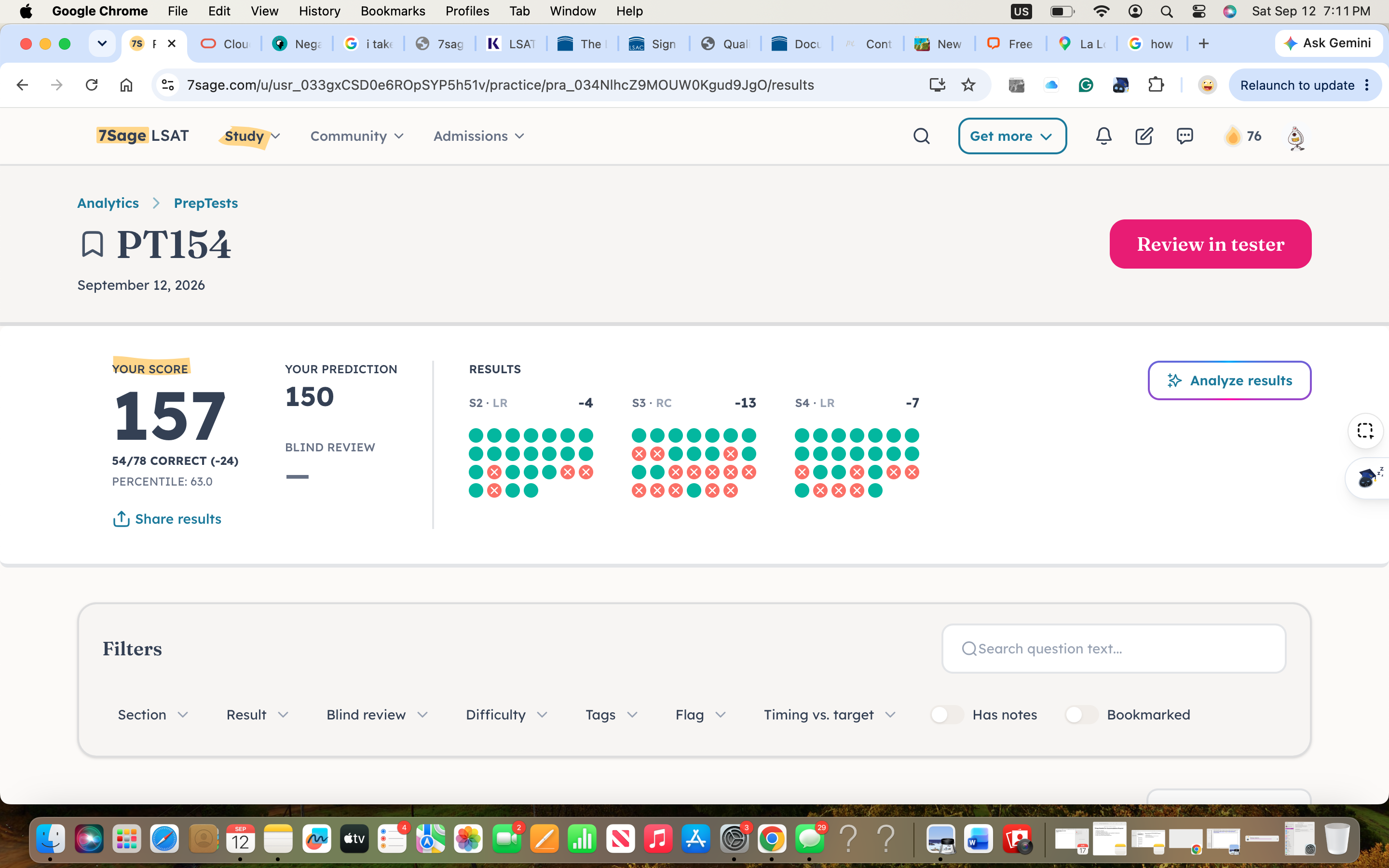

 I’m so happy to get a higher score during BR. I’m really trying to figure out how I can get my timed score closer to my blind review score/ how long it typically takes for the gap. I’m set to take my exam in October. I know it’s just about 4 weeks away but any tips on getting closer to the 170+ range is truly appreciated. Thank you!!

 Best of luck to everyone!
ETA: It was not nearly as scary as I built it up to be. I was well prepared. Shout out to 7Sage generally and special credit to Chapin and Henry's live classes and Kevin's Conditional Logic in 30 Minutes video!

Hi everyone, I'm Hana! I'm a 7Sage tutor and 178 scorer. I'm doing an LSAT AMA on Reddit until 6pm ET. Feel free to drop in a question on this thread: https://www.reddit.com/r/7SageLSAT/s/bs1ymrJRkC

On the drive alone to the center I cried my ahh off and later on finished the test feeling like I did so much better than expected. Not sure if the test was easier than the PTs I took, but I went through it with barely any mental exhaustion and my timing was so much more precise. I'm definitely still taking the October test since I realized I still have plenty of room for improvements.
Imma list out things I should keep in mind for the upcoming tests:
Never again attempt to take a timed PT the few days before test day. There's no benefit to it, and even if there is, the consequences to your mental health outweigh all of it. Just no. An untimed one might be fine, but you are definitely better off just doing casual drills.
Never again look at Crystal Ball. They predicted that PT 148 (the most disgusting thing ever written) is one of the PTs that resemble the September test. I barely got 150 on that PT and was so depressed. Unless you are sure predictions can help you in some way, just pretend it doesn't exist and give yourself the peace of mind. I, in fact, would have had better sleep the night before if I didn't check Crystal Ball.
The best thing to do just before test days is preparing yourself mentally well so that you can comfortably breeze through the stupid arguments. That means random drills and 7sage games. Not learning new things, but reinforcing your reading habits.

How did you fix an LR execution gap where your Blind Review is much stronger than your first pass — even when untimed?
I’m early in my LSAT prep and currently drilling LR untimed. I’ve noticed that my Blind Review/re-review reasoning is consistently better than my initial answers, even though my initial drills are already unlimited time.
The issue doesn’t seem to be that I don’t understand the question types. When I review a miss without seeing the correct answer or explanation, I usually identify what went wrong and change to the correct answer. My recurring mistakes are things like:
compressing language in the stimulus too early and losing an important relationship
reading two similar but meaningfully different concepts as the same (how long something formed v. when it formed or attempt v. success)
overlooking a word/phrase in an answer choice that changes what it means
understanding an argument better on the second read and then realizing my original AC was based on a slightly different representation of it (making the wrong AC sound right basically)
I’m intentionally not working on speed yet. I want to make the reasoning I’m capable of during BR happen reliably on the first encounter.
If you had this problem, what specifically helped? Did you use a checklist, change how you read/translate stimuli, force yourself to verify answer choices against the stimulus, do smaller drill sets, keep a particular kind of wrong-answer journal, etc.?
I’m more interested in concrete habits that eventually became automatic rather than just “slow down/read carefully.” You can still say the latter though.


 I've been scoring in the high 160s low 170s recently, but I would be suprised if I broke 160 on that. IDK what the hell happened it just felt like such a struggle