


LSAT
New post300 posts in the last 30 days

I tend to do well on RC Passages but frequently go over time, whether that's with reading or answering questions. Any tips out there from those that struggled with timing but eventually managed to find solutions to knock out this section(s) of the exam?

I am taking the August LSAT and as I take PT I keep scoring around 155 under timed conditions. Then, once I blind review, I keep scoring around 167. My goal is a 170 or higher on this August test, but I would still be very happy with a 167 or 168 on my August one. This has been a consistent trend in the last 3 PT I have taken, and I am not sure what to do in between my PT to get more correct answers under timed conditions. I have been studying for many months, I have finished the core curriculum, but this keeps happening. What do I do???

Title says it all. Heard a rumor somewhere that this is a real thing, and AI bot mentioned it lol. Can anyone confirm that in a RC section, passages 4 vs 1 tend to be different?

New to Flaw questions? Check out the top 10 flaws you need to know:
Great quick overview for beginners. If you're experienced, you might appreciate the visuals for each flaw type.
Check out this flaw cheat sheet, too: https://7sage.com/lessons/logical-reasoning/flaw-or-descriptive-weakening-questions/argument-flaw-cheat-sheet
@EricB7Sage


Hi, I have been studying the LSAT for quite a few months now, and I have built my score from a low 145 to a nice score of 164 at my best, and an average of 161. Especially my past few PTs have generally been around the low 160 area. My problem is when I test sections, I typically have strong scores like -4 being my worst in LR recently and having common -4, -3, and -2. Yet on full PTs, no matter the beginning or ending of the exam, I do fairly worse. I'm talking closer to -4, -5, -6. I'm not exactly sure why this is, but I have some guesses, like the scary feeling of taking a full test compared to a section, but honestly, I am not too sure. This is also corroborated by the fact that, unlike sections where this practically never happens, sometimes on recent PTs I completely bomb sections. I'd love to hear any advice or thoughts on how to approach this, because my room for improvement feels less on the fundamentals and understanding of questions and more on the psychological / consistency side. Thanks for any comments in advance!

I'm curious how everyone is using their Wrong Answer Journals to actually reinforce what they've learned. When I do drills I go through each question even if I got it right and watch the video/read the explanation to make sure that my reasoning is correct and matches up. I go through each Answer choice and say why its wrong or right and why I thought it was correct, and why I made the mistake that I did in choosing the wrong answer. My issue isn't reviewing the questions; it's retaining the lessons afterward.
How are you reinforcing the takeaways from your mistakes? Do you revisit your Wrong Answer Journal on a schedule? Do you summarize recurring patterns or make flashcards? I'm finding it difficult to remember the notes, errors, and takeaways from a drill I did two weeks ago, or even from a question type I worked on five days ago. And sometimes the takeaway isn't even a recurring pattern—it's something very specific about that particular stimulus or argument that tripped me up. I'm not sure how people retain those kinds of lessons either.
I'd love to hear what has worked for other people!! #help

I have had trouble when it comes to review. Whenever it's time to do blind review or wrong answer journal, it feels like my brain completely turns off. Just going through the motions to say "I did it". When it came to trying to understand the argument and the answer choices, I would just read the explanation and again move on. Not taking the time to understand anything on my own. Just shooting myself in the foot. I did a drill today and on the one question I got wrong, I ignored my first instinct to just read the explanation and move on. I was determined to understand this argument on my own. I broke it down and was able to not only see why my answer choice was incorrect, but what the argument was, I found the gap in the assumption, and was able to see what the correct answer was. It feels like a small win to move forward for effectively but a massive win personally. If anyone else is struggling with this, don't take the easy way out!

I have found that when I take RC sections (and to a lesser extent any later section in a PT), I often have moments when my eyes totally glaze over, and I completely lose focus on what I’m reading. I’ll ‘read’ two or three lines, then have to physically shake my head and re-read, having internalized NOTHING. This also happens when I try to skim for details to confirm answers, I’ll just kind of lose what I’m doing and need to spend mental energy regaining my place in things.
This might not be a strict LSAT issue, but does anyone have any tips for streamlining RC sections in general, or tips to maintain focus on singularly important points?

Hi everyone,
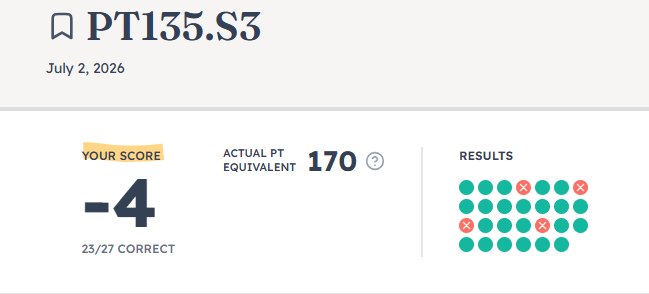
I've been consistently getting -4 on RC lately and I have no clue on how to improve my accuracy, since the question types I get wrong on each practice section differ.
Has anyone else dealt with this issue and have advice to share? I'm aiming for the September test and hope to improve by then!

I have been studying for the past 3-4 months but feel as if nothing is breaking through. When I drill, I am usually able to understand all my mistakes after review and am constantly note taking. But when I am doing PTs or longer drills- it feels like nothing is breaking through. I FEEL like I know so much more but my actual performance is showing other wise.
My PTs have been 145, 153, 152, 160 (which really encouraged me), 152 and 153.
I have not done the core curriculum or watched videos. I feel as if I am a fail, examine and learn, type of learner, but will of course consider this. Does anyone have any suggestions or any notes? I am so convinced I understand the logic and tricks soooo much more- but in practice it shows otherwise. I KNOW we can all do this, but super disheartened.


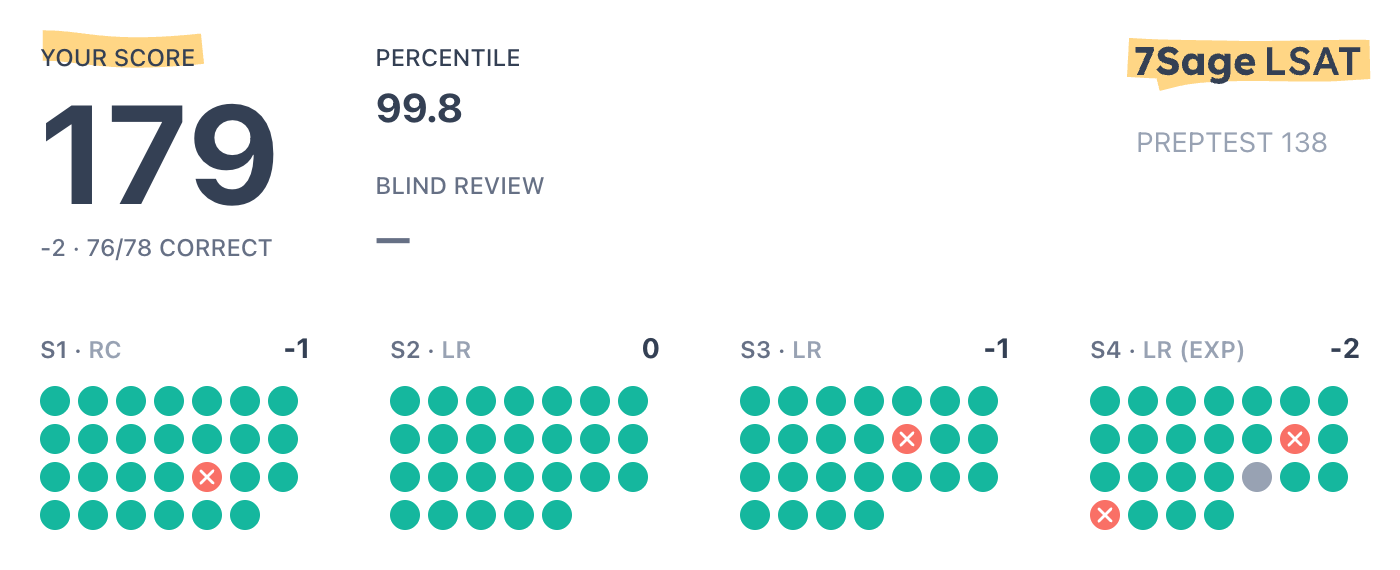
Had to get zero wrong out of respect for how many picks the Lakers have left

I am stuck. I am horrible at RC and have been studying for over 6 months now with multiple types of resources (7sage, tutoring, blueprint, powerscore...) and nothing is helping. I cant seem to get better AT ALL. I am not fully sure where my problem is but I am a ESL lsat studier and i don't know if that's why. I will accept any help, any tips and any tricks.
THANK YOU!!!

If you're feeling stuck or de-motivated, you're not alone. Improving your LSAT score takes a lot of practice.
How much? We ran the numbers: https://7sage.com/how-long-to-improve
The LSAT is hard, but fun!
Play our LSAT games on your phone or tablet! These work offline, so you can keep gaming and training on flights, cruises, creepy mountain trails, and anywhere else your signal dies.
https://apps.apple.com/app/lsat-games/id6781413607
https://play.google.com/store/apps/details?id=com.sevensage.lsatgames
We're listening to your feedback and rolling out improvements every week!
(You can still play them on your laptop/PC here: https://7sage.com/games.)

The standard schedule administers one preptest a week. I registered for the August test, started with a 166 have a 170+ goal. I was wondering if it would be worthwhile to limit drilling to full sections only, and bringing in a second preptest midweek to simulate testing conditions more frequently. Anyone have insight on this plan?

After I have published a note, I cannot seem to edit it anymore. Anyone else having this issue. Clicking "Edit Note" does nothing for me.

Hi everyone,
I have cerebral palsy with severe muscle spasms, and I'm planning to take the LSAT this fall.
I'm wondering if anyone here has cerebral palsy or another condition with severe spasms. How do you manage studying on difficult days? Do you have any tips for staying consistent or preparing for the LSAT while dealing with chronic pain and muscle spasms?
I'd really appreciate any advice or experiences you're willing to share. Thank you!

ScienceAlex
Independent TutorEssential Study Skills for MinMaxing Your Score (part 1 - remembering + understanding)
This is part of how I got to a 177 PT after 4 weeks of studying.
Hi! I have a master's degree in education, and I'm currently using it to minmax my studying for this test using some of the most foundational things that teachers learn about in college. That means I want to put in the least amount of study hours and have the maximum retention and mastery of the material. I'd like to share with you what I know, so you, too, can steal my study methods.
I'd like to introduce y'all to a framework called Bloom's Taxonomy. This is one tool teachers are using when they create lesson plans and decide what order students should learn things in. This is also the very foundation of what I'm doing to accelerate my study timeline.
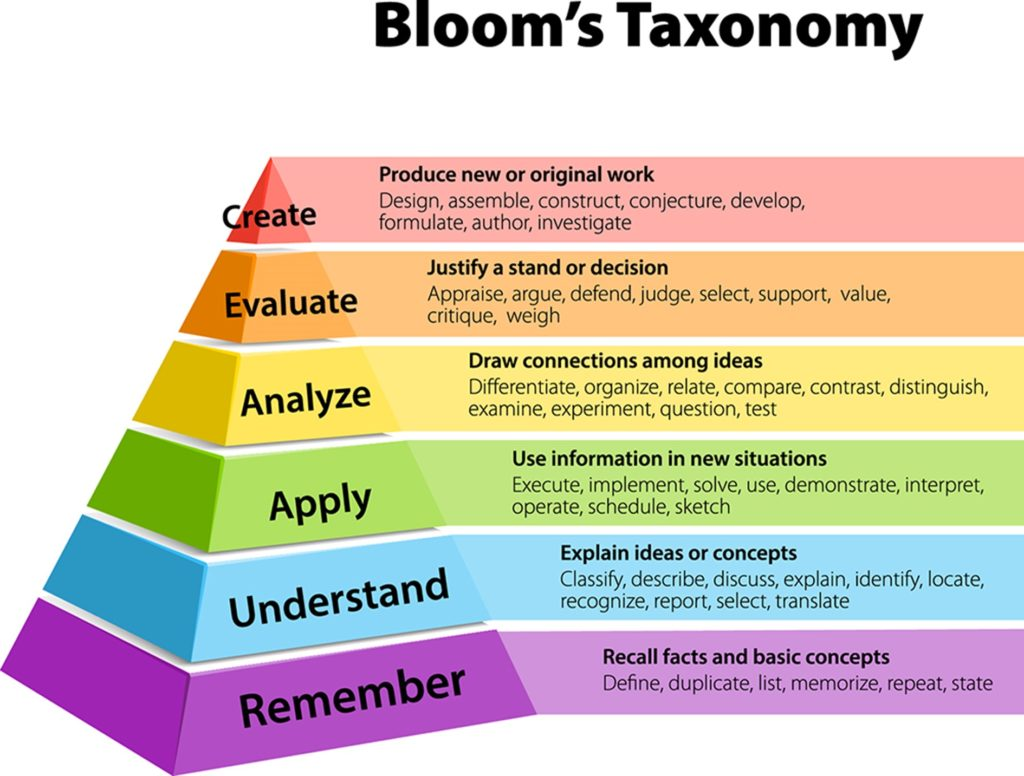
No matter what curriculum you're using to study for the LSAT, you should not be starting off with immediately doing questions*. Instead, you need to learn the very most basic facts and concepts and understand what you're reading. Most people think that this means that they should skim the article, maybe watch the video for a little bit, and then call it a day. "Okay, I've done the reading, now I can apply." No. Without truly understanding what you just read and internalizing it, you cannot get the apply, analyze, and evaluate stages of Bloom's taxonomy (which is where the questions live). And I'll be honest, this part, the understand and remember stage, does require a little bit of front-loading the material. Meaning, you might put more hours into this stage than any other stage.
So what does internalizing something mean? How do I do it repeatably, easily, and fluidly? It's not really a one-size-fits-all kind of situation, but the "topic learning cycle" I outline below can really improve your retention. It may not work for everyone, but it is one framework based on the science of how people actually learn that works for me.
Day 1 of a topic: Be an active reader. This means finding ways to connect with the text using some level of background knowledge. This means asking questions of the text and actively summarizing in your brain as you read. I'll probably make a separate post on the details of active reading strategies we teach in k-12.
Day 1: Check your understanding. This is different than the Apply stage on Bloom's. Checking your understanding means perhaps doing a skill builder or a you try (caution - this does involve going beyond the understand level of Bloom's sometimes) about the material that you just consumed. If there isn't a Skill Builder published about that reading, or there isn't a you try published about that reading, then you need to design it yourself as you're reading. One way you can do this is anytime you have a question about the reading, write that question down on an index card. Then, if the answer comes up later, write that answer down on the back side. Then compile all your index cards and quiz yourself with them.
Day 2: Only take notes on the second pass! The first time you read something, it should be purely for understanding. The second time, you should take notes on what you remember as the most important things in the reading. This should ideally happen at least a day after you did the reading the first time.
Day 3: Compile your notes, any quiz questions you made for yourself, and any key terms from the reading into an Anki deck. While I have my own, it is way more effective if you make it for yourself. Identifying what to put in the deck is part of the learning process.
Day 4 and beyond: use spaced repetition, which is what Anki is for, to continue to review the material as you add new material in (note - Anki will not be the only way you use this material, it is just the foundation).
Does this mean that you're taking four days to learn each topic? Yes, but you shouldn't be only learning one topic at a time. There's a reason I said this was a cycle:
Day 1: learn one topic.
Day 2: review the first topic and add in a second.
Day 3: review topics one and two and add in a third.
What do I mean by one topic? Well, there isn't an easy, clear-cut answer for this. One topic could mean just one reading here on 7Sage. It could also mean all of the content in a module. It really depends on you: how much your brain can handle learning at once and how long you have to study.
Now, I know I just said that you probably shouldn't be using actual LSAT questions during this stage, but there are a couple exceptions. You could probably safely do the Main Conclusion and Argument Part questions as soon as you have memorized all of the argument indicator words and understand what an argument structure is. That might be getting to apply just a little bit, but I would argue it's still mostly in the understand stage
By taking the time to truly internalize each topic that you learn, you'll be much better prepared to move on to the apply, analyze, and evaluate stages of Bloom's taxonomy. That's the end of this post, but I'll probably make another one about the higher stages later on.
*yes, you should take a diagnostic.

This was just a section but incredibly motivating to see 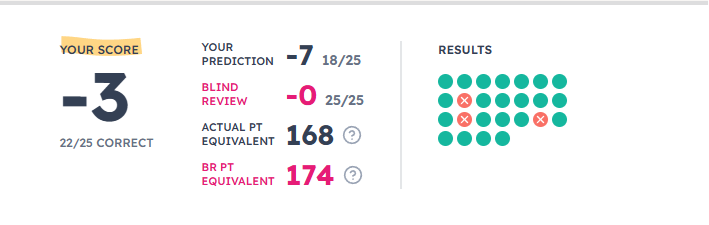

Hi, I would love to hear some testimonials about your experience with 7Sage. I don't know anyone personally who has taken it before. I want to make sure I get a better idea of what the experience is like for students who achieved their dream score.
I'm still in the decision-making stage between Test Prep Companies and want to ensure I make the right choice.
Thank you for your time and advice.

Hello all! I am consistently getting about sixteen questions correct on logical reasoning sections. I typically get two to three wrong within the first 15/16 questions but then I tank in the last ten. I feel like I am not improving on those harder questions and I haven't been able to identify why that is.
I am currently doing timed sections and untimed drilling. My accuracy is usually anywhere from 70-75 percent on the questions that I get to and I on average score a 15/16. However, I usually don't get to about the last five.
If anyone wants to share any advice or have any study tips that significantly helped them I'm more than open to hearing them. Any help is much appreciated.
Thanks & happy studying to everyone!
Edit: I tried to implement everyone's suggestions in a timed LR section (mostly skipping questions that were eating up my time and going back to them) and was able to get to all of the questions. I also scored a 17/25 and received a 17/25 for my accuracy as well. Thank you everyone!

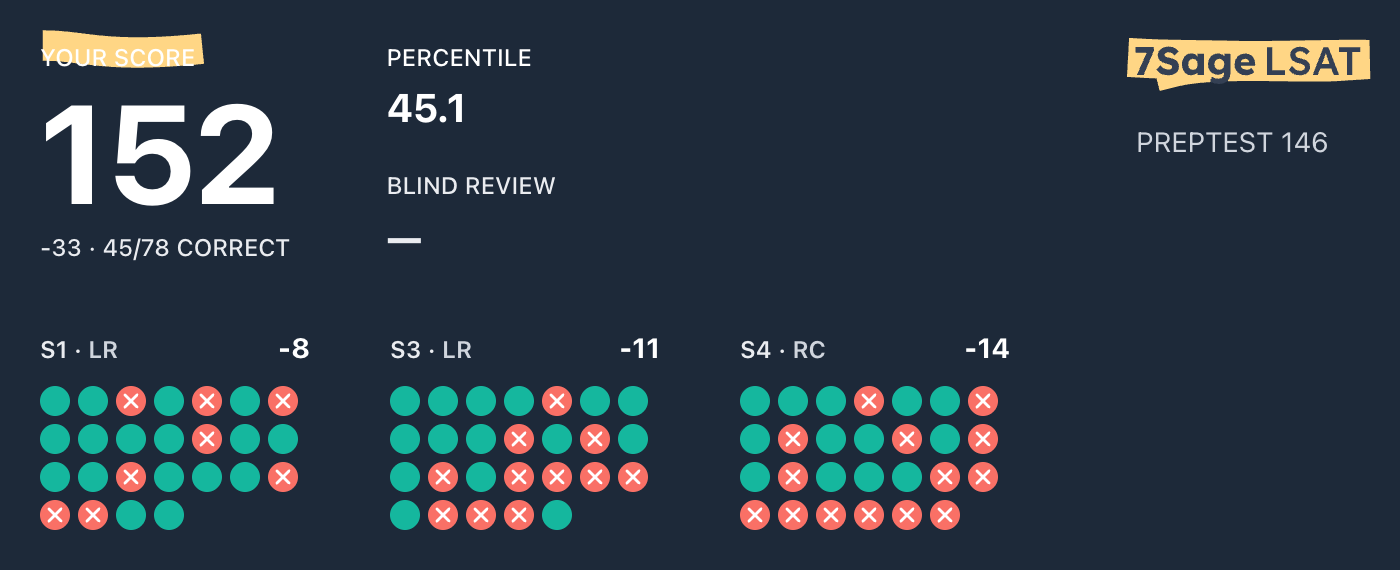
So, I just took the June lsat and did atrocious. I got a 152. I had been scoring in the high 150's and even got a 160 once. I've been studying more, because I am taking the August LSAT. AND IT IS NOT GOOD. I keep hitting my original diagnostic of a 151. I think what frustrates me the most is that I have a very good application besides the LSAT and I can not seem to crack this test. I started going back through what I struggle through the most, and have been reviewing like crazy but if anyone has any advice or has been in this position it would be greatly appreciated. I feel like I have "hit a wall". (I will be applying this upcoming application cycle and I really only want a 157 or above).

Every time I take a section my score ranges and my types range and depending on how i take it (starting from difficult to easy or easy to difficult) changes where my most wring answers are too any tips?