General
New post65 posts in the last 30 days

Hi everyone!
I'm an undergrad student who is pretty set on law school (2028 cycle) and im having trouble with consistency. Over the summer i was studying a decent amount and now that school has started i havent been holding myself accountable. I guess my question is for other busy people with school, work, extracariculars and not a ton of free time:
What are some unhinged tips for creating a good lsat routine and avoiding burnout?

We’re starting a new, weekly contest for submissions to our subreddit, located here: https://reddit.com/r/7SageLSAT .
At the end of the week, the best post will win you a free 7Sage class (LSAT Accelerated, LSAT Advanced, or Total Prep Intensive, your choice!) or an essay workshop, your choice.
Obviously, keep things appropriate, but feel free to post questions, observations, memes–anything you think will add to our community on the subreddit.
If you have any questions about the contest, let me know. Otherwise, happy posting!

EthanMadore
Admissions CoordinatorAsk an AO at UT Austin anything! (Also, win a free Essay Workshop?)
Hey Applicants!
We're having Mathiew Le, Assistant Dean for Admissions at Texas Law, on the podcast next week. If you have a question, please post it on this reddit thread!
https://www.reddit.com/r/7SageLSAT/comments/1whkcam/do_you_have_a_question_for_the_texas_law/
We'll ask the most upvoted questions on air next week (post your questions by 5PM this Thursday, Texas Time)
The best question for Mathiew (as determined scientifically by Pauline, our fantastic YLS-educated hot-shot lawyer co-host) will get a free Essay Workshop with a 7Sage Admissions Consultant (possibly Pauline herself!)

When I'm reviewing a question, and I am under the notes section, I get kicked out and redirected to the explanation video or sometimes the pop-up window just closes down without me clicking on anything. After I try to get back into the notes section of the question, it takes a while for the pop-up window to load. And sometimes when it does load, it just closes again. I had this other issue where the timer, during a practice test, glitched and kept jumping back between 3 to 5 seconds. After going through three questions, the clock ran without glitching.
Anyone else having these problems? I thought it might have been my computer or WIFI but other websites run perfectly fine.

Hi everyone,
I'm very confused by how to interpret "or"/disjunction in conditional logic.
For the sentence "If A or B don't occur, then C occurs",
Does this imply:
1) /(A or B) -> C
2) (/A or /B) -> C
Let's say A occurs and B doesn't.
For Interpretation 1, the sufficient assumption would not be fulfilled; "A or B" is fulfilled since B is fulfilled. Since the conditional only works if "A or B" isn't true (the "/"), the conditional fails.
For Interpretation 2, the sufficient assumption WOULD be fulfilled; "/B" is fulfilled; since only one needs to be fulfilled, the condition works and we can infer C.
I'm not sure if that explanation made sense to anyone else. If it did, can someone explain which interpretation is accurate and WHY?
(I come from a Computer Science background and so this is the way it makes sense to me.)

I must say, i really wish 7Sage had the games function last year when I wrote the LSAT for the first time. It has helped me improve my conditional, negation and other skills in a way drilling didn't help. I wanna see more games!!

Hi everyone!
I had a question about remote testing for this upcoming October LSAT session and was wondering if anyone is in a similar situation? I live in Victoria, B.C., off the coast of Vancouver. The closest testing centre for me is in Vancouver and will take more than, or slightly less than, 3 hours to get to by car, or closer to 4 hours on public transit (I have to take a ferry).
I called LSAC this morning asking when I can expect to hear back regarding my request, and they said the administrators would start going over requests on September 22nd (test centre registration day) and that I should not book a testing location until I hear back about my request. Since LSAC says that only a very limited number of candidates will be approved for remote testing, I'm afraid they will deny my request, and I won't be able to secure a desirable time/date for in-person testing.
If anyone is going through a similar situation, please let me know what you plan on doing! I would appreciate some insight :)

This has been going on since 9/5 where the timer gets stuck in an interval of 30-65 seconds and goes back to the same time. At first it would get fixed when I refreshed the page and update my chrome. But now it just keeps looping after a few more minutes goes by.
Just curious if its a me problem or if others are experiencing it too, if so what did you do to fix it?

In the past few weeks, I'm having issues with turning the response masking feature on and off without it lagging while the clock continues running normally on timed sections. This has made it on my most recent section that I missed the last question because the clock ran out of time while I was trying to get the response masking to cooperate.
To get a bit more specific, I tried to turn on the feature, strike out an AC, and then turn it off, and select the answer choice I thought was correct. The feature lagged and didn't read all of my inputs correctly and highlighted the answer that I was trying to cross out instead. While I was trying to fix this error on the system's part, I ran out of time on the section and the answer was marked as wrong, which messes with my analytics.
Is anyone else having similar issues with the system, or is my computer just lagging? I thought at first it was just my computer being slow, but the timer doesn't seem to pause when the rest of the platform is lagging like this.

Hi all,
I have been having this problem where my BR score is usually 10 points or more higher than my actual score. Does anyone have any advice on how to close the gap? Thanks!

I am taking the Sep LSAT tomorrow and have done my last drill, section and PT on 7Sage. Surprisingly, it is a bittersweet feeling.
Since January, I have spent 1-2 hours nearly every morning on 7Sage, first on lessons, and then incessant drilling, PTing and reviewing. It had become a staple of my daily routine and I have felt the full range of emotions during this time. It started with me pulling my hair out, as I felt crushed by the LSAT's wiles under time pressure, and ended with me celebrating "perfect mornings", where I didn't miss a single question during the study plan's allotted section and drills. Now, I take a 60 day PT avg of 176 into test day tomorrow morning.
There were several times throughout my studying where I tried to imagine what my progress would have been without 7Sage, and I found it impossible. The inexorable tide of resources, bundled into this incredible interface and coupled with countless hours of studying and review all but guaranteed success from my perspective.
To @J.Y.Ping, @Kevin_Lin, @MichaelWright and the rest of the incredible 7Sage team, I can't thank you enough. There were so many times where one of your videos, explanations, or comments led me to genuine breakthroughs that in accumulation enable me to go to sleep tonight with the utmost of confidence and preparation.
goodnight

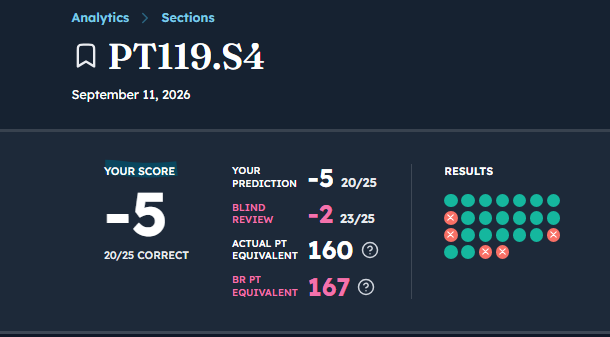 MY best PT yet!!!!! Made me very happy.

Is there a way to make it so my "priority tabs" are based off the data from Month x to month x? I think it would be helpful in my studying to focus on priorities from the past say 4 months instead of the 1+ year I have been studying, especially because when I started studying I was lucky to have 30 min a day to study.
-if not I think this would be a useful system to add in-
Also, when I drill missed questions, is there a way to set that timeframe as well? That I think would be more useful to set to 5+ months ago, this way I am getting questions I got wrong, but not ones I got wrong in the past 2 weeks and have a strong memory of the correct answer because I spent 5+ minutes reviewing it and beating myself up over it.

Hello fellow masochists,
I've been feeling overwhelmingly discouraged as of late. Between my full-time job and the rest of life, the hours spent in the evening away from my family, and the time away from fiancee, that I'm marrying in 9 days, LSAT prep has been seriously draining me. I am frustrated, tired, confused, and just overall exhausted. But, I know that consistency beats everything. I wasn't giving up my 44 day streak for anything. I decided to do a quick ten-question timed LR drill before bed. Went 8 for 10 on my first pass. Got both correct in BR that I missed during my first pass. I have never done that well under timed conditions. It feels good.
I just wanted to share a small victory for anyone else who might be struggling. In 44 days, you'll be a little better. I'm sure in 44 days, I'll be even better. +1% every day is so more impressive than you think.
Consistency is king.
You got this, future lawyer.
Thanks,
TR

Hello!
So, I am registered for the November LSAT but am facing a dilemma. I've been reviewing LR and RC for a solid 6-8 months and have been building my skills through Level 1 and 2 LR drilling. I'm almost 2000 questions in, and I know quality over quantity, but my analytics are now skewed toward lower percentages per priority. I've done multiple sections, have almost completed both the LR and RC curriculum, and now I'm self-practicing and incorporating more sections in both LR and RC. My main dilemma is that I haven't taken any prep tests at all, and I thought taking them once I felt adequately prepared would be sufficient. Now that I have two months left, should I take a prep test once a week, or more/less? Also, I struggle during timed conditions, and specifically with the idea of prep tests, and I need tips on how to stay engaged. I know the logic is in the 160s, and I'm aiming for no more than a 165. I also struggle with my big gap between timed/untimed conditions. For example, in the labs section of the stat overview, when it converts drills into a PT equiv, I've averaged a supposed score in the high 160s, up to 171. But timed is close to 150-155 sometimes. I also know that when I drill untimed but try to answer questions at a relatively good pace, I get more questions correct (+10 -> +30) seconds over. Levels 1-2 are easy, 3 is 70/30 accuracy, and levels 4-5 are hit and miss. I'm wondering if it's ok to be over time on some questions. I'm wondering if it's okay to go over time on some questions. If anyone can relate, let me know.
Thanks.

Any Iranian-American/Canadian here?
I just received this email, assuming because my profile includes my Iranian citizenship as well as Canadian. I also tried to login to LSAC and it says "account blocked". I'm a canadian citizen and live in Canada and I'm also registered for the October test! I've emailed them but I can't stop freaking out!! Any help is appreciated! 😭
Update: thank you everyone for your help and support! I got my account back today after providing documentation!!

I downloaded the calendar .ics file but received an error saying the calendar file is corrupted when I attempted to import into Google Calendar. Please help.

Is anyone else’s webpage force refreshing? It happens when I try to type messages to Sage and literally happened twice when writing this post (I had to copy & paste from my notes app) because the refreshes erase everything you’ve typed. It’s super annoying and is making the website unusable.

Is this right? On the old interface we could highlight parts of an answer choice but I'm noticing we no longer can. Is this something that is permanent?

Does anyone know when the Tutor Office Hours are or where I can find a schedule for them?

 i love him tho thats twin

I've been stuck in the mid-160s for like a whole week after breaking my plateau of a month in the late 150s. I want to go to a good law school. So I will likely have to retake the exam. I feel stupid as shit, and this exam just seems to confirm that.

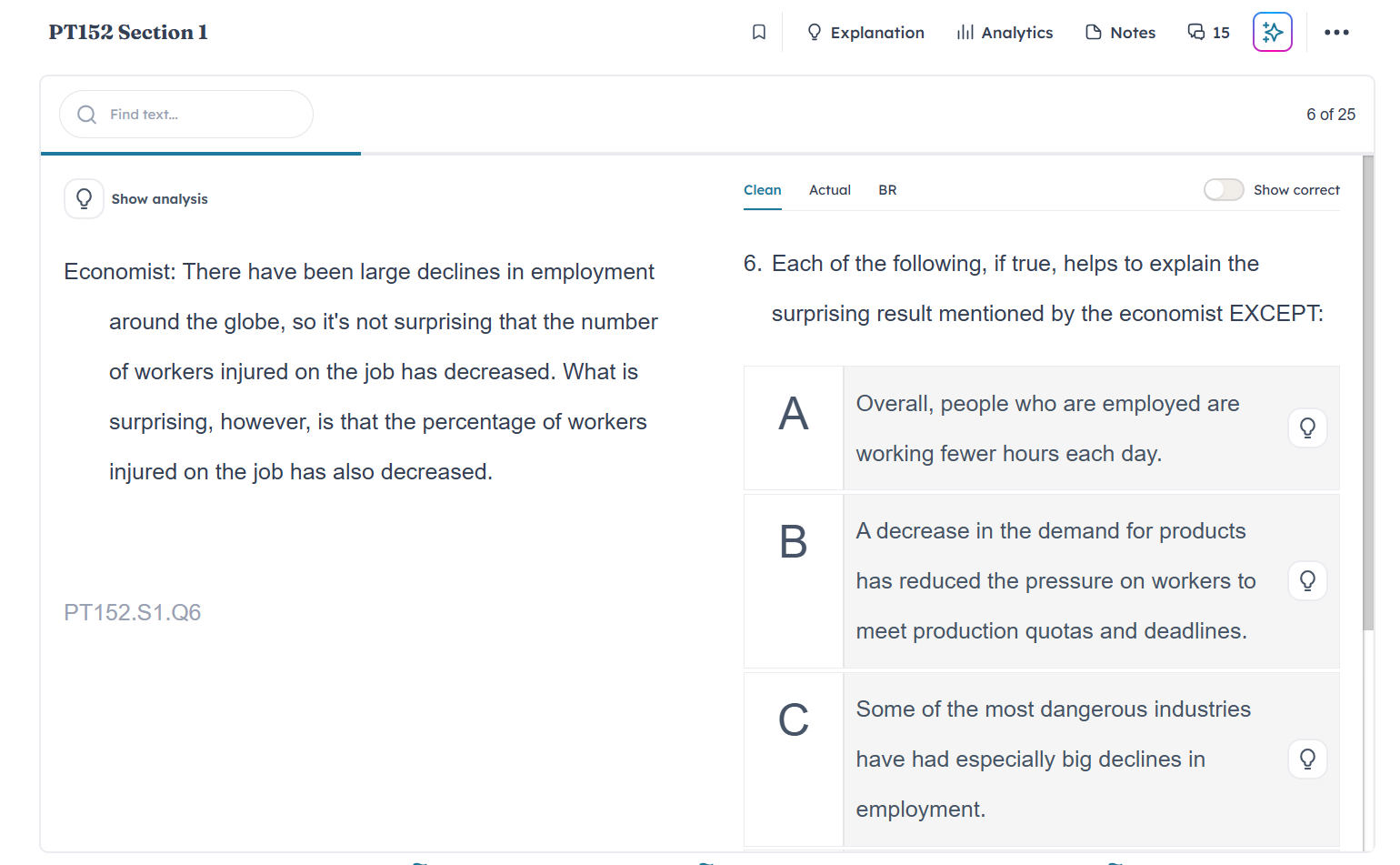
i had this issue a few weeks ago and it came up again while taking a practice section today

I'm taking the LSAT for the first time on the 10th and I just dropped my lowest PT score yet. I have been on a tight LSAT schedule and I've only taken 5 practice tests total, and got my lowest score yet by a few points, making it a 12 point range from my high score a week ago to the one I took today. I am for sure a little rattled and do not have the confidence I was hoping to have going into the final week of prep. General advice seems to be to not take a PT within a week of your test date, so this is probably the last PT score I'm looking at before test day.
Do people have advice on how to build confidence in the week up to my test?