


All posts
New post620 posts in the last 30 days

Hi! I'm a student at NYU Law School with an official LSAT score of 175. I've spent the past year+ tutoring the LSAT, and I have worked with 10+ students across a range of starting points and timelines. On average, my students have improved 7–10 points from their diagnostic score. Throughout my time tutoring (and while studying for the exam myself), I compiled a study guide including all of the question types you will see on the exam and relevant strategies for answering them. I also identify some important patterns across the exam. I’ve written some general tips below, but if you want the full guide, either comment or DM me and I can send it over!
A few general tips:
The LSAT tends to emphasize scope and tone words. The biggest place that my students see improvement is when they begin reading for tone and quantifying words in both LR and RC. In practice, this means recognizing when the passage or stimulus uses words like "some," "all," or "most" and being able to use those words to eliminate answer that are out of the scope of the question. It's my favorite hack and can help you eliminate answers almost every time.
You do not have to start from scratch each time you see a necessary assumption question. Similar to most other question types, necessary assumption leverages your pattern recognition skills, meaning you rarely have to start from complete scratch in answering a necessary assumption question. For example, many necessary assumption questions dealing with an experiment or trial carry the assumption that the group being studies does not have some other common variable that would impact the results one way or another.
For RC, the main point questions should cover the entire passage. If there is a prominent argument or tone in the passage, you will see that in the correct answer choice. If there is a counterargument that is discussed and rebutted extensively, that will also be in there. The most common wrong answers here are the ones that are too specific or too broad and don't cover enough of the passage.
I tutor both online and in person in the NYC area, and I'm flexible on scheduling. If you're aiming for a specific score range or just feeling stuck, message me and we can schedule a free intro call to go over what a study plan might look like. My rate is typically $100 per hour if we are meeting online, and $120 for in-person in NYC but am open to negotiating for class packages/fee waivers.

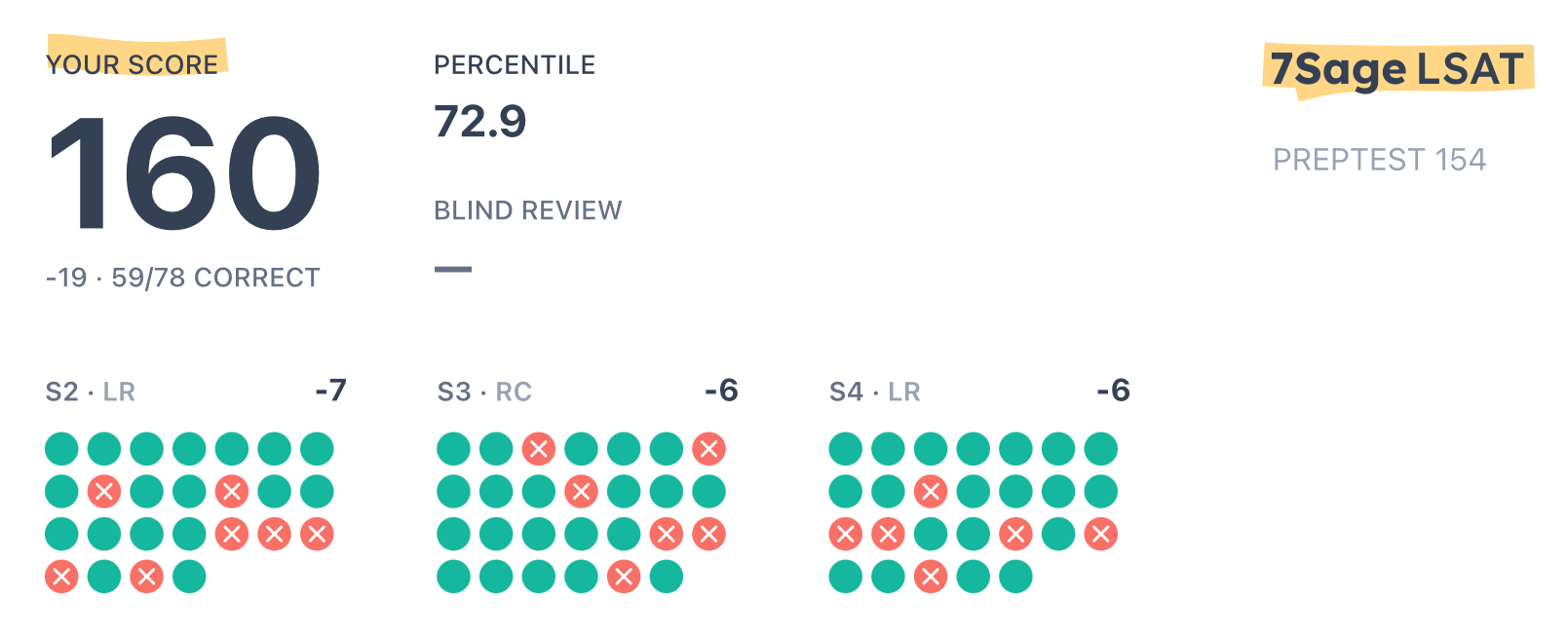 THIS IS MY FIRST TIME OUT OF 150S HELL. ITS BEEN 4 YEARS OF RAISING A BABY, WORKING 12 HOUR SHIFTS IN THE HOSPITAL, LEARNING LSAT LANGUAGE, RUNNING A HOUSE, WASHING CLOTHES, MOPING FLOORS, DOING DISHES, DOING LAUNDRY, AND ALOT OF TEARS. DO YALL THINK IN CAN REPEAT IT ?

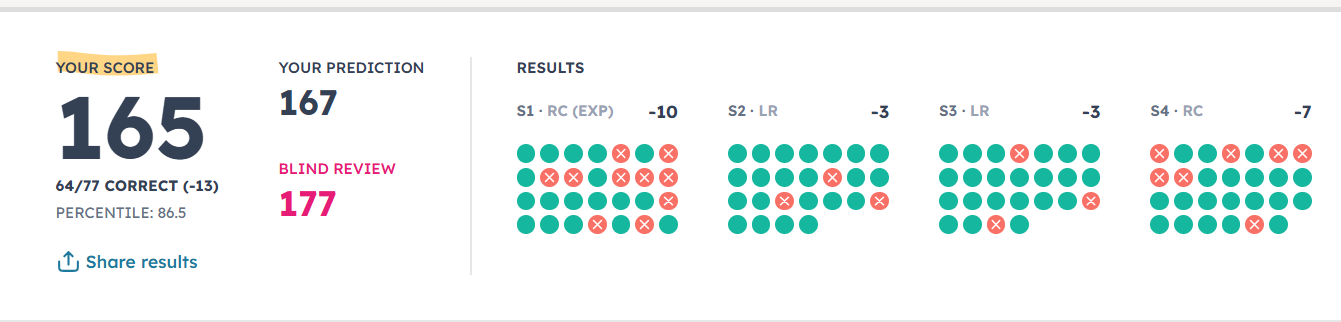 Hello!
I just recently finished the core curriculum here on 7Sage and have a pretty decent understanding of the LSAT as a whole, but like many others, I struggle with shrinking the gap between BR and my actual score! Particularly on RC where my scores most volatile under a timer.
Any tips?

Please add more info to the classes and tutoring pages (like the live page)
Group Classes
Upcoming group classes (all I can see is my schedule but not all the upcoming group classes)
Course details (tutor, date, time, level) | pricing -> (join)
Schedule tutoring
Tutors | Available Spots | Pricing
Don’t know who to pick (let us help you)
It would be very convenient and helpful to schedule base on individual needs (such as schedule, tutor or/and pricing). Students wouldn’t need to hunt tutors for their info (schedules, pricing + additional info during lives) and there’d be no need for a consultation.

Hi y'all,
I'm looking to find study buddies in-person or virtually so I can hold myself accountable.
A little about myself...
I just started studying and I'm in the ~145 to 150s range
I'd prefer to meet in-person regularily every week
Please do not chat with me when we are studying or I will go on a tangent :(
I am located around the Seattle areas so I'd love to make some more friends who have the same goals in mind!
Nice to e-meet everyone!!


I'm seeing a pattern of always getting analogy questions wrong on any RC passage.
I have my low res written down, I have the main point, and I have a structural understanding when going through the other questions.
What is the key to getting analogy questions? Is there something I'm missing in the passage that would help me get the analogy questions better? Or should I prephrase what kind of analogy I need to look for in the answer choices?
Any tips and tricks for Analogy questions would be great!

Hi! I recently took the August LSAT and wanted some tips on when to prioritize speed vs accuracy. My practice test scores have been variable, swinging between 163-171. I'd like to score a 170+
In both LR and RC, I am able to get almost every question right untimed. However, especially during the August LSAT, I felt like I had to guess on answers or speed through the questions when I wasn't 100% sure.
I know most of the advice is to work on the question types more and you will gradually get faster, which I intend to do before the October LSAT! But I was also looking for any advice you guys may have to get out of such a variable score and really work on speed without sacrificing accuracy for my next exam!

Anyone else having trouble downloading the preptest? I usually get a message that says "Internal Server Error."

Looking for others down to study by Tufts in Boston! We could each do our own thing but be silent together. My ig is @ arianamathews_ if anyone wants to message me on there!


Hi all, posting here to share my experience with the tech issues in Writing. It look me 4 hours of back and forth with ProctorU and LSAC technicians to figure things out, but I finally finished it. I want to share my experience here so folks don't have to go through the same struggles. For context, I took it with my laptop closed, connected to an external monitor, and I used a webcam.
Once you click on "launch the test" from your LSAC page, you'll be directed to install ProctorU extension on Chrome, and then you'll do a pre-check via a ProctorU interface. During the last step, you'll be directed to the "exam lobby". Once you click on "start testing", you'll see the LSAC interface to start the test. Before you start the test, you'll be prompted another Proctor U interface to do a 360-camera pan of your room. Once you are done with that, you'll read the LSAC acknowledgement, and start the writing test.
My lessons learned:
Test your camera beforehand, make sure it can take a focused image of your ID: I had a cheap webcam that couldn't focus on my ID. My laptop integrated camera couldn't either. I first connected with a real proctor to check my ID. However, by the time we finished checking everything, the LSAC writing page had already expired. I ended up having to call LSAC to cancel my first launch, starting a new link, and then borrowing my friend's Logitech 920.
Pre-check: the program will not let you go back to earlier steps once you take your photo and ID photo. If your camera is weird during this process (I think mine was trying to use the laptop's integrated camera, which was closed) - please do not clear cache or refresh page during this pre-check. Call and connect with a technician, they'll take over the screen to help you.
Register for ProctorU beforehand: you can register with ProctorU beforehand, and once you log in, you can also do a system check to make sure things are good.
Best of luck everyone! Hope everyone has a smooth testing experience.

Hi, I’m looking for a budget friendly tutor to help me break into the 160s by October. I’m currently scoring 153-157ish range and really would like to get to the mid 160s. I am able to study full time every day with the exception of saturday where I only can for an hour or so. I’d say I struggle most with RC and resolve/explain the most. I’m hoping to find a tutor for a session or two a week until October with weekday availability and budget friendly pricing as I have the fee waiver. Let me know what you all have to offer, thank you!!

I am having such a hard time reviewing practice tests by myself. I feel like I become so unmotivated. I feel like it could be super beneficial to get a group together and take the same practice test during the week then join a zoom to review the test. Would anyone be interested in this?


obviously, my study routine is not going to be the same the week of my LSAT. I'm taking it in less than a month in September, so I'm wondering what is recommended during the days prior. is it recommended to continue studying like normal but take some days off? or to cut study time in half the days leading up to it? Let me know! any other advice of how to prepare for the test mentally leading up to the test is welcomed too.

Is it possible to look at game history? I know there’s a way to look at questions we did immediately but I was wondering if we can go back and look at the history (I exited by accident a couple times, also sometimes I want to back and look at the question I did wrong again)
Also would be nice/more motivating to see our past game scores

 I've been stuck at 161 for three separate tests now and its been VERY frustrating but I finally got my BR to hit my goal score!! Went from -3 to 0, -6 to -3, -8 to -1, and then -4 to -2. I keep running into an issue where I do so well on the first few RC passages (-0, -2, -0) and then I don't bank enough time to get through the last passage and have to rush through it in 4 minutes. That's really the main section I need to close the gap on I've noticed, because my LR scores have continuously improved even with time, so I guess it's time to just speed drill RC until september 😭. Doable within a month?? I feel like it could be because I've identified the main issue there

Thanks RC for making me think about you during my hike

@AlexJacobs Any time frame on the 7sage fellowship descisions? Thanks!

Hi! I would love to be able to type my notes while watching the video explanations rather than having to click back and forth between functionalities.

Hi!
I am currently scoring in this 166-169 range and I am looking to break into the 170's. I recently took the August LSAT (my first one) and am signed up for September as well. I am open to taking October. My diagnostic was a 154 and I have been studying since March, although only consistently since about the middle of May.
I find myself struggling with RC the most, and for LR, I seem to have trouble with flaw, strengthen/weaken questions, and conditional reasoning.
I am looking for a few sessions over the next few weeks before the September test.
Thank you!!!!

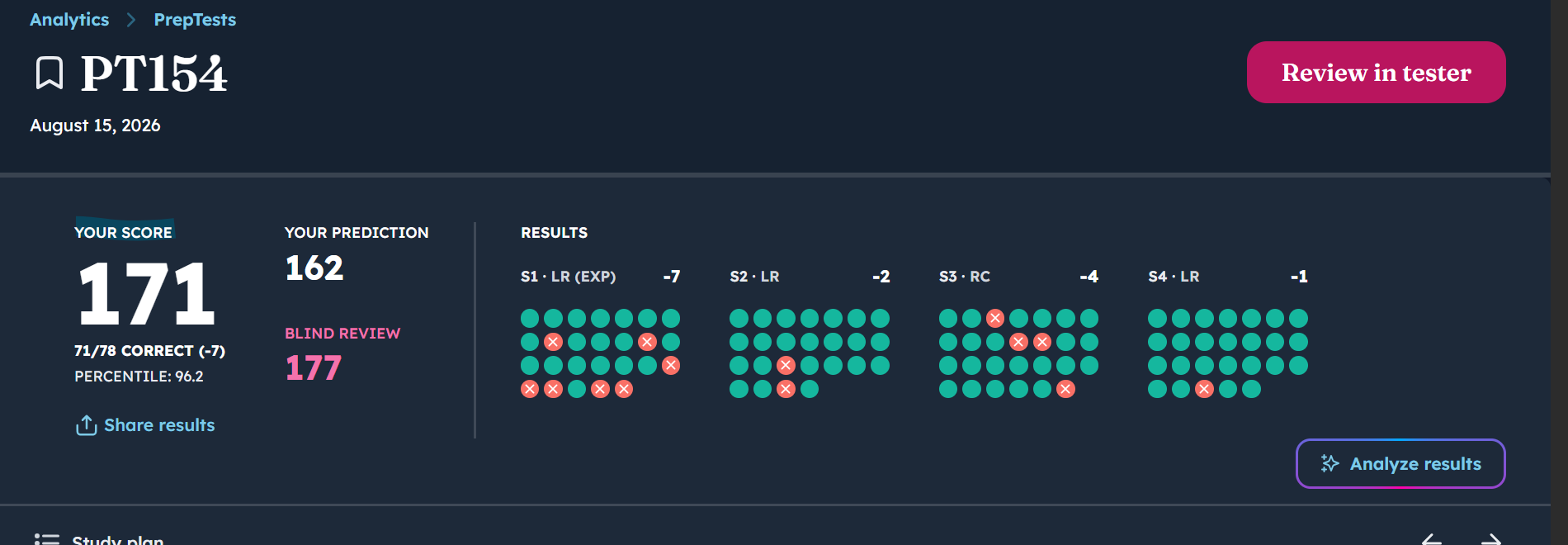
Dawg I legit double fist pumped in the middle of the library. I just wanted to celebrate this because if I could get this score on my test in September, it would legitimately be life changing.

Took June but retaking LSAT in october. Started studying again but I used up most of my fresh full PTs studying for June. did really well on practice test I took today but how much should I take it with a grain of salt? Any suggestions for studying with few full length fresh PTs left?

I am feeling so frustrated. I takes a timed test and am barely scraping into the 150s, I will then look at my BR and it will be a 169-170+. I have drilled, reviewed conditional logic, and quantifiers as I have recognized this is what slows me down, but I feel defeated. I do have an issue with wanting to look at all answer choices before moving on so I go over 90 seconds per question. However, even with spending all that time, I get it wrong. When I WAJ my explanations are spot on and I have so many “omg duh” moments. If anyone has any advice I would love to hear it. I really want to apply to law school this cycle so anything helps🙏🏻

Hello everyone,
My name is MJ or Madi, I am writing the LSAT for the first and only time in October. Although I live close enough to a testing centre to write there, due to accommodations, I am writing online from home. I have just taken another practice test (PT122 without experimental) and I am feeling quite discouraged. I was doing pretty well for the first section (LR) and half of the second section (RC), but by the time I got to the second half of RC, I felt tired and stressed. I finished the first LR section with only a few minutes remaining, and that led me to absolutely blaze through the second half of the test, hardly even reading passage four, and not diagramming anything for the third LR section.
I know I can do this, I know I'm smart, and I know I'm capable. However, the school I want to go to only takes into account two things: Your LSAT (50% of the decision) and your GPA (50% of the decision). To get into this school, which is the only one I want to go to and is the closest to me, I believe I need around a 165 or so. Currently PTing at about 151.
This leads me to my call for help. I am looking for effective ways to increase my stamina with taking the LSAT. I tend to lose my sustained focus about half-way through, and it leads me to not think as hard. I truly appreciate any and all advice given. I have been studying since June 1st, and took a week off at the end of July as I felt burnout creeping up on me.
Sincerely,
MJ from Canada

Hi all!!!
I just had to share this! So I admit my LR sections actually were not good in this PT, but I have been trying for months to improve my RC scores of the PT tests!
I literally have never been able to get a perfect score on a single passage and never had time to even start the last section!
This is honestly a major mile stone that I could get this level of accuracy and at least have some time to start Q4!
Still some ways to go, but I am so happy with my progress and for anyone struggling in RC, just know that you can and will get there!
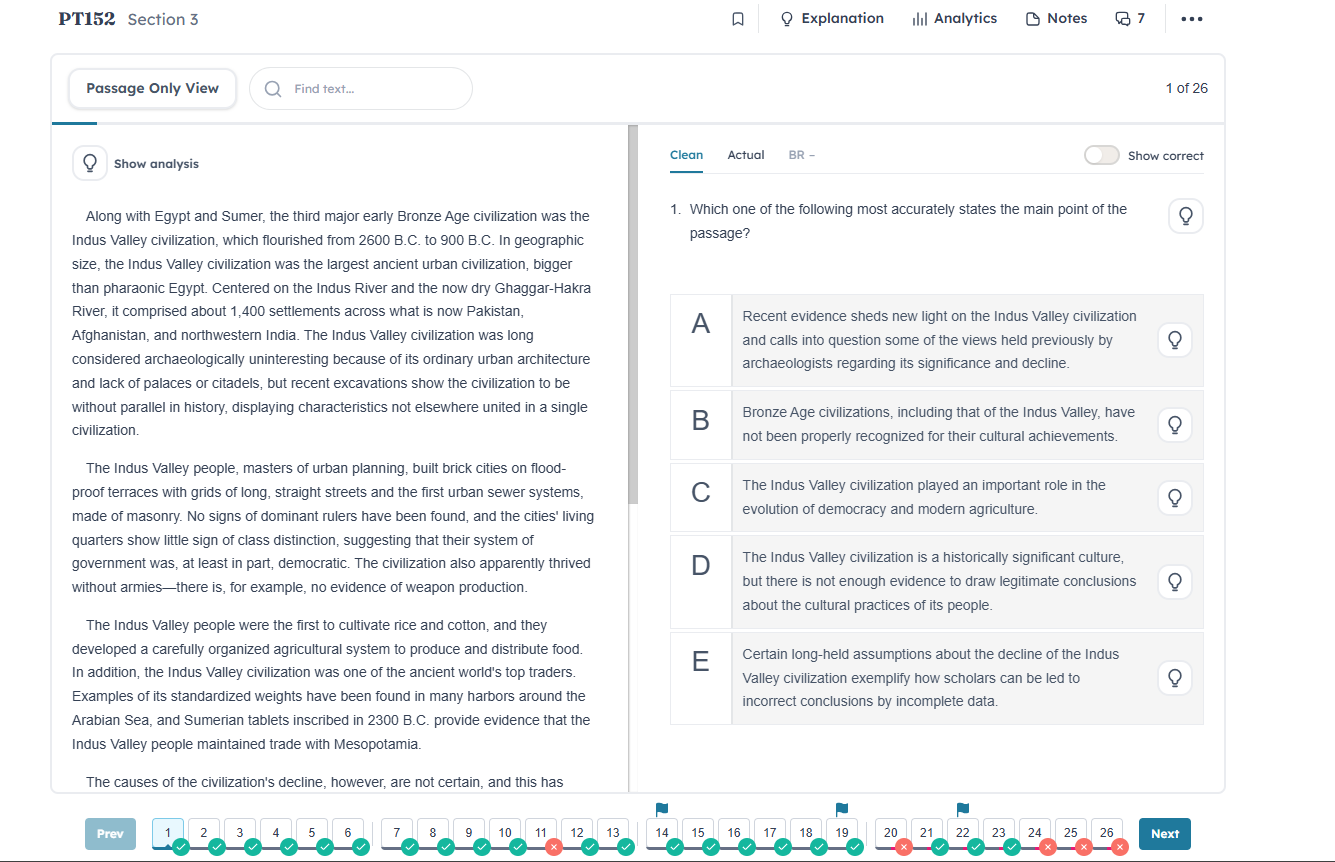

 So, I've been practicing for months, and while my PT scores have been consistently in the low 160's (which is fine by me!) however my BR results are almost always 10+ points higher. I have no idea how to close the gap even a little bit, and in fact my LR scores have been getting worse! I get these results even when I take the test untimed. I have started my wrong answer journal as well, so maybe I just need more time with that. Any tips?