I think what helped me the most was the technique of identifying the cause and effect. For example:
Q1 states that all the people who ate the day old sushi suffered from poisoning .
This question is telling you a result... in essence an effect, but it is not giving you the actual cause of HOW they got sick. This stumped me because I used my 'real world' thinking and not logic.
If you are struggling with this skill builder, as I was, I asked ChatGPT to provide more details, and it honestly helped me. It even gave me extra practice. "Is the author saying that one thing produced, brought about, increased, decreased, prevented, or influenced another thing." Is it only a pattern or explanation.
If the sentence is only describing what is true together, it’s not causal.If it’s describing why something is true, it is causal.
Turning Q1 into a causal statement:
High school basketball teams tend to favor their best players, which increases those players’ popularity.
Turning Q5 into a causal statement:
Noise and distractions at parties reduce people’s mental functioning.
@paligrrl i asked chatgpt to give me 10 examples of causal vs non-causal for practice and the answers were 1. non-causal, 2. causal, 3. non-causal, 4. causal, etc.
@yesterdayseeker LOL maybe respond back to it and ask it to not make it a pattern like that? but either way it helped me see the different between causal and not-causal language.
For anyone new to this section, lookout for the words "tends to be" "usually" basically words that do not fully confirm the correlation between the cause and effect, that is what helped me in this section.
I think the point of this exercise is to retrain our brains to not jump to hypotheses to explain phenomena in the stimulus. In real life, we often conflate correlation with causation (see the sushi example), but on the LSAT, we cannot do that.
I think this lesson would be helpful if each question came with an example of how to make the claim causal or non-casual. I think seeing what would make it meet the standards would help understand why it doesn't.
There needs to be more lessons regarding the diffrence between causation and correlation.
While the list of indicator words was helpful, it was sparse. There were indicator words - yet they don't imply a causal relationship. There are Non-causal indicator words that imply causal relationships.
@CMas One issue is that there's no way to give you an exhaustive list. I recommend studying the language that throws you off in any case where you thought something was causal but it wasn't, or vice versa. Then you can build a personal list of language that you've missed before. It's not practical to list out every single word or phrase that the LSAT could present that means there's a causal relationship.
Can you let me know which indicator words sometimes don't indicate cause, and which words you thought don't indicate cause, but sometimes they do?
Q5 uses "Decreased," which is an indicator word for causal language, but it isn't causal. It's not the verb, yes, but the former lesson implies that Decreased = Causal. And that lesson wasn't there a few months ago.
That's why I think there should be more lessons inolving causal indicators that don't imply causal language. It teaches students not to rely on the list, and to look for the underlining structure.
This really confused me. Nothing about indicators such as the verb "decreases" and the term "tend to" were mentioned, then used in the explanation as if it were common knowledge.
Additionally, I feel like I understood all of the lessons, but then got all of these questions wrong. For #2 and #3, I am extremely confused how we can be certain that giving children everything directly causes adults who are not able to cope, but then for number 3, we are supposed to pick out that there could have been something else that caused the food poisoning, and not sushi.
Could there not be something else that caused the adults to not be able to cope?
Edit: I think I now understand that it all boils down to language. In the second question, the term "produces" implies causation. This is missing from the third question. The word "suffered" is used to describe the food poisoning, which could have come from elsewhere. There needs to be more sections on this before a skill builder.
@RichardSanta-Cruz I also got #3 wrong the first time around.
A few things that helped me to understand why:
Conditional relationships are different than Causal relationships. In my mind I was operating under the assumption that
a --> b = a -c-> b
and this is not the case. So getting that clarity was helpful.
I re-phrased the question as
A group of people ate day-old sushi.
All of the people in this group also had food poisoning the next day.
By phrasing the question as two separate ideas it helped me to see that while two events happened to the same group of people, we can't see from the language that one event definitively caused the other. For me, the word 'also' represents two ideas that might be connected but are still separate.
Another thing to look for is sample. For all the non-causal, the terms "every" or "all" or "most" appear, which indicates that there is a specific group and therefore that it relates just to them, which is why it's a correlation, whereas all the other ones are sure facts without subsets.
This had nothing to do with causal relationships and the hypothesis content we just learned. The first question could have been another learning section itself, discussing language and grammar identifiers.
On the first one, couldn't being the best at basketball make someone popular at school? like MVPs are usually very popular because being that good at basketball makes them cool
@Kevin_Lin I really like your 7 Sage program, but this by far is the worst section. I understood all of the lessons. I dealt with lots of causation and correlation in my undergraduate studies in both psychology and business. This was second nature to me. Then, to have a drill set that is completely unrelated to all the previous lessons is not only disappointing, but extremely frustrating. Read all of the comments here. I'm clearly not the only one who had this experience. This was very strange and out of character for the entire curriculum to this point.
Edit:
#2 is causal because we have causal language "produce" ?
Okay. When was that presented? When was that taught? Making an affirmative statement doesn't make it causal, does it? I don't see how it is an assertion of causality either. When something tends to do something, does that mean it happens all the time or most of the time? An assertion of a causal relationship is to say that A causes B, not that A tends to cause B.
All the lessons seemed very helpful, but completely unrelated to this drill set.
@StanHolt Noted, a lesson before this will be added.
I think it's best to just consider this Skill Builder a lesson in itself for now -- I understand that it's frustrating to struggle when it feels like the concepts haven't been introduced, but isn't it still an opportunity to learn? Even if a "quiz" introduces concepts not covered, aren't the explanations still valuable and become a lesson themselves? Whether a concept is presented as part of a lesson or whether it's presented as part of an exercise like this one, it seems to me a lesson no matter what :)!
In any case, look out for an additional lesson soon.
@Kevin_Lin Please discern a lesson from a quiz. You APPLY what you learned in a quiz and hence build your confidence. If you are primarily learning in a quiz then its no longer a quiz but a lesson which is like a "workbook".
Even with workbook style lessons you need empathy & guidance. This is a pattern with this course : introduce quizes without proper instruction prior. Some of us may have the prior knowledge but if you present a learning ladder with missing rungs it slows the students down and negatively impacts their confidence. That is not cool.
If the curators of the course used less profanity "f" words & "mf" words and focused on actual pedagogy we would not have these problems.
@Kevin_Lin Absolutely agree with you. It definitely was an opportunity to learn. I think most of us here are extremely motivated to do well on this curriculum, and this exam. And we are of the mindset that anytime there is an opportunity to be tested, we want to be perfect--drill sets, PTs, timed, untimed, BR, drills, and sections. So, when we seem to be unprepared, it is disappointing. I understand your point, and I agree with you.
In the meantime, it may be worth adding a small disclaimer in front of this drill set saying that this is more of a learning lesson and a way to introduce new information or ideas. That way it will change the expectations of the students. Just a thought. Looking forward to the next lesson. Is there a way we will be notified when the lesson is posted? Thanks again for your response. Have a great day!
I guess this is how the LSAT is. But to me, question three mentioning "suffered from" should qualify the statement as a causal claim. What else could they have suffered from besides the thing mentioned right before that phrase? Especially if "produce" in question three makes it causal, I feel like "suffered from" implies that the thing they were suffering from wasn't some random third thing, but the day old sushi mentioned right before that phrase. I guess I just need to keep retraining my brain to remember the key words like "produce" and "increase" and "decrease."
@BillyM_ That's right. They suffered from food poisoning...but was it the sushi that caused it?
It's totally a trick question in that people would normally assume that the sushi is what caused it. But I think you'll agree that if we read literally....that's not what the sentence says. This is what we're training ourselves to do -- read more literally and see where we're filling in the gaps with our own assumptions.


83 comments
I was so confident going into this one... I got humbled
i need to quit relying on strictly looking for causal language and to instead focus on actual comprehension
Dang I thought I understood the concepts. Keep practicing
how did i get all of these wrong omg
1/5 correct. Drilling in LR and RC improved by 20% after learning this. lol, I'll review this again with a fresh brain.
I'm fricked.
I think what helped me the most was the technique of identifying the cause and effect. For example:
Q1 states that all the people who ate the day old sushi suffered from poisoning .
This question is telling you a result... in essence an effect, but it is not giving you the actual cause of HOW they got sick. This stumped me because I used my 'real world' thinking and not logic.
If you are struggling with this skill builder, as I was, I asked ChatGPT to provide more details, and it honestly helped me. It even gave me extra practice. "Is the author saying that one thing produced, brought about, increased, decreased, prevented, or influenced another thing." Is it only a pattern or explanation.
If the sentence is only describing what is true together, it’s not causal.If it’s describing why something is true, it is causal.
Turning Q1 into a causal statement:
High school basketball teams tend to favor their best players, which increases those players’ popularity.
Turning Q5 into a causal statement:
Noise and distractions at parties reduce people’s mental functioning.
@paligrrl i asked chatgpt to give me 10 examples of causal vs non-causal for practice and the answers were 1. non-causal, 2. causal, 3. non-causal, 4. causal, etc.
evil-gpt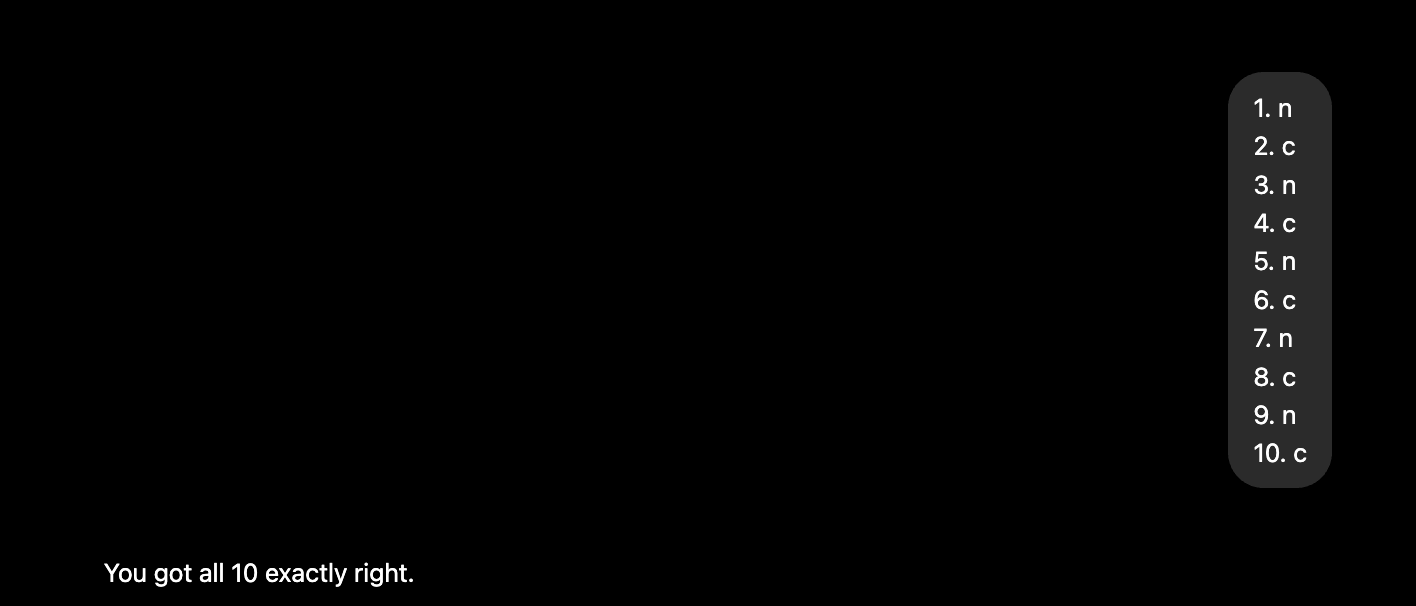
@yesterdayseeker LOL maybe respond back to it and ask it to not make it a pattern like that? but either way it helped me see the different between causal and not-causal language.
I need some more skillbuilders.
For anyone new to this section, lookout for the words "tends to be" "usually" basically words that do not fully confirm the correlation between the cause and effect, that is what helped me in this section.
This whole thing is just very confusing. Part of me thinks that I should rely on my intuition, but the sushi example takes that all away. Very lost
I'm so cooked
I think the point of this exercise is to retrain our brains to not jump to hypotheses to explain phenomena in the stimulus. In real life, we often conflate correlation with causation (see the sushi example), but on the LSAT, we cannot do that.
4/5... Question 5 tripped me up but after listening to the video I feel it cleared up the confusion!
I think this lesson would be helpful if each question came with an example of how to make the claim causal or non-casual. I think seeing what would make it meet the standards would help understand why it doesn't.
#3 -_-
There needs to be more lessons regarding the diffrence between causation and correlation.
While the list of indicator words was helpful, it was sparse. There were indicator words - yet they don't imply a causal relationship. There are Non-causal indicator words that imply causal relationships.
@CMas One issue is that there's no way to give you an exhaustive list. I recommend studying the language that throws you off in any case where you thought something was causal but it wasn't, or vice versa. Then you can build a personal list of language that you've missed before. It's not practical to list out every single word or phrase that the LSAT could present that means there's a causal relationship.
Can you let me know which indicator words sometimes don't indicate cause, and which words you thought don't indicate cause, but sometimes they do?
@Kevin_Lin Thanks for the advice.
Q5 uses "Decreased," which is an indicator word for causal language, but it isn't causal. It's not the verb, yes, but the former lesson implies that Decreased = Causal. And that lesson wasn't there a few months ago.
That's why I think there should be more lessons inolving causal indicators that don't imply causal language. It teaches students not to rely on the list, and to look for the underlining structure.
This really confused me. Nothing about indicators such as the verb "decreases" and the term "tend to" were mentioned, then used in the explanation as if it were common knowledge.
Additionally, I feel like I understood all of the lessons, but then got all of these questions wrong. For #2 and #3, I am extremely confused how we can be certain that giving children everything directly causes adults who are not able to cope, but then for number 3, we are supposed to pick out that there could have been something else that caused the food poisoning, and not sushi.
Could there not be something else that caused the adults to not be able to cope?
Edit: I think I now understand that it all boils down to language. In the second question, the term "produces" implies causation. This is missing from the third question. The word "suffered" is used to describe the food poisoning, which could have come from elsewhere. There needs to be more sections on this before a skill builder.
@RichardSanta-Cruz Just added this lesson: Causal Language
@RichardSanta-Cruz I also got #3 wrong the first time around.
A few things that helped me to understand why:
Conditional relationships are different than Causal relationships. In my mind I was operating under the assumption that
and this is not the case. So getting that clarity was helpful.
I re-phrased the question as
By phrasing the question as two separate ideas it helped me to see that while two events happened to the same group of people, we can't see from the language that one event definitively caused the other. For me, the word 'also' represents two ideas that might be connected but are still separate.
Hope that's helpful!
Another thing to look for is sample. For all the non-causal, the terms "every" or "all" or "most" appear, which indicates that there is a specific group and therefore that it relates just to them, which is why it's a correlation, whereas all the other ones are sure facts without subsets.
@Alysa_Suleiman omg reminds me of intro psych classes!!!! good ol days
This had nothing to do with causal relationships and the hypothesis content we just learned. The first question could have been another learning section itself, discussing language and grammar identifiers.
What are some important causal words we should recognize, like "produce?"
@iwillcrushthelsat Just added this lesson: Causal Language
#help
On the first one, couldn't being the best at basketball make someone popular at school? like MVPs are usually very popular because being that good at basketball makes them cool
@lyousif The question is, is that what the statement asserts?
@Kevin_Lin I really like your 7 Sage program, but this by far is the worst section. I understood all of the lessons. I dealt with lots of causation and correlation in my undergraduate studies in both psychology and business. This was second nature to me. Then, to have a drill set that is completely unrelated to all the previous lessons is not only disappointing, but extremely frustrating. Read all of the comments here. I'm clearly not the only one who had this experience. This was very strange and out of character for the entire curriculum to this point.
Edit:
#2 is causal because we have causal language "produce" ?
Okay. When was that presented? When was that taught? Making an affirmative statement doesn't make it causal, does it? I don't see how it is an assertion of causality either. When something tends to do something, does that mean it happens all the time or most of the time? An assertion of a causal relationship is to say that A causes B, not that A tends to cause B.
All the lessons seemed very helpful, but completely unrelated to this drill set.
@StanHolt Noted, a lesson before this will be added.
I think it's best to just consider this Skill Builder a lesson in itself for now -- I understand that it's frustrating to struggle when it feels like the concepts haven't been introduced, but isn't it still an opportunity to learn? Even if a "quiz" introduces concepts not covered, aren't the explanations still valuable and become a lesson themselves? Whether a concept is presented as part of a lesson or whether it's presented as part of an exercise like this one, it seems to me a lesson no matter what :)!
In any case, look out for an additional lesson soon.
@Kevin_Lin Please discern a lesson from a quiz. You APPLY what you learned in a quiz and hence build your confidence. If you are primarily learning in a quiz then its no longer a quiz but a lesson which is like a "workbook".
Even with workbook style lessons you need empathy & guidance. This is a pattern with this course : introduce quizes without proper instruction prior. Some of us may have the prior knowledge but if you present a learning ladder with missing rungs it slows the students down and negatively impacts their confidence. That is not cool.
If the curators of the course used less profanity "f" words & "mf" words and focused on actual pedagogy we would not have these problems.
@Kevin_Lin Absolutely agree with you. It definitely was an opportunity to learn. I think most of us here are extremely motivated to do well on this curriculum, and this exam. And we are of the mindset that anytime there is an opportunity to be tested, we want to be perfect--drill sets, PTs, timed, untimed, BR, drills, and sections. So, when we seem to be unprepared, it is disappointing. I understand your point, and I agree with you.
In the meantime, it may be worth adding a small disclaimer in front of this drill set saying that this is more of a learning lesson and a way to introduce new information or ideas. That way it will change the expectations of the students. Just a thought. Looking forward to the next lesson. Is there a way we will be notified when the lesson is posted? Thanks again for your response. Have a great day!
@ArthurWhite Just added this lesson: Causal Language
@StanHolt Just added this lesson: Causal Language
@Kevin_Lin Thank you!
5/5 yayyyy been a while since I’ve gotten 100%
4/5 got tripped up by 5 using the word decrease
I guess this is how the LSAT is. But to me, question three mentioning "suffered from" should qualify the statement as a causal claim. What else could they have suffered from besides the thing mentioned right before that phrase? Especially if "produce" in question three makes it causal, I feel like "suffered from" implies that the thing they were suffering from wasn't some random third thing, but the day old sushi mentioned right before that phrase. I guess I just need to keep retraining my brain to remember the key words like "produce" and "increase" and "decrease."
@BillyM_ I guess "suffered from" is referring to food poisoning and not people who ate day old sushi.
@BillyM_ That's right. They suffered from food poisoning...but was it the sushi that caused it?
It's totally a trick question in that people would normally assume that the sushi is what caused it. But I think you'll agree that if we read literally....that's not what the sentence says. This is what we're training ourselves to do -- read more literally and see where we're filling in the gaps with our own assumptions.
@Kevin_Lin Thank you! Yeah coming back to this three days later and it seems much more clear.