#feedback I believe I understand this lesson just fine, but I really think a simple visual would be helpful here and in the last few lessons. I especially appreciate the bucket explanation, and I think a visual could be applied to that with circle diagrams.
Thanks for sharing your thoughts with us! We're glad you're getting the hang of the lesson. Your idea about adding visuals sounds pretty cool. I'll definitely pass this on to the team for consideration. Your input is super important in helping us improve. If you ever have more suggestions or questions, just give us a shout—we're all ears!😊👍
Another way to see this relationship is realize that there is at least one food, the almond, that is produced for domestic consumption and requires irrigation.
Applying that to any argument
Most jets fans are in NY. Most jets fans like hot dogs. Some people in New York like hot dogs.
We KNOW there are jets fans in New York and we also know that Jet's fans like hot dogs. They very well could be the people in in New York that like hot dogs, referenced in my conclusion. Therefore there are at least some people in NY that like hot dogs.
This is made easier if one uses Venn diagrams. Put "almonds grown in CA" in the center circle. Then each of the concepts "grown for domestic consumption" and "requiring intense irrigation" have to overlap that circle more than 50%. There necessarily has to be some almonds in the overlapping zone.
Most girls use makeup to enhance their beauty. Most girls that use makeup have top notch beauty products. Therefore, some people that use makeup to enhance their beauty have top notch beauty products.
I do think this section would really benefit from visuals, either from graphs or a video.
It really helped me understand this concept using Venn diagrams. One large circle is "Almonds grown in California." Another circle that takes up around 90% of the first circle is "produced for domestic consumption" and another circle that takes up around 90% of the first circle is "require intense irrigation to produce." With these three overlapping circles, it would make sense that some foods produced for domestic consumption require intense irrigation to produce.
One way I found to visualize this is by using your hands. On one hand, hold up three fingers to represent 'most A are B.' On the other hand, hold up three fingers for 'most A are C,' then bring your hands together. No matter what you do, at least one of your fingers will overlap. Hopefully, that helps someone!
If we know that a majority of almonds are produced for domestic consumption and that most almonds require intense irrigation, we know that at least on almond produced for domestic consumption requires irrigation to produce. So, you could say that.
I'm not sure why they chose to go with "some foods." Maybe they wanted to make it as clear as possible that you can use this argument format to demonstrate a separate third point.
@breezyprabahar944 I learned in a one of the classes that you can most definitely conclude "some" between two alls, not sure about most, though. Would love to know someone elses thoughts!
Most almonds grown in California are produced for domestic consumption. Most almonds grown in California require intense irrigation to produce. Therefore, some almonds produced (forgot to put "in California" here) for domestic consumption require intense irrigation to produce.
Wouldn't the argument only be valid if the last sentence said "Therefore, some almonds produced for domestic consumption require intense irrigation to produce." Because almonds is a subset of foods which is a massive set.
since being an almond is sufficient for being a food, you can say that some foods are produced for domestic consumption. it's like saying some cats drink milk therefore some mammals drink milk. mammals is a massive set, but cats are still apart of it.
My guess is that if the conclusion had said something like "some fruits" or "some vegetables", that would be invalid because almonds are not fruits or vegetables. But since almonds are food, the argument remains logically sound when it generalizes to "foods."
on a purely logical front, you're correct. all you can suppose is what is given in the argument. i think 7sage calls their use of logic intended for the lsat as "lawgic," which allows for some presupposition, because if they just said they were teaching propositional logic, then yeah the above argument wouldn't technically be valid and they'd hail a lot of similar criticism (even though that type of strict logicality isn't necessary or beneficial for/to the lsat).


78 comments
If anyone is a visual learner, this is the best way I helped myself understand.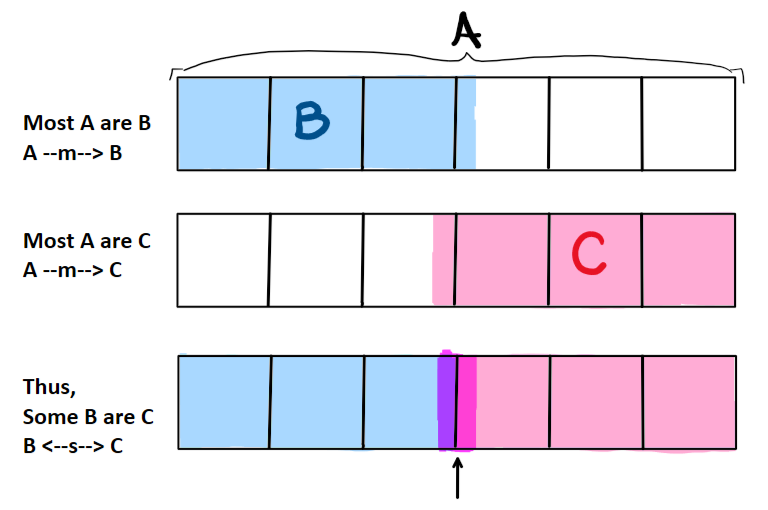
@ckilk Nice diagram to highlight how this argument works! Best of luck with your studies
@ckilk Comment section really is the underrated hero of this website, so many good alternative explanations provided
Most students who study daily do well
Most students who study daily have willpower
Therefore, some students who do well have willpower.
#feedback I believe I understand this lesson just fine, but I really think a simple visual would be helpful here and in the last few lessons. I especially appreciate the bucket explanation, and I think a visual could be applied to that with circle diagrams.
Hey there,
Thanks for sharing your thoughts with us! We're glad you're getting the hang of the lesson. Your idea about adding visuals sounds pretty cool. I'll definitely pass this on to the team for consideration. Your input is super important in helping us improve. If you ever have more suggestions or questions, just give us a shout—we're all ears!😊👍
Another way to see this relationship is realize that there is at least one food, the almond, that is produced for domestic consumption and requires irrigation.
Applying that to any argument
Most jets fans are in NY. Most jets fans like hot dogs. Some people in New York like hot dogs.
We KNOW there are jets fans in New York and we also know that Jet's fans like hot dogs. They very well could be the people in in New York that like hot dogs, referenced in my conclusion. Therefore there are at least some people in NY that like hot dogs.
thank you this actually helped me understand it I appreciate it
Is there anyway that we can drill on each of the formal arguments?
#feedback this would be helpful
agreed, I would love to drill on the formal arguments!
ok this might be oversimplifying it? but, the way i understand it super fast is
A -m-> B.
A -m-> C.
then you just take whatever's on the right side of the arrow on both conditions, and put the some quantifier in between. therefore
B <- s -> C
This is made easier if one uses Venn diagrams. Put "almonds grown in CA" in the center circle. Then each of the concepts "grown for domestic consumption" and "requiring intense irrigation" have to overlap that circle more than 50%. There necessarily has to be some almonds in the overlapping zone.
Using math helped me with this concept:
55% of almonds are consumed domestically
55% of almonds require intense irrigation
55+55 = 110.
Some (at least 10%) of almonds consumed domestically require intense irrigation
Most girls use makeup to enhance their beauty. Most girls that use makeup have top notch beauty products. Therefore, some people that use makeup to enhance their beauty have top notch beauty products.
#feedback
I do think this section would really benefit from visuals, either from graphs or a video.
It really helped me understand this concept using Venn diagrams. One large circle is "Almonds grown in California." Another circle that takes up around 90% of the first circle is "produced for domestic consumption" and another circle that takes up around 90% of the first circle is "require intense irrigation to produce." With these three overlapping circles, it would make sense that some foods produced for domestic consumption require intense irrigation to produce.
Agreed! Venn diagrams are really helping me as well.
One way I found to visualize this is by using your hands. On one hand, hold up three fingers to represent 'most A are B.' On the other hand, hold up three fingers for 'most A are C,' then bring your hands together. No matter what you do, at least one of your fingers will overlap. Hopefully, that helps someone!
Most of us have a 7Sage subscription. Most of us are going through the modules and lectures. Therefore, some of us are enjoying this...right?
LOVE this bucket analogy. Makes thinks super clear in understanding the form of these types of arguments.
Is there a reason why we went from almonds to "some foods"?
Most almonds grown in California are produced for domestic consumption.
Most almonds grown in California require intense irrigation to produce.
Therefore, some foods produced for domestic consumption require intense irrigation to produce.
Could we not say some almonds produced for domestic consumption require intense irrigation to produce?
wondering ab this too
A: almonds grown in California
B: foods produced for domestic consumption
C: foods that require intense irrigation to produce
Rule: A —m→ B
A —m→ C
B ←s→ C
Lawgic: AGC (A) —m→ FPF-Domestic Consumption (B)
AGC (A) —m→ FTR-Intense Irrigation-P (C)
FPF-Domestic Consumption ←s→ FTR-Intense Irrigation-P
Conclusion in English : Therefore, some foods produced for domestic consumption require intense irrigation to produce.
Correct me if I'm wrong.
probably to create a trap
If we know that a majority of almonds are produced for domestic consumption and that most almonds require intense irrigation, we know that at least on almond produced for domestic consumption requires irrigation to produce. So, you could say that.
I'm not sure why they chose to go with "some foods." Maybe they wanted to make it as clear as possible that you can use this argument format to demonstrate a separate third point.
Just thought I'd add that all of this also holds true when we're dealing with two "all" statements.
For example:
All pizzas have tomato sauce.
A → B
All pizzas have cheese.
A → C
Therefore, some things that have tomato sauce also have cheese.
B←s→C
love the pfp
Most astronauts are strong. Most astronauts like space. Therefore, some strong beings like space.
A‑m→S
A‑m→LS
Therefore, S←s→LS
Bucket A: Initially contains 100 A letters.
Transfer to B: A —m→ B (at least 51 A letters, let's say 51).
Bucket A now has 49 A letters.
Bucket B has 51 A letters.
Transfer to C: A —m→ C (again at least 51 A letters, let's say 51).
Bucket A now has 0 A letters (empty).
Bucket C has 51 A letters.
Overlap between B and C: B ←s→ C (ensuring the "plus 1" overlap, let's say 1 item is exchanged).
Bucket B has 50 A letters and the 1 exchanged item.
Bucket C has the 1 exchanged item and 50 A letters.
Okay, so:
Most cats are domesticated.
Most cats have fur.
Therefore, some domesticated cats have fur.
Does that work?
Looks right to me!
It was tripping me up that JY said the two groups have to overlap by at least one member.
In the thought experiment I did it seemed like they would have to overlap by at least two members.
Say there are 100 members of A.
51 of the 100 members of A are also members of B.
51 of the 100 members of A are also members of C.
Even if the max number of available members of A who were also members of B and not members of C existed, that could only be 49.
2 members of A would have to be members of both B and C in order to get to the minimum most threshold of 51.
Visually it looks like this... https://docs.google.com/spreadsheets/d/1sIdM57Jl-pIks-_z8-BInZhEYDOr4cDA49GK2tHkdzA/edit?usp=sharing
But then I realized that is because the thought experiment used an even number (100) for the total members of A.
If there were 25 members of A:
12 of the 25 members of A would also only be members of B
12 of the 25 members of A would also only be members of C
1 member of A would have to be members of both B and C.
In the case of an odd number for the total members of A, only one member would have to overlap.
Could not make this work in my head at all until you did the visualization.
Is there anything like this on two split "alls"?
@breezyprabahar944 I learned in a one of the classes that you can most definitely conclude "some" between two alls, not sure about most, though. Would love to know someone elses thoughts!
Most butterflies like rocks, most butterflies require a nap time of 2 + hours, therefore some entities that like rocks require a nap time of 2+ hours.
Most muffins have chocolate chips, most muffins are also not gluten free. Therefore some pastries that have chocolate chips are not gluten free.
#feedback would this be the Lawgic form of those arguments?
B ‑m→ R
B ‑m→ N2+
R ←s→ N2+
M ‑m→ CC
M ‑m→ /GF
CC ←s→ /GF
Most astronauts are strong. Most astronauts like space. Therefore, some strong beings like space.
A‑m→S
A‑m→LS
Therefore, S←s→LS
What was the last word of the video? I watched it back multiple times and have no idea hahahahah
@petvma Formal!
Most almonds grown in California are produced for domestic consumption. Most almonds grown in California require intense irrigation to produce. Therefore, some almonds produced (forgot to put "in California" here) for domestic consumption require intense irrigation to produce.
Wouldn't the argument only be valid if the last sentence said "Therefore, some almonds produced for domestic consumption require intense irrigation to produce." Because almonds is a subset of foods which is a massive set.
I agree I'm also confused on that. I feel as though the use of 'foods' makes the argument invalid
since being an almond is sufficient for being a food, you can say that some foods are produced for domestic consumption. it's like saying some cats drink milk therefore some mammals drink milk. mammals is a massive set, but cats are still apart of it.
My guess is that if the conclusion had said something like "some fruits" or "some vegetables", that would be invalid because almonds are not fruits or vegetables. But since almonds are food, the argument remains logically sound when it generalizes to "foods."
on a purely logical front, you're correct. all you can suppose is what is given in the argument. i think 7sage calls their use of logic intended for the lsat as "lawgic," which allows for some presupposition, because if they just said they were teaching propositional logic, then yeah the above argument wouldn't technically be valid and they'd hail a lot of similar criticism (even though that type of strict logicality isn't necessary or beneficial for/to the lsat).